Agencia SEO Para Ecommerce: Build Infrastructure, Not Reports
Most ecommerce SEO agencies bill hours and deliver reports. We install systems that compound. The infrastructure approach to organic revenue for DTC brands.
**
INFRASTRUCTURE OVER RETAINERS
Agencia SEO Para Ecommerce: Build Infrastructure, Not Reports
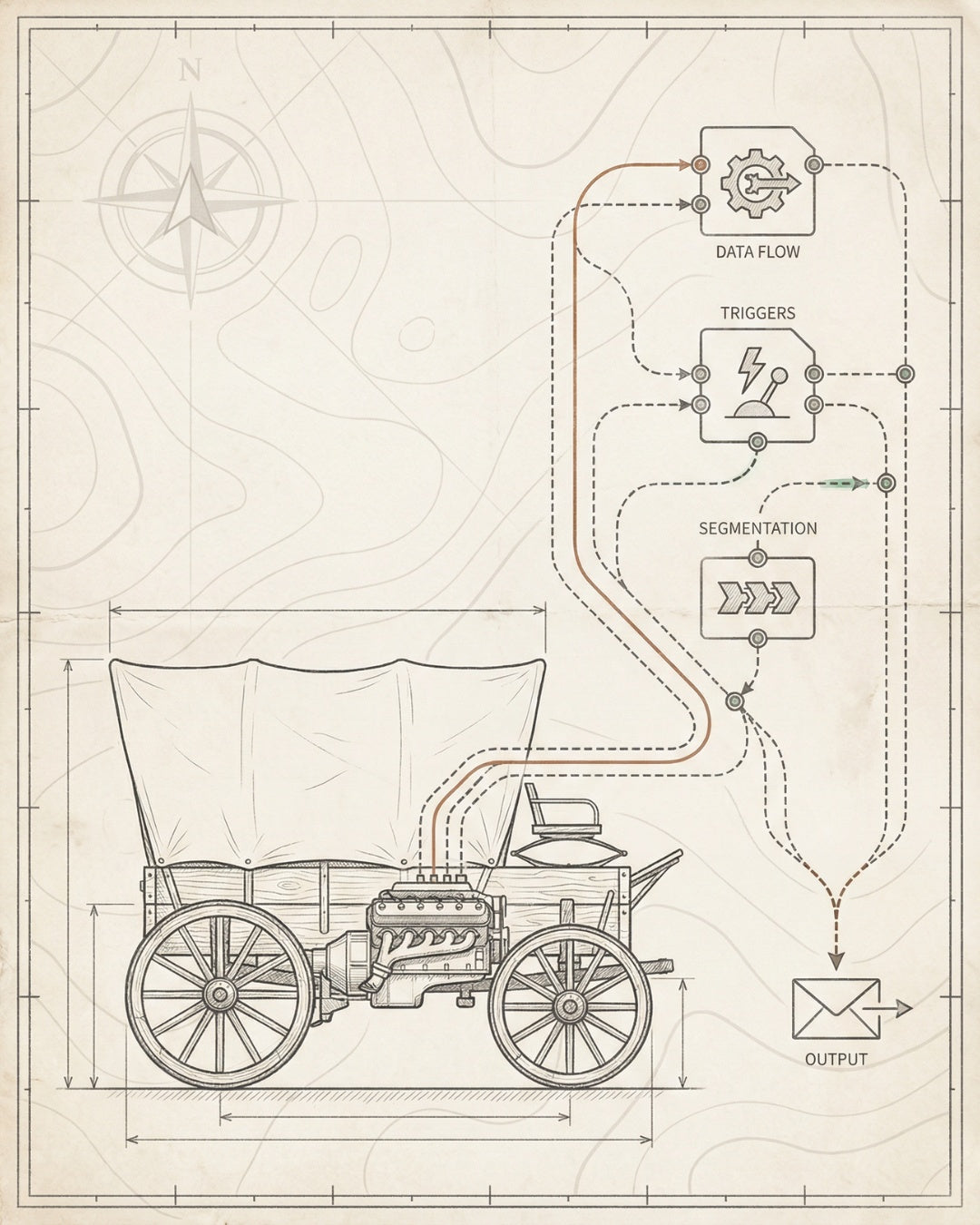
Here’s what most ecommerce brands discover six months into an SEO retainer: you’ve paid for reports, not results. Monthly deliverables. Keyword tracking spreadsheets. “Strategy sessions” that feel like status updates. Meanwhile, your organic traffic flatlines because no one installed the infrastructure that makes rankings inevitable.
The traditional agencia SEO para ecommerce model is broken. It optimizes for billable hours, not compounding visibility. It treats SEO like a service, not a system. And it leaves founders paying monthly fees for work that should have been built once and scaled forever.
We’ve generated over $30M in organic revenue across 50+ brands. The pattern is clear: the stores that win don’t hire agencies that write reports. They partner with teams that install systems. Infrastructure first. Retainers never.
01 / 05 The Retainer Trap Traditional agencies bill monthly for deliverables that don’t compound. You’re paying for activity, not infrastructure. The work resets every 30 days.
02 / 05 Infrastructure > Reports SEO is a system, not a service. The 4-Layer Foundation (Crawlability → Indexability → Rankability → Convertibility) gets built once and scales forever.
03 / 05 The Sprint Model 30-day focused cycles replace endless retainers. Audit → Foundation → Content → Distribution. Build it, install it, scale it. No monthly fees for maintenance theater.
04 / 05 AI Search Changes Everything Perplexity, ChatGPT, and AI Overviews require entity signals and structured data. Most agencies ignore this. Your visibility depends on it.
05 / 05 Compound Visibility Website × Content × Technical × Distribution. The Compound Visibility Stack multiplies over time. Install it right, and organic revenue becomes predictable.
What Makes an Agencia SEO Para Ecommerce Different
The difference between a traditional SEO agency and an infrastructure-first agencia SEO para ecommerce isn’t what they promise—it’s what they build. Most agencies optimize for recurring revenue. They sell retainers because monthly fees are predictable. The work? Optimized for billing cycles, not compounding results.
An infrastructure-first approach flips the model. You’re not buying hours. You’re installing systems. The goal isn’t to keep you on retainer forever—it’s to build the technical foundation that makes organic growth inevitable, then get out of the way.

The Retainer Model: Optimized for Billing
Here’s how traditional agencies structure their work:
- Monthly deliverables:** Blog posts, keyword reports, competitor analysis—work that resets every 30 days
- Ongoing optimization: Endless tweaks that never address the foundation
- Strategy decks: Beautiful PDFs that outline what should be done, rarely what gets built
- Reporting theater: Dashboards showing traffic trends without connecting them to revenue
The incentive structure is backwards. If the agency builds systems that work without them, they lose the retainer. So the work never quite finishes. There’s always another month of “optimization.”
The Infrastructure Model: Built Once, Scales Forever
An agencia SEO para ecommerce focused on infrastructure operates differently. The engagement has a clear scope and end date. You’re not paying for perpetual optimization—you’re paying to install the four layers that make rankings compound:
- Crawlability: Site architecture, robots.txt, XML sitemaps—making sure Google can find your pages
- Indexability: Canonical structure, meta tags, duplicate content elimination—making sure Google indexes the right pages
- Rankability: Schema markup, internal linking, content structure—making sure Google understands what your pages are about
- Convertibility: Core Web Vitals, UX optimization, conversion paths—making sure visitors become customers
Once these layers are installed, they compound. You’re not dependent on monthly agency work to maintain rankings. The system runs. You scale content on top of it. Revenue grows without proportional increases in agency spend.
This is the shift: from renting SEO services to owning SEO infrastructure. Learn more about what SEO infrastructure actually means and why it’s the foundation of every high-performing ecommerce store.
The 4-Layer SEO Foundation Every Ecommerce Store Needs
Most ecommerce brands start with content. They hire writers, publish blog posts, optimize product descriptions—and wonder why traffic doesn’t move. The problem isn’t the content. It’s the foundation underneath it.
SEO doesn’t start with keywords. It starts with infrastructure. The 4-Layer SEO Foundation is the sequential build process that makes everything else work. Skip a layer, and the system breaks. Install them in order, and organic visibility becomes predictable.
Layer 1: Crawlability
If Google can’t crawl your site efficiently, nothing else matters. Crawlability is about removing friction from the discovery process. It’s the difference between Google indexing 500 pages in a week versus 50.
What gets built:
- Site architecture: Flat hierarchy, category structure, URL patterns that make sense to both users and bots
- Robots.txt optimization: Block admin pages, allow product and category pages, manage crawl budget
- XML sitemaps: Dynamic sitemaps for products, categories, blog content—organized by priority and update frequency
- Internal linking: Logical link flow from homepage → categories → products, with contextual links between related pages
This is foundational technical SEO for ecommerce. It’s not glamorous. It’s invisible to customers. But it’s the difference between Google discovering your new products in hours versus weeks.
Layer 2: Indexability
Crawlable doesn’t mean indexable. Google might find your pages but choose not to index them—or worse, index the wrong versions. Indexability is about controlling what gets into the search index and ensuring Google understands the canonical version of each page.
What gets built:
- Canonical tags: Prevent duplicate content issues from variant pages, filters, and pagination
- Meta robots directives: Strategic noindex for thin content, search results, and parameter-based URLs
- Duplicate content elimination: Consolidate similar pages, redirect old URLs, manage product variants properly
- HTTPS implementation: SSL across the entire site, no mixed content warnings
Poor indexability is why ecommerce stores often have thousands of pages in Google but only dozens ranking. The index is polluted with duplicates, filters, and low-value pages. Clean indexability means Google’s resources focus on pages that drive revenue.
Layer 3: Rankability
Now Google can crawl your site and knows what to index. Rankability is about making sure Google understands what each page is about and why it should rank. This is where schema markup, content structure, and semantic signals come in.
What gets built:
- Schema markup: Product schema, breadcrumb schema, review schema, organization schema—structured data that powers rich results
- Content architecture: H1/H2/H3 hierarchy, keyword mapping, semantic relevance between related pages
- Entity signals: Consistent brand mentions, product attributes, category definitions that build topical authority
- E-E-A-T signals: Author bios, about pages, trust signals that establish expertise and authority
This layer is where on-page SEO for ecommerce happens. It’s not just about keywords—it’s about semantic relationships, structured data, and making it easy for Google to understand what you sell and why you’re the best result.

Layer 4: Convertibility
Rankings without conversions are vanity metrics. Convertibility is about turning organic visitors into customers. It’s the intersection of SEO and CRO—where technical performance meets user experience.
What gets built:
- Core Web Vitals optimization: LCP under 2.5s, FID under 100ms, CLS under 0.1—Google’s performance benchmarks
- Mobile experience: Responsive design, touch-friendly navigation, fast mobile page speed
- Conversion paths: Clear CTAs, streamlined checkout, trust signals above the fold
- Page experience signals: No intrusive interstitials, secure browsing, accessible navigation
This is where SEO stops being about Google and starts being about revenue. A slow site with poor UX might rank, but it won’t convert. The brands that win optimize for both algorithms and humans simultaneously.
The 4-Layer Foundation isn’t a checklist—it’s a build sequence. Each layer depends on the one before it. Trying to rank without crawlability is like building a house without a foundation. It might stand for a while, but it won’t hold.
Technical SEO Infrastructure: The Foundation Layer
Technical SEO is where most agencies fumble. They audit, identify issues, then hand you a spreadsheet of recommendations. The problems get documented. The fixes? Those take “ongoing optimization” (translation: more billable hours).
An infrastructure-first agencia SEO para ecommerce doesn’t audit and recommend—they audit and build. Technical SEO isn’t a report. It’s a deployment. Here’s what actually gets installed.
Site Architecture: The Skeleton
Your site architecture determines how link equity flows, how users navigate, and how Google understands your product hierarchy. Most ecommerce stores grow organically—adding categories, subcategories, and products without a blueprint. The result is a tangled mess that confuses both users and crawlers.
What gets fixed:
- Flat hierarchy: Every product page should be 3 clicks or fewer from the homepage
- Logical categories: Category structure based on user intent and search volume, not internal org charts
- URL patterns: Clean, descriptive URLs that match site structure (e.g., /category/subcategory/product)
- Breadcrumb navigation: Visual and schema-based breadcrumbs that reinforce hierarchy
This is the foundation of ecommerce SEO strategy. Get the architecture right, and everything else—internal linking, content distribution, conversion paths—falls into place.
Core Web Vitals: The Performance Layer
Google uses Core Web Vitals as a ranking signal. More importantly, users abandon slow sites. A one-second delay in page load can drop conversions by 7%. For ecommerce, speed isn’t optional—it’s revenue.
What gets optimized:
- Largest Contentful Paint (LCP): Optimize images, implement lazy loading, use CDN distribution—target under 2.5 seconds
- First Input Delay (FID): Minimize JavaScript execution, defer non-critical scripts—target under 100ms
- Cumulative Layout Shift (CLS): Set image dimensions, reserve space for ads, avoid layout-shifting elements—target under 0.1
These aren’t abstract metrics. They’re user experience signals that Google measures and users feel. A site that passes Core Web Vitals loads fast, feels responsive, and doesn’t jump around while loading. That’s the baseline for modern ecommerce.
Schema Markup: The Semantic Layer
Schema markup is how you communicate with Google in a language it understands perfectly. It’s structured data that tells Google exactly what’s on your page—product details, prices, reviews, availability, brand information.
Without schema, Google has to guess. With schema, you tell it explicitly. The result: rich snippets, enhanced search results, and better visibility in AI-powered search experiences.
What gets implemented:
- Product schema: Name, image, price, availability, SKU, brand, reviews—all the attributes that power rich results
- Breadcrumb schema: Navigation paths that appear in search results
- Review schema: Star ratings that increase click-through rates
- Organization schema: Brand entity signals that build authority across your site
This is critical for SEO for ecommerce product pages. Schema doesn’t just help rankings—it makes your results more clickable, more informative, and more likely to convert.
Technical Insight: Schema markup is also the foundation for AI search optimization. Perplexity, ChatGPT, and Google AI Overviews pull heavily from structured data. If your product schema is clean, you’re more likely to appear in AI-generated answers.
Canonical Structure: The Deduplication Layer
Ecommerce sites generate duplicate content by design. Product variants, filter URLs, pagination, sort parameters—every combination creates a new URL. Without proper canonicalization, Google indexes hundreds of near-identical pages and dilutes your ranking power.
What gets configured:
- Self-referencing canonicals: Every page points to its canonical version, even if it’s itself
- Parameter handling: Google Search Console configuration to ignore sort/filter parameters
- Variant consolidation: Product variants point to the main product page as canonical
- Pagination strategy: Rel=next/prev or view-all canonicalization depending on site structure
Clean canonical structure means Google indexes one version of each product, category, and content page. All the ranking signals consolidate. Instead of 10 weak pages competing for the same keyword, you have one strong page that dominates.
This is the technical backbone of any ecommerce SEO audit. It’s not visible to users, but it’s the difference between scattered rankings and concentrated authority.
AI Search Optimization for Ecommerce
Google isn’t the only search engine that matters anymore. Perplexity, ChatGPT, Claude, and Google’s own AI Overviews are changing how people discover products. And most ecommerce stores are invisible in these experiences.
AI search doesn’t work like traditional search. There’s no page two. There are no ten blue links. AI models generate answers, and they cite sources. If your site isn’t structured for AI discoverability, you’re not getting cited. You’re not getting traffic. You’re not getting revenue.
An agencia SEO para ecommerce that understands AI search optimization builds for both traditional rankings and AI visibility simultaneously. Here’s how.

Entity Signals: Building Brand Authority
AI models understand entities—people, places, brands, products—better than they understand keywords. They build knowledge graphs based on how entities relate to each other. If your brand isn’t recognized as an entity, you’re not getting cited.
What gets built:
- Consistent NAP: Name, address, phone number identical across your site, Google Business Profile, and citations
- Brand schema: Organization schema that defines your brand entity, logo, social profiles, and contact information
- Knowledge graph optimization: Wikipedia presence, Wikidata entry, authoritative third-party mentions
- Product entities: Unique product identifiers (GTINs, MPNs) that connect your products to broader product knowledge graphs
This isn’t traditional SEO. It’s semantic SEO—teaching AI models who you are, what you sell, and why you’re authoritative. When someone asks ChatGPT for product recommendations in your category, entity signals determine whether you get mentioned.
Structured Data for LLMs
Large language models can’t “read” your site the way humans do. They parse structured data. Schema markup isn’t just for Google rich results anymore—it’s the language AI models use to understand your content.
What gets implemented:
- Product schema with extended attributes: Not just price and availability—include materials, dimensions, use cases, compatibility
- FAQ schema: Common questions and answers in structured format (even though Google deprecated FAQ rich results, LLMs still use it)
- How-to schema: Step-by-step instructions for product usage, assembly, or application
- Article schema: Blog content with clear author attribution, publish dates, and topic categorization
The more structured data you provide, the easier it is for AI models to cite you. When Perplexity generates an answer about “best running shoes for flat feet,” it pulls from sites with clean product schema, detailed attributes, and clear entity signals.
AI Overview Optimization
Google AI Overviews appear at the top of search results for many commercial queries. They’re generated by Google’s Gemini model and cite sources. Getting cited in an AI Overview is the new featured snippet—high visibility, high click-through rates, and massive trust signals.
What gets optimized:
- Clear, concise answers: Direct responses to common questions, formatted for extraction
- List-based content: Top 10 lists, comparison tables, step-by-step guides—formats AI models prefer
- Data-backed claims: Statistics, studies, and authoritative sources that AI can verify
- Visual content: Images with descriptive alt text and captions that provide context
AI Overviews prioritize authoritative, well-structured content. If your product pages and blog content are optimized for traditional SEO but not AI extraction, you’re missing the fastest-growing search channel.
Learn more about how we approach AI search optimization and why it’s becoming non-negotiable for ecommerce brands that want to stay visible.
Citation Optimization: The New Link Building
In traditional SEO, backlinks are the currency of authority. In AI search, citations are. When AI models generate answers, they cite sources. The more often you’re cited, the more authority you build in the model’s training data and real-time retrieval systems.
What drives citations:
- Authoritative content: In-depth guides, original research, data-driven insights that AI models trust
- Clear attribution: Author bios, expertise signals, brand credibility markers
- Structured answers: Content formatted for extraction—Q&A sections, comparison tables, definition blocks
- Third-party validation: Press mentions, industry awards, expert endorsements that reinforce authority
AI search is still evolving, but the pattern is clear: brands that invest in entity signals, structured data, and authoritative content now will dominate AI-driven discovery in the next 12-24 months. The ones that ignore it will become invisible.
The Compound Visibility Stack (CVS) for DTC Brands
SEO doesn’t exist in isolation. It’s one layer in a visibility system that compounds over time. The Compound Visibility Stack (CVS) is the framework we use to build organic growth engines for DTC brands. Four layers that multiply each other’s impact.
Website × Content × Technical × Distribution = Compound Visibility
Each layer amplifies the others. A fast website makes content rank better. Great content drives distribution. Technical infrastructure makes everything scale. When all four layers are optimized, organic growth becomes exponential, not linear.
Layer 1: Website (The Platform)
Your website is the foundation. It’s where all organic traffic lands, where conversions happen, and where Google evaluates performance. A poorly built website caps your organic potential no matter how good your content is.
What matters:
- Performance: Core Web Vitals, page speed, mobile responsiveness—technical benchmarks that affect both rankings and conversions
- Architecture: Site structure, URL patterns, internal linking—the skeleton that supports everything else
- Conversion optimization: UX design, checkout flow, trust signals—turning visitors into customers
- Technical foundation: HTTPS, canonical tags, schema markup—the infrastructure that makes SEO possible
We build websites on platforms optimized for SEO from day one—Shopify, Astro, and headless architectures that prioritize performance and flexibility. Learn more about our website design and build services.
Layer 2: Content (The Signal)
Content is how you signal relevance to Google and value to users. But content without strategy is noise. The CVS approach to content is surgical: keyword-mapped, intent-aligned, and structured for both human readers and AI extraction.
What gets created:
- Product pages: Optimized for transactional keywords, rich with schema markup, designed to convert
- Category pages: Topical hubs that target commercial keywords and organize product hierarchies
- Content hubs: In-depth guides, comparison content, and educational resources that build topical authority
- Programmatic content: Scalable templates for location pages, product variations, and category expansions
Content isn’t about volume—it’s about leverage. One well-optimized category page can outperform 50 generic blog posts. The goal is information gain per page, not pages published per month.
Layer 3: Technical (The Infrastructure)
This is the layer most agencies treat as “optimization” work. In the CVS model, it’s infrastructure—built once, maintained minimally, scaled infinitely. Technical SEO is what makes content rank and websites perform.
What gets installed:
- Crawl optimization: Robots.txt, sitemaps, crawl budget management
- Indexation control: Canonical tags, noindex directives, duplicate content elimination
- Structured data: Schema markup across products, categories, articles, and brand entities
- Performance optimization: Core Web Vitals, image optimization, script management
Technical infrastructure is invisible to users but critical to Google. It’s the difference between a site that ranks for 50 keywords and one that ranks for 500. This is where best ecommerce SEO practices separate from average ones.
Layer 4: Distribution (The Amplifier)
Great content on a technically perfect site still needs distribution. Distribution is how you accelerate rankings, build authority, and drive traffic before organic visibility kicks in. It’s the amplifier that turns good SEO into fast SEO.
What gets activated:
- Email marketing: Capture organic visitors, nurture them, drive repeat traffic and purchases
- Social signals: Share content, build brand mentions, generate engagement signals
- Link acquisition: Strategic outreach, digital PR, partnerships that build domain authority
- AI search visibility: Optimize for citations in ChatGPT, Perplexity, and AI Overviews
Distribution doesn’t replace SEO—it accelerates it. A new product page with zero backlinks might take six months to rank. The same page with strategic distribution can rank in weeks.
The Compound Effect: The CVS isn’t additive—it’s multiplicative. A 10% improvement in website performance × 10% better content × 10% stronger technical foundation × 10% more distribution = 46% total improvement. That’s how you get 250% organic traffic increases in 12 months.
This is the framework behind every ecommerce SEO case study we publish. It’s not magic. It’s systems thinking applied to organic growth.
Sprint SEO vs. Retainer SEO: The Model Shift
The retainer model made sense when SEO was about ongoing link building and content publishing. But modern SEO—especially for ecommerce—is about infrastructure. And infrastructure doesn’t need monthly maintenance. It needs to be built right once.
That’s why we replaced retainers with sprints. 30-day focused cycles that install systems, not services. Here’s why founders are switching.
Dimension Traditional Retainer Model Sprint Model (Infrastructure-First)
Engagement Structure Open-ended monthly contract, 6-12 month minimums Fixed-scope 30-day sprints, clear deliverables
Pricing Model Monthly recurring fee ($3K-$10K+/month) Project-based pricing, one-time or sprint-based
What You’re Buying Hours, deliverables, ongoing optimization Systems, infrastructure, compounding assets
Timeline to Results 3-6 months to see meaningful traction Foundation built in 30 days, rankings follow
Dependency High—you need the agency to maintain rankings Low—systems run independently after installation
Focus Monthly deliverables, reporting, “optimization” Infrastructure deployment, technical builds, systems
Accountability Measured by activity (reports, posts, meetings) Measured by outcomes (rankings, traffic, revenue)
Why the Retainer Model Breaks for Ecommerce
Retainers optimize for recurring revenue, not compounding results. The agency’s incentive is to keep you paying monthly, which means the work never quite finishes. There’s always another round of “optimization.” Another month of “content.” Another strategy deck.
Meanwhile, the foundational work—site architecture, schema markup, canonical structure, Core Web Vitals—gets delayed. It’s not billable like content. It doesn’t fit neatly into monthly deliverables. So it gets pushed to “next month.”
The result: you pay for 12 months of SEO and end up with 200 blog posts but no technical foundation. Traffic is flat. Rankings are scattered. And you’re locked into another year of the same cycle.
Why the Sprint Model Works for Ecommerce
Sprints have a clear scope, timeline, and outcome. You’re not paying for hours—you’re paying for infrastructure. The engagement ends when the system is installed, not when the budget runs out.
Here’s how it works:
- Sprint 1 (Days 1-30): Audit current state, fix technical blockers, install foundational infrastructure (crawlability, indexability, Core Web Vitals)
- Sprint 2 (Days 31-60): Build rankability layer—schema markup, content structure, internal linking, entity signals
- Sprint 3 (Days 61-90): Deploy content and distribution—keyword-mapped content, AI search optimization, conversion optimization
After three sprints, the infrastructure is installed. You own it. It compounds. You can scale content on top of it, run ads to it, or let it grow organically. You’re not dependent on monthly agency work to maintain what was built.
This is the model behind our SEO infrastructure services. Build once. Scale forever. No retainers.
When Retainers Still Make Sense
There are cases where ongoing agency support makes sense:
- Enterprise-scale content production: If you’re publishing 50+ optimized pages per month, you might need ongoing content support
- Continuous link acquisition: If your industry requires aggressive link building, retainers can provide consistent outreach
- Ongoing technical maintenance: If your platform is custom-built and requires constant SEO adjustments, ongoing support might be necessary
But for most DTC ecommerce brands ($0-$10M revenue), infrastructure is the bottleneck, not ongoing optimization. Fix the foundation, and growth becomes predictable. That’s a build project, not a retainer.
How to Evaluate an Agencia SEO Para Ecommerce
Most founders evaluate SEO agencies the wrong way. They ask about pricing, turnaround time, and how many blog posts they’ll get per month. They should be asking about infrastructure, technical capability, and what systems get built.
Here’s the evaluation framework we’d use if we were hiring an agencia SEO para ecommerce (and what you should look for).
✓
Do they audit before they propose?
Red flag: agencies that send proposals without auditing your site. They’re selling a package, not solving your problem. Look for agencies that run technical audits, analyze your current rankings, and identify specific bottlenecks before quoting a price.
✓
Can they explain the 4-Layer SEO Foundation?
Ask them to walk through crawlability, indexability, rankability, and convertibility. If they can’t explain the sequential build process, they’re treating SEO like a checklist, not a system. You want an agency that thinks in layers, not tasks.
✓
Do they talk about schema markup and structured data?
If schema isn’t part of the conversation, they’re behind. Modern ecommerce SEO requires Product schema, Review schema, Breadcrumb schema, and Organization schema. Ask to see examples of schema implementations they’ve done.
✓
Do they optimize for AI search?
ChatGPT, Perplexity, and AI Overviews are changing search. If the agency isn’t talking about entity signals, AI citations, and structured data for LLMs, they’re optimizing for 2020, not 2026. Ask how they approach AI search visibility.
✓
Can they show revenue-focused case studies?
Traffic increases are vanity metrics. Ask for case studies that show organic revenue growth, conversion rate improvements, and ROI. If they can’t connect SEO to revenue, they’re not thinking like a growth partner.
✓
Do they offer sprints or only retainers?
If the only option is a 12-month retainer, ask why. Infrastructure-first agencies should be able to scope discrete projects with clear deliverables. Retainers optimize for agency revenue, not your outcomes.
✓
Who’s actually doing the work?
Big agencies sell with senior strategists, then hand execution to junior contractors. Ask who will build your site architecture, implement schema, and optimize Core Web Vitals. If it’s not the people you’re meeting with, clarify the team structure.
✓
What’s their technical stack?
Ask what tools they use for audits (Screaming Frog, Ahrefs, SEMrush), performance monitoring (Google Search Console, PageSpeed Insights), and schema validation (Google Rich Results Test). Agencies that rely on one tool or proprietary platforms often lack technical depth.
Matt Hyder
SEO infrastructure and AI search optimization at Founding Engine.
Want SEO that actually holds?
Get a free infrastructure audit from the Founding Engine team.
Get Your Free Audit