Best Company for Ecommerce SEO: What Founders Actually Need
Not every ecommerce SEO company builds systems that compound. Here's how to evaluate agencies, avoid retainer traps, and install infrastructure that holds.
**

01 / 05 The Agency Landscape Is Broken
Most ecommerce SEO companies sell retainers and deliver reports. The best ones install systems — crawlability, indexability, rankability, convertibility — then step back.
02 / 05 Retainers vs. Sprints
Monthly retainers incentivize slow delivery. 30-day sprints force prioritization. Same work, different economics. One compounds faster.
03 / 05 Technical Depth Separates Winners
Can they fix JavaScript rendering issues? Build schema for AI search? Architect internal linking that scales? If not, you’re hiring content writers, not engineers.
04 / 05 AI Search Changes Everything
Google AI Overviews, Perplexity, ChatGPT citations. Your next customer might never click a blue link. The best ecommerce SEO companies already optimize for this.
05 / 05 Build Once, Scale Forever
Infrastructure compounds. Content scales. Distribution multiplies. The Compound Visibility Stack isn’t theory — it’s how $30M+ in organic revenue gets built.
Table of Contents
- Infrastructure vs. Deliverables: Why Most Agencies Fail
- Retainer Model vs. Sprint Model: The Economic Reality
- Evaluating Ecommerce SEO Companies: The Founder’s Checklist
- AI Search Optimization: The New Visibility Layer
- Technical SEO Capabilities That Actually Matter
- The Compound Visibility Stack in Practice
- When to Hire vs. When to Build In-House
- Implementation Guide: Selecting Your SEO Partner
- Frequently Asked Questions
You’ve heard the pitch before. “We’ll get you to page one.” “We’re a full-service SEO agency.” “Our proprietary process delivers results.”
Then six months later, you’re sitting on a 47-page audit PDF you’ll never implement, paying $8,000/month for blog posts that don’t rank, and your organic traffic is flat.
The ecommerce SEO agency landscape is fundamentally broken. Not because agencies are incompetent — many aren’t. It’s because the business model incentivizes the wrong outcomes. Retainers reward time spent, not systems built. Audits generate deliverables, not execution. And most agencies are structured to maximize recurring revenue, not your organic growth velocity.
The best company for ecommerce SEO** isn’t the one with the slickest deck or the longest client list. It’s the one that installs infrastructure that compounds — then gets out of your way.
This is the evaluation framework we wish existed when we were on the other side of the table.
Infrastructure vs. Deliverables: Why Most Agencies Fail
Here’s the split that matters: infrastructure builders vs. deliverable factories.
Most ecommerce SEO companies sell deliverables. Monthly blog posts. Quarterly audits. Weekly rank reports. These are countable, billable, easy to scope. They also don’t compound.
Infrastructure is different. It’s the technical foundation that makes every piece of content you publish more discoverable, every product page more rankable, every internal link more valuable. It’s SEO infrastructure — the systems layer beneath the visible work.
The 4-Layer SEO Foundation is how we think about this:
- Crawlability — Can Google’s bots access and render your pages efficiently?
- Indexability — Are the right pages indexed and the wrong ones blocked?
- Rankability — Do your pages have the technical and content signals to compete?
- Convertibility — Does organic traffic convert, or just bounce?
Most agencies skip straight to layer 3 (rankability) and publish content. Then wonder why it doesn’t rank. The foundation wasn’t there.
We’ve seen this repeatedly: a brand spends $50K on content before fixing their robots.txt file that was blocking half their product pages. Another had 12,000 indexed pages when they should have had 400. Another had a 6-second Largest Contentful Paint (LCP) killing every ranking they tried to build.
One technical SEO fix — cleaning up crawl budget waste from faceted navigation — unlocked 6 figures in annual organic revenue for a $3M Shopify store. No new content. Just infrastructure.
The best ecommerce SEO companies audit the foundation first. They fix what’s broken before they build what’s new. They treat your site like a system, not a content repository.

Retainer Model vs. Sprint Model: The Economic Reality
Let’s talk about the business model problem directly.
Traditional SEO agencies operate on monthly retainers. You pay $5K–$15K/month for 6–12 months. The agency allocates hours. Work gets done. Reports get sent. Calls happen.
But here’s the misalignment: the agency makes more money the longer you stay on retainer. You make more money the faster you see results and can scale.
Retainers incentivize sustained engagement, not concentrated execution. There’s no economic pressure to front-load the highest-impact work. In fact, there’s a disincentive — if they fix everything in month one, what do you need them for in month six?
This is why 30-day sprint cycles are fundamentally different. The entire model forces prioritization. You can’t do everything in 30 days, so you do what matters most. You install the foundation, validate it works, then decide if you need another sprint.
Factor Retainer Model Sprint Model
Pricing Structure $5K–$15K/month × 6–12 months $8K–$25K per 30-day sprint
Total Cost (6 months) $30K–$90K $16K–$50K (2 sprints)
Incentive Alignment Maximize retention Maximize impact per cycle
Execution Speed Spread over months Compressed into 30 days
Flexibility Locked into contract Pause or pivot after each sprint
Ownership Ongoing dependency Infrastructure installed, you own it
We’re not saying retainers never work. For brands doing $20M+ with internal SEO teams, an ongoing strategic partner makes sense. But for ecommerce brands in the $0–$10M range? You need infrastructure installed, not hours allocated.
The sprint model also creates a natural forcing function: what’s the single highest-leverage thing we can build in the next 30 days? That question eliminates 90% of the fluff that fills retainer hours.
Evaluating Ecommerce SEO Companies: The Founder’s Checklist
You’re on discovery calls. Everyone sounds competent. Everyone has case studies. How do you separate infrastructure builders from content mills?
Here’s the checklist we’d use if we were hiring an ecommerce SEO company today:
Green Flags (Systems Thinking)
- They audit your technical foundation before proposing content strategy
- They ask about your site’s JavaScript framework and rendering method
- They discuss crawl budget, indexation strategy, and internal linking architecture
- They show you a case study with technical fixes that drove revenue, not just traffic
- They explain how they’ll measure success beyond “rankings” (organic revenue attribution, conversion rate by landing page type, ranking velocity)
- They talk about AI search optimization and structured data for LLMs
- They offer a defined scope with clear deliverables, not just “ongoing optimization”
- They ask what you’ve already tried and why it didn’t work
Red Flags (Commodity SEO)
- They lead with “we’ll publish 20 blog posts per month”
- They guarantee page 1 rankings without seeing your site
- They don’t mention Core Web Vitals, schema markup, or crawlability
- Their case studies show traffic increases but no revenue data
- They propose a 12-month retainer before running an audit
- They use vague language like “holistic SEO strategy” without technical specifics
- They don’t ask about your platform, tech stack, or existing SEO tools
- They talk about “link building packages” before discussing on-page optimization
The single best question you can ask: “Walk me through the first 30 days. What gets built, in what order, and why?”
If they can’t give you a sequential build plan — crawlability fixes → indexation cleanup → schema installation → content mapping → internal linking — they’re winging it.
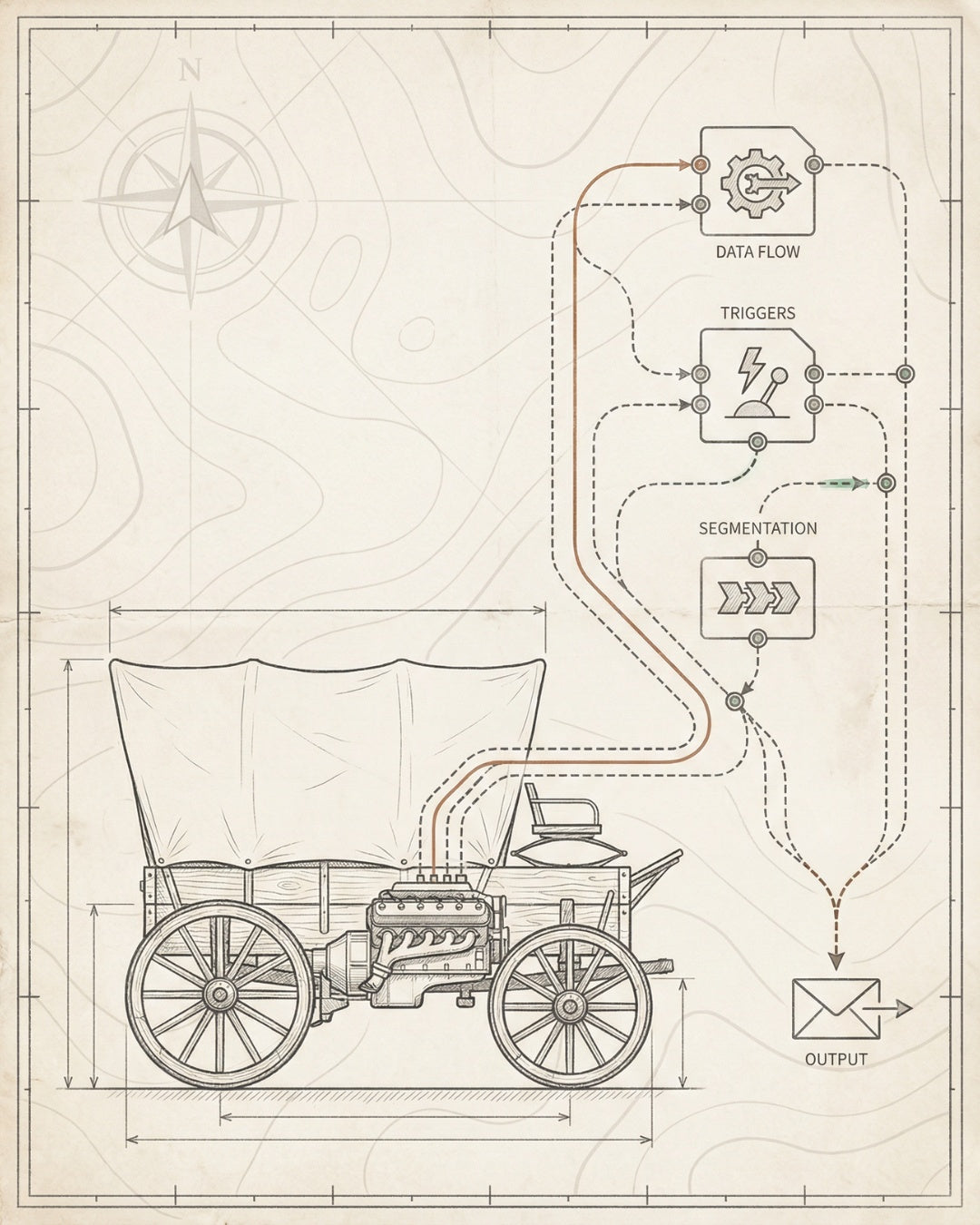
The best company for ecommerce SEO will show you the blueprint before they sell you the build.
AI Search Optimization: The New Visibility Layer
Here’s what changed in the last 18 months: your next customer might never click a link.
Google AI Overviews now appear for 15%+ of commercial queries. Perplexity answers product questions with citations. ChatGPT recommends brands based on structured knowledge, not PageRank.
If your ecommerce SEO company isn’t talking about this, they’re optimizing for a search landscape that’s already shifting.
AI search optimization isn’t a separate channel — it’s a new visibility layer on top of traditional SEO. And it requires different technical infrastructure:
What AI Search Optimization Actually Requires
- Entity-first schema markup — Not just Product schema. Organization, Brand, FAQPage, HowTo, and knowledge graph signals that help LLMs understand your expertise.
- Structured content for extraction — Tables, lists, and clearly marked answers that AI models can parse and cite.
- Citation-worthy depth — AI models cite sources that demonstrate expertise. Thin content doesn’t get referenced.
- Knowledge graph connections — Internal linking that establishes topical authority and entity relationships.
- API-readable data — Structured data that’s machine-parseable, not just human-readable.
We’ve started seeing this play out: brands that invested in comprehensive schema markup and entity optimization are getting cited in Perplexity results. Brands that only optimized for traditional SERPs aren’t.
One DTC skincare brand we worked with went from zero AI Overview appearances to showing up in 23% of their target queries after we rebuilt their schema architecture and content structure. No new content — just better markup and entity signals.
The best ecommerce SEO companies are already building for this. They understand that technical SEO for ecommerce now includes optimizing for citation engines, not just ranking algorithms.
If your agency evaluation doesn’t include questions about AI search readiness, you’re hiring for yesterday’s game.
Technical SEO Capabilities That Actually Matter
Let’s get specific about technical depth. Not every ecommerce SEO company has the same capabilities. Some are content agencies with an SEO label. Some are link builders who dabble in on-page. Some are actual technical SEO engineers.
Here are the technical capabilities that separate infrastructure builders from content publishers:
1. JavaScript Rendering and Crawl Budget Optimization
If your store runs on a headless Shopify build, Next.js, or any modern JavaScript framework, Google has to render your pages to see your content. Most agencies don’t understand this.
The best ones know how to:
- Audit server-side rendering (SSR) vs. client-side rendering (CSR) vs. static site generation (SSG)
- Identify JavaScript-blocked content and fix it
- Optimize crawl budget by eliminating infinite scroll, faceted navigation waste, and parameter-based duplicate URLs
- Use dynamic rendering strategically (when necessary, not as a default)
One $8M Shopify Plus store we audited had 40,000+ crawlable URLs from faceted filters. Google was wasting 90% of its crawl budget on duplicate pages. We consolidated it to 1,200 indexable URLs, and rankings started moving within 3 weeks.
2. Core Web Vitals and Performance Optimization
Core Web Vitals are a confirmed ranking factor. But more importantly, they’re a conversion factor. A 1-second delay in LCP can drop conversion rates by 7%.
Can your agency:
- Diagnose LCP, CLS, and INP issues at the code level?
- Optimize image delivery (WebP, lazy loading, responsive images, CDN configuration)?
- Reduce JavaScript execution time and eliminate render-blocking resources?
- Fix layout shifts caused by dynamic content insertion?
This isn’t “run a Lighthouse test and send a report.” This is actual performance engineering. If they can’t do it, they’ll recommend you hire a developer. The best ecommerce SEO companies have developers on the team.
3. Schema Markup and Structured Data Architecture
Schema isn’t just about rich snippets anymore. It’s about making your content machine-readable for AI search engines.
The best agencies implement:
- Product schema with complete attributes (price, availability, reviews, SKU, brand)
- Organization and Brand schema for entity establishment
- BreadcrumbList for site architecture clarity
- HowTo and FAQPage for featured snippet targeting
- Review and AggregateRating schema for trust signals
- Custom schema for unique product attributes (ingredients, materials, specs)
They also validate it. Not just “we added schema” — they show you the Rich Results Test, confirm it’s error-free, and monitor for schema deprecation warnings.
4. Internal Linking Architecture
Internal linking is the most underutilized lever in ecommerce SEO. It’s how you distribute PageRank, establish topical clusters, and help Google understand your site hierarchy.
Random “related product” widgets don’t count. Strategic internal linking means:
- Hub-and-spoke content architecture (pillar pages linking to cluster content)
- Category-to-product linking patterns that reinforce hierarchy
- Contextual links from blog content to commercial pages
- Breadcrumb navigation that’s both user-friendly and crawl-efficient
- Anchor text optimization (descriptive, keyword-rich, not generic)
We’ve seen on-page SEO improvements from internal linking alone drive 40%+ increases in product page rankings — no backlinks, no new content, just better architecture.
If your agency doesn’t have a documented internal linking strategy, they’re leaving money on the table.

The Compound Visibility Stack in Practice
Here’s the framework that ties this together: the Compound Visibility Stack (CVS).
It’s not a service offering. It’s a systems model for how SEO infrastructure, content, and distribution multiply each other over time.
The Compound Visibility Stack
Layer 1: Website Infrastructure** Technical foundation — crawlability, indexability, Core Web Vitals, schema, site architecture. This is the platform everything else builds on.
Layer 2: Content Structure**** Keyword-mapped content with proper hierarchy, internal linking, and entity signals. Not random blog posts — strategic content that reinforces your topical authority.
Layer 3: Technical Optimization**** Ongoing refinement — schema updates, performance tuning, indexation management, AI search signal optimization. The maintenance layer that keeps the system efficient.
Layer 4: Distribution**** The layer most agencies ignore. Email capture from organic traffic. Social amplification. Backlink acquisition. Turning visibility into owned audience.
Each layer multiplies the one below it. Great content on a broken site doesn’t rank. Great infrastructure with no content doesn’t get traffic. Great traffic with no distribution mechanism doesn’t build equity.
The best ecommerce SEO companies build all four layers, in sequence. They don’t skip the foundation to publish content faster. They don’t ignore distribution because it’s “not SEO.”
Here’s what this looks like in practice:
Month 1 (Sprint 1): Foundation Installation**
- Technical audit and crawlability fixes
- Indexation cleanup (block what shouldn’t rank, unblock what should)
- Schema markup installation across product and category pages
- Core Web Vitals baseline and critical performance fixes
- Internal linking architecture design
Month 2 (Sprint 2): Content Structure
- Keyword research and content gap analysis
- Pillar page creation (category-level, high-volume keywords)
- Cluster content mapping (supporting articles, how-tos, comparisons)
- On-page optimization for existing product pages
- AI search optimization (entity signals, citation-worthy depth)
Month 3 (Sprint 3): Distribution Installation
- Email capture flows for organic traffic (exit intent, scroll triggers)
- Google Search Console monitoring and ranking velocity tracking
- Backlink outreach to high-authority sites in your niche
- Content syndication and strategic guest posting
- Conversion rate optimization for top organic landing pages
After 90 days, you have a system. Not a pile of content. Not a retainer dependency. A compounding SEO infrastructure that your team can maintain and scale.
This is how $30M+ in organic revenue gets built. Not from one big win, but from systems that multiply over time.
When to Hire vs. When to Build In-House
Not every ecommerce brand needs an agency. Some should hire in-house. Some should stay DIY longer. Here’s the decision framework:
You Should Hire an Ecommerce SEO Company If:
- You’re doing $500K–$10M in revenue and organic is
Timeline Expectations:
- Month 1: Technical improvements visible in GSC (fewer errors, better crawl efficiency)
- Month 2-3: Ranking movement starts (target keywords moving from page 3-5 to page 2)
- Month 4-6: Traffic and revenue growth becomes measurable (20-50% increases are realistic)
- Month 6+: Compound effects kick in (content published in month 2 starts ranking, internal links distribute authority)
SEO isn’t instant. But it’s also not a mystery. If you’re not seeing measurable progress by month 3, something’s wrong.
Frequently Asked Questions
What makes an ecommerce SEO company “the best”?
The best company for ecommerce SEO isn’t defined by size or client count — it’s defined by systems thinking. They audit technical infrastructure before proposing content. They understand crawl budget, JavaScript rendering, schema markup, and Core Web Vitals at a code level. They build the 4-Layer SEO Foundation (crawlability, indexability, rankability, convertibility) in sequence, not randomly. They show you case studies with revenue data, not just traffic increases. And they design for ownership — they install systems you can maintain, not dependencies you have to pay for forever.
How much should ecommerce SEO cost?
Pricing varies widely based on model and scope. Traditional retainers run $5K–$15K/month with 6-12 month commitments ($30K–$180K total). Sprint-based models typically cost $8K–$25K per 30-day cycle, with most brands running 2-3 sprints to install full infrastructure ($16K–$75K total). For context, a comprehensive ecommerce SEO buildout —
Matt Hyder
SEO infrastructure and AI search optimization at Founding Engine.
Want SEO that actually holds?
Get a free infrastructure audit from the Founding Engine team.
Get Your Free Audit