Comprehensive Ecommerce SEO Tricks That Actually Compound
The infrastructure-first SEO tactics ecommerce founders use to build rankings that compound. No fluff. Just systems that scale from $500K to $5M+.
ECOMMERCE SEO SYSTEMS
Comprehensive Ecommerce SEO Tricks That Actually Compound
By Matt Hyder · February 14, 2026 · 12 min read

Most ecommerce SEO “tricks” are tactical band-aids. Fix this meta tag. Add that keyword. Optimize these three product pages. Then wait. Then wonder why rankings stall at page two.
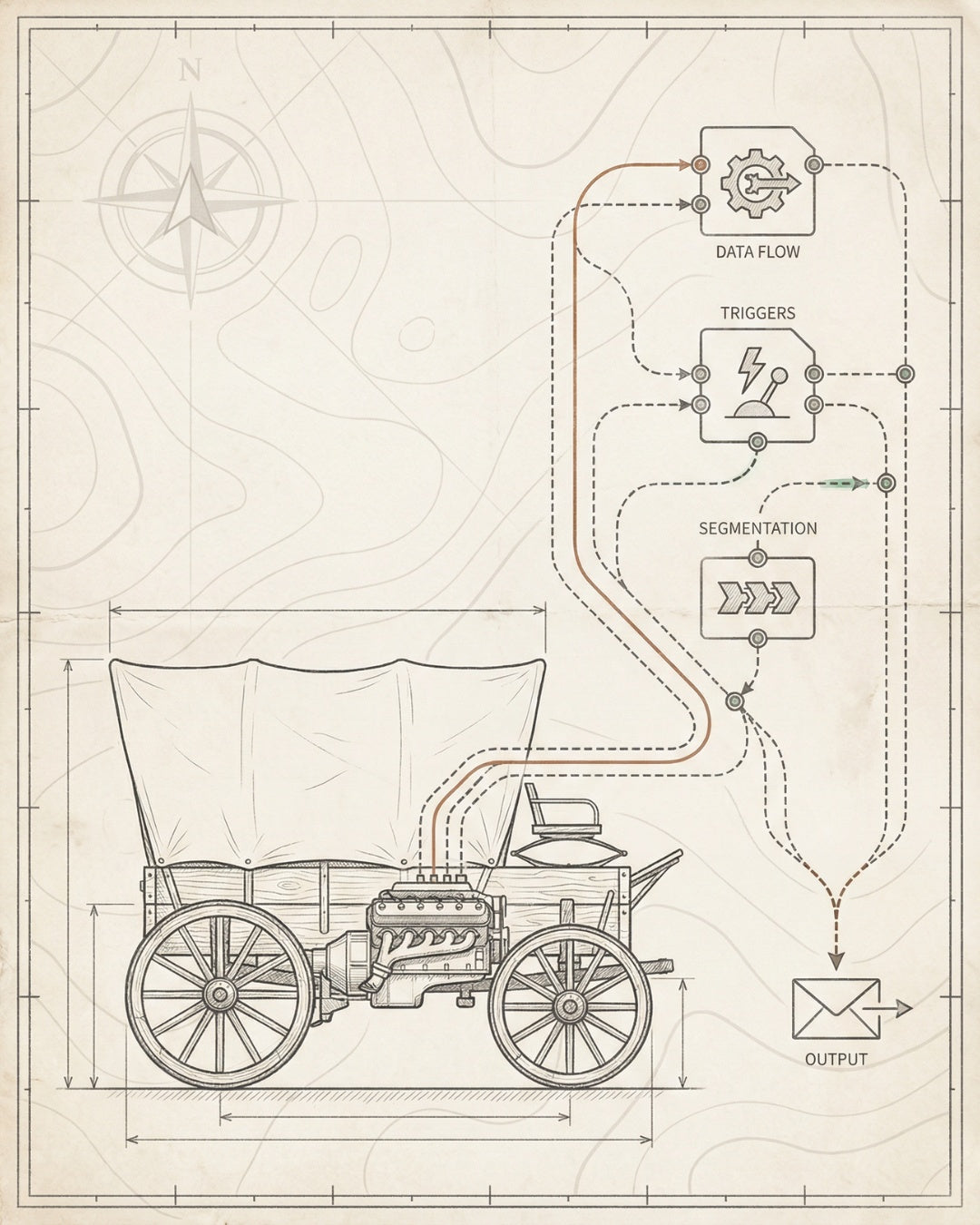
Here’s what actually happens: You’re treating SEO like a to-do list when you should be building it like infrastructure. The stores that scale from $500K to $5M+ in organic revenue don’t execute more tasks — they install better systems.
This guide covers the comprehensive ecommerce SEO tricks that compound over time. Not hacks. Not shortcuts. The architecture that makes rankings inevitable. We’re talking crawl budget management for 10,000+ SKUs, schema markup that feeds AI search engines, URL structures that scale without breaking, and Core Web Vitals optimization that doesn’t sacrifice conversion rate.
If you’ve outgrown basic ecommerce SEO tips and need the technical blueprint that holds at scale, this is it.
01 / 05 Most ecommerce SEO advice is tactical noise. Real growth comes from infrastructure: crawl architecture, schema systems, and URL design that scales.
02 / 05 Crawl budget matters at 1000+ SKUs. Segment your sitemaps, control robots.txt patterns, and prioritize revenue pages in your internal linking hierarchy.
03 / 05 Schema markup isn’t just for rich snippets. It’s how you feed AI search engines entity data, earn citations in ChatGPT, and rank in Perplexity results.
04 / 05 Core Web Vitals for ecommerce means optimizing product images without killing quality, managing third-party scripts, and keeping INP under 200ms.
05 / 05 Build SEO like you build product: audit current state, fix the foundation, install content infrastructure, optimize performance, then iterate in 30-day cycles.
Table of Contents
- 1. Crawl Budget Architecture for Product Catalogs
- 2. Schema Markup Beyond Product Schema
- 3. URL Architecture That Scales
- 4. Core Web Vitals for Ecommerce
- 5. Content Infrastructure vs. Content Marketing
- 6. AI Search Optimization for Ecommerce
- 7. Implementation: The Audit-to-Throttle Pipeline
- Frequently Asked Questions
1. Crawl Budget Architecture for Product Catalogs
Once you hit 1,000+ SKUs, Google doesn’t crawl everything. It allocates a crawl budget based on your site’s authority, server response time, and perceived value of your pages. If you’re wasting that budget on low-value URLs — filtered views, paginated archives, out-of-stock products — your best pages get ignored.
Here’s how to architect crawl efficiency:
Segment Your XML Sitemaps by Priority
Don’t dump all 10,000 URLs into one sitemap. Segment by page type and business priority:
- sitemap-products-bestsellers.xml — Top 100 revenue-generating SKUs
- sitemap-products-core.xml — Core catalog (in-stock, active)
- sitemap-categories.xml — Collection and category pages
- sitemap-content.xml — Blog, guides, landing pages
- sitemap-archive.xml — Seasonal or low-priority pages
Submit the high-priority sitemaps first in Google Search Console. Update them daily for bestsellers, weekly for core products. This signals to Google which pages matter most.
Control Crawl Paths with Robots.txt
Block low-value URL patterns that burn crawl budget:
- Faceted navigation parameters: Disallow: /*?filter=
- Search result pages: Disallow: /search
- Cart and checkout pages: Disallow: /cart
- Internal search queries: Disallow: /*?q=
Be precise. A poorly configured robots.txt can block your entire site. Test changes in Google Search Console’s robots.txt tester before deploying.
Build an Internal Linking Hierarchy That Prioritizes Revenue
Internal links distribute crawl priority. If your homepage links to 50 random products, you’re telling Google they’re all equally important. Instead:
- Homepage → Top 5-10 category pages
- Category pages → Top 10-20 products in that category
- Product pages → Related products (2-4 links) + parent category
Use breadcrumb navigation to reinforce hierarchy. Every product should link back to its parent category, and every category should link back to the homepage. This creates a clear crawl path and distributes authority efficiently.
For a deeper dive into technical crawl optimization, see our guide on technical SEO for ecommerce.

2. Schema Markup Beyond Product Schema
Product schema is table stakes. If you’re not marking up price, availability, and reviews, you’re invisible in rich results. But that’s the baseline. The comprehensive ecommerce SEO tricks involve layering multiple schema types to feed both traditional search and AI engines.
Schema Types Every Ecommerce Store Needs
Schema Type Where to Use It Why It Matters
Product All product pages Enables rich snippets, price display, review stars in SERPs
BreadcrumbList All pages with breadcrumbs Shows site hierarchy in search results, improves crawlability
Organization Homepage, About page Establishes brand entity, feeds knowledge graph
WebSite Homepage Enables sitelinks search box in Google
HowTo Guides, tutorials, setup instructions Rich results eligibility, AI citation potential
FAQ Category pages, product pages with common questions Answers “People Also Ask” queries, improves relevance
Implement Schema for AI Search Engines
ChatGPT, Perplexity, and Google’s AI Overviews don’t just read your content — they parse structured data. To rank in AI-generated answers:
- Add entity-level markup: Use Organization, Brand, and Person schema to establish who you are in the knowledge graph
- Mark up key facts: Use FAQ and HowTo schema for citation-worthy content that answers specific questions
- Include context: Add about and mentions properties to connect your content to related entities
This is part of what we call the Compound Visibility Stack — layering technical signals that make your brand discoverable across traditional search, AI Overviews, and conversational search engines.
For implementation details, check out our ecommerce SEO checklist and our guide to AI search optimization.
3. URL Architecture That Scales
Your URL structure is permanent infrastructure. Change it later and you’re dealing with 301 redirects, lost authority, and ranking drops. Get it right from the start.
Flat vs. Deep Category Structures
Most ecommerce stores default to deep category hierarchies:
example.com/mens/clothing/shirts/casual/product-name
This looks organized, but it creates problems:
- Deep URLs are harder to crawl and index
- Authority gets diluted across multiple category layers
- Users have to click 4-5 times to reach a product
A flatter structure works better at scale:
example.com/products/product-name or example.com/mens-casual-shirts/product-name
Keep products 2-3 clicks from the homepage. Use breadcrumbs and internal linking to show hierarchy without embedding it in the URL.
Handle Faceted Navigation Without Duplicate Content
Faceted navigation (filters for size, color, price) generates thousands of URL variations. Without proper handling, you create massive duplicate content issues:
- example.com/mens-shirts
- example.com/mens-shirts?color=blue
- example.com/mens-shirts?color=blue&size=large
Solution: Use canonical tags to point all filtered views back to the main category page. Or use noindex on filtered pages if you don’t want them in the index at all. Better yet, implement AJAX-based filters that don’t change the URL.
Canonicalization Rules
Set clear canonical rules across your store:
- All product variants (size, color) → canonical to the main product page
- HTTP → canonical to HTTPS
- www → canonical to non-www (or vice versa, just pick one)
- Trailing slash → canonical to non-trailing slash (or vice versa)
Inconsistent canonicals split authority and confuse Google. Pick a standard and enforce it site-wide.
For more on URL strategy, see our post on advanced ecommerce SEO.

4. Core Web Vitals for Ecommerce
Core Web Vitals are a ranking factor, but more importantly, they’re a conversion factor. A slow site kills both SEO and revenue. Here’s how to optimize without sacrificing design or functionality.
Largest Contentful Paint (LCP): Target Under 2.5 Seconds
LCP measures how long it takes for the largest visible element (usually your hero image or product photo) to load. For ecommerce, this is critical — users bounce if products don’t load fast.
How to optimize:
- Compress product images: Use WebP format, compress to 80-85% quality, serve different sizes for mobile vs. desktop
- Lazy load below the fold: Only the hero image should load immediately (loading=“eager”). Everything else gets loading=“lazy”
- Use a CDN: Serve images from a content delivery network (Cloudflare, Fastly, Shopify CDN) to reduce latency
- Preload critical assets: Add for hero images and critical fonts
Cumulative Layout Shift (CLS): Target Under 0.1
CLS measures visual stability. If elements shift while the page loads (image pops in, ad pushes content down), it creates a bad user experience and hurts rankings.
How to fix:
- Set explicit width and height on all images: This reserves space so images don’t shift when they load
- Reserve space for dynamic content: If you load reviews or related products via JavaScript, allocate space for them in the initial render
- Avoid inserting content above existing content: Don’t inject banners or ads that push content down
Interaction to Next Paint (INP): Target Under 200ms
INP replaced First Input Delay (FID) in 2024. It measures how quickly your site responds to user interactions — clicks, taps, keyboard input.
For ecommerce, this matters on:
- Add to cart buttons
- Color/size selectors
- Quantity adjusters
- Filter dropdowns
How to optimize:
- Minimize JavaScript execution: Defer non-critical scripts, break up long tasks, use web workers for heavy processing
- Remove or defer third-party scripts: Review apps, chat widgets, analytics tags — each one adds execution time
- Optimize event handlers: Debounce rapid interactions (like quantity adjusters), use passive event listeners where possible
Third-Party Script Management
Most ecommerce stores load 10-20 third-party scripts: analytics, reviews, chat widgets, A/B testing, pixel tracking. Each one adds latency and execution time.
Audit your scripts:
- Do you actually use the data from this tool?
- Can you load it asynchronously or defer it?
- Can you lazy load it (only load when needed)?
Use Google Tag Manager to control when scripts fire. Load critical scripts (analytics, pixels) immediately. Defer everything else until after the page is interactive.
For a full technical breakdown, see our guide on on-page SEO for ecommerce.
5. Content Infrastructure vs. Content Marketing
Content marketing is writing blog posts and hoping they rank. Content infrastructure is building scalable systems that generate rankings across hundreds or thousands of pages.
The difference: one is a tactic, the other is architecture.
Programmatic SEO for Category and Collection Pages
If you have 500 products across 20 categories, you shouldn’t be manually writing unique copy for every category page. Instead, build templates that scale:
- Dynamic title templates: [Category] | [Brand] - Shop [Product Type] Online
- Intro paragraph template: Pull in category name, product count, key features, and a CTA
- FAQ section template: Generate common questions based on category (shipping, sizing, materials, care instructions)
This is programmatic SEO — using data and templates to create unique, valuable pages at scale. It’s how marketplaces like Airbnb and Zillow rank for millions of keywords.
Internal Linking Systems That Distribute Authority
Internal linking isn’t just navigation — it’s how you distribute PageRank across your site. Most stores link randomly: related products, recent posts, “you might also like.” No strategy. No structure.
Build a linking system:
- Hub-and-spoke model: Create pillar pages (e.g., “Complete Guide to Running Shoes”) that link to all related products and content. Then link back from products to the pillar.
- Contextual product links: Link from blog content to relevant products using descriptive anchor text (“waterproof trail running shoes” → product page)
- Category-to-product links: Every category page should link to its top 10-20 products. Update monthly based on sales data.
The goal: Every important page should be 2-3 clicks from the homepage and receive internal links from multiple sources.
Content Templates That Scale Across SKUs
For product pages, build a content template that includes:
- Above the fold: Product name, price, primary image, add to cart button
- Product description: 150-300 words covering features, benefits, use cases
- Specifications table: Size, weight, materials, SKU, UPC
- FAQ section: 3-5 common questions (shipping, returns, sizing, care)
- Reviews: User-generated content (critical for SEO and conversion)
- Related products: 4-6 contextually related items
Use this template across all products. Customize the description and FAQ based on product type, but keep the structure consistent. This makes it easy to scale content creation and maintain quality.
For more on content strategy, see our post on SEO for ecommerce product pages.

6. AI Search Optimization for Ecommerce
Google’s AI Overviews, ChatGPT, Perplexity, and other LLM-powered search engines are changing how users discover products. If your store isn’t optimized for AI search, you’re invisible in the fastest-growing search channel.
Entity Signals and Knowledge Graph Positioning
AI search engines rely on entity recognition — understanding what your brand is, what you sell, and how you relate to other entities (competitors, categories, influencers).
To establish entity signals:
- Implement Organization schema: Mark up your brand name, logo, social profiles, contact info
- Build a knowledge graph presence: Get listed on Wikipedia, Wikidata, Crunchbase, and industry directories
- Earn brand mentions: Get cited in articles, reviews, and guides — even without links, mentions help establish entity authority
Structured Data for LLM Citation
LLMs cite sources that provide clear, structured answers. To earn citations:
- Use FAQ schema: Mark up common questions and concise answers
- Use HowTo schema: For setup guides, care instructions, or usage tutorials
- Add context with “about” properties: In your schema markup, use about to connect content to specific topics and entities
Example: A product page for running shoes should include FAQ schema answering “Are these shoes good for trail running?” with a clear, citation-worthy answer.
Build Citation-Worthy Content
AI engines prefer content that:
- Answers specific questions directly
- Includes data, specs, and measurable claims
- Cites sources (yes, even ecommerce content can cite manufacturers, studies, or reviews)
- Uses clear, structured formatting (lists, tables, headings)
Instead of writing fluffy product descriptions, write content that could be cited as an authoritative source. Think: “This shoe has a 12mm heel-to-toe drop, weighs 10.2 oz, and is rated for 300-500 miles of use.”
For more on AI search, see our guide to AI search optimization.
Pro Tip: Monitor how your brand appears in ChatGPT and Perplexity. Search for “[your category] recommendations” or “[your product type] best options” and see if your store gets cited. If not, you’re missing structured data or entity signals.
7. Implementation: The Audit-to-Throttle Pipeline
You now have the comprehensive ecommerce SEO tricks. Here’s how to implement them without burning six months and $50K on an agency retainer.
We use a framework called the Audit-to-Throttle Pipeline — a 30-day sprint model that prioritizes impact over effort and builds infrastructure in layers.
Step 1: Audit Current State (Days 1-5)
Run a technical SEO audit covering:
- Crawlability: Check robots.txt, XML sitemaps, crawl errors in Google Search Console
- Indexability: Identify indexation issues (noindex tags, canonical conflicts, duplicate content)
- Rankability: Analyze keyword rankings, content gaps, internal linking structure
- Convertibility: Review Core Web Vitals, mobile usability, conversion path friction
This is the 4-Layer SEO Foundation: Crawlability → Indexability → Rankability → Convertibility. Fix issues in this order.
Tools: Google Search Console, Screaming Frog, PageSpeed Insights, Ahrefs or Semrush.
For a detailed audit process, see our ecommerce SEO audit guide.
Step 2: Fix the Foundation Layer (Days 6-12)
Address technical blockers first:
- Optimize robots.txt to block low-value pages
- Segment XML sitemaps by priority
- Fix canonical tag issues
- Resolve indexation errors (noindex tags, redirect chains)
- Set up proper URL structure and redirects
Don’t touch content yet. Foundation first.
Step 3: Build Content Infrastructure (Days 13-20)
Now layer in content systems:
- Implement schema markup (Product, BreadcrumbList, Organization, FAQ, HowTo)
- Build internal linking architecture (hub-and-spoke model)
- Create content templates for category and product pages
- Optimize top 20 revenue-generating pages (titles, descriptions, content)
Step 4: Optimize Core Web Vitals (Days 21-25)
Improve site performance:
- Compress and lazy-load images
- Defer non-critical JavaScript
- Audit and remove unnecessary third-party scripts
- Test mobile performance and fix layout shift issues
Step 5: Install AI Search Signals (Days 26-28)
Add AI-readiness:
- Implement entity-level schema (Organization, Brand)
- Add FAQ and HowTo schema to key pages
- Build citation-worthy content (data, specs, structured answers)
- Monitor brand mentions in ChatGPT and Perplexity
Step 6: Monitor and Iterate (Days 29-30)
Set up tracking and measurement:
- Connect Google Search Console and verify data flow
- Track ranking velocity by page type (product, category, content)
- Measure organic revenue attribution
- Identify next iteration priorities
Then repeat. SEO compounds when you iterate in focused cycles, not when you execute a giant checklist once and walk away.
This is how we work at Founding Engine — 30-day sprints, infrastructure-first, no retainers. See our ecommerce SEO case studies for results.
Frequently Asked Questions
What are the most effective ecommerce SEO tricks for new stores? For new stores, focus on foundation first: proper URL structure, schema markup (Product, BreadcrumbList, Organization), optimized product page templates, and a clear internal linking hierarchy. Skip the blog for now — prioritize product and category page optimization. Get your technical SEO right before scaling content.
How long does it take to see results from comprehensive ecommerce SEO? Technical fixes (Core Web Vitals, crawl optimization) show impact in 2-4 weeks. Content and schema updates take 4-8 weeks. Competitive keyword rankings take 3-6 months. But the key is compound growth — rankings accelerate over time if you build infrastructure correctly. Most stores see 20-30% traffic increases in the first 90 days.
Should I hire an ecommerce SEO agency or do it in-house? If you’re under $1M in revenue, start in-house using frameworks like the 4-Layer SEO Foundation. Between $1M-$5M, consider an agency for technical execution while you own strategy. Above $5M, you need dedicated SEO infrastructure — either hire full-time or work with a specialist agency. Avoid retainer agencies that bill hours without building systems. Look for sprint-based models that install infrastructure.
What’s the difference between ecommerce SEO and regular SEO? Ecommerce SEO deals with scale (1000+ pages), product-specific schema markup, faceted navigation, inventory management (out-of-stock pages), and conversion-focused optimization. Regular SEO focuses on content ranking and link building. Ecommerce SEO is more technical, more architecture-focused, and directly tied to revenue attribution.
How do I optimize for AI search engines like ChatGPT and Perplexity? Use entity-level schema markup (Organization, Brand), implement FAQ and HowTo schema, build citation-worthy content with data and specs, and earn brand mentions across the web. AI engines prioritize structured, authoritative answers. Make your content machine-readable and citation-friendly.
What’s the ROI of investing in ecommerce SEO infrastructure? Organic search has the highest ROI of any marketing channel — typically 5-10x compared to paid ads. Infrastructure-first SEO compounds over time, so your investment in Year 1 continues generating returns in Years 2, 3, and beyond. Stores that build proper SEO infrastructure see 100-250% traffic increases within 12 months and sustained organic revenue growth.
How often should I update my ecommerce SEO strategy? Run technical audits quarterly. Update product and category page optimization monthly (based on sales data and keyword performance). Iterate on content and schema every 30 days using a sprint model. SEO isn’t a one-time project — it’s ongoing infrastructure maintenance and improvement.
What are the biggest ecommerce SEO mistakes to avoid? Biggest mistakes: ignoring crawl budget at scale, not implementing schema markup, creating duplicate content through faceted navigation, neglecting Core Web Vitals, building deep URL structures, and treating SEO as a checklist instead of infrastructure. Also: hiring agencies that bill retainers without installing systems.
READY TO BUILD?
Install SEO Infrastructure That Compounds
We engineer the technical SEO systems that hold. No retainers. No fluff. 30-day focused cycles that build crawlability, indexability, rankability, and convertibility.
$30M+ organic revenue generated. 250% average traffic increase. 500+ keywords ranked page 1.
SEO Infrastructure AI Search Optimization Website Design & Build
See Our Results · Start a Project
RELATED READING
More Ecommerce SEO Systems
- Ecommerce SEO Strategy: The Infrastructure-First Approach
- Ecommerce SEO Best Practices That Scale
- Best Ecommerce SEO: What Actually Works at $5M+
- Ecommerce SEO Optimization: From Audit to Execution
- Ecommerce SEO Services: What to Look For (and Avoid)
- SEO Infrastructure: What It Means and Why It Matters
Matt Hyder
SEO infrastructure and AI search optimization at Founding Engine.
Want SEO that actually holds?
Get a free infrastructure audit from the Founding Engine team.
Get Your Free Audit