Dynamic Ecommerce SEO Patterns That Scale With Revenue
Learn the dynamic SEO patterns that adapt as your ecommerce store grows. Infrastructure-first systems that scale from $100K to $10M without rebuilding.
ECOMMERCE SEO INFRASTRUCTURE / FEB 14, 2026
Dynamic Ecommerce SEO Patterns That Scale With Revenue
Most ecommerce stores hit a wall around $500K in revenue. Not because their product sucks. Not because they ran out of keywords. They hit the wall because their SEO was built for where they were, not where they’re going.
Static SEO strategies work until they don’t. You optimize 50 product pages manually, build some category content, fix your Core Web Vitals, and watch rankings climb. Then you add 200 SKUs. Launch in three new markets. Spin up a B2B channel. Suddenly, your “optimized” site is a mess of orphaned pages, diluted link equity, and crawl budget waste.

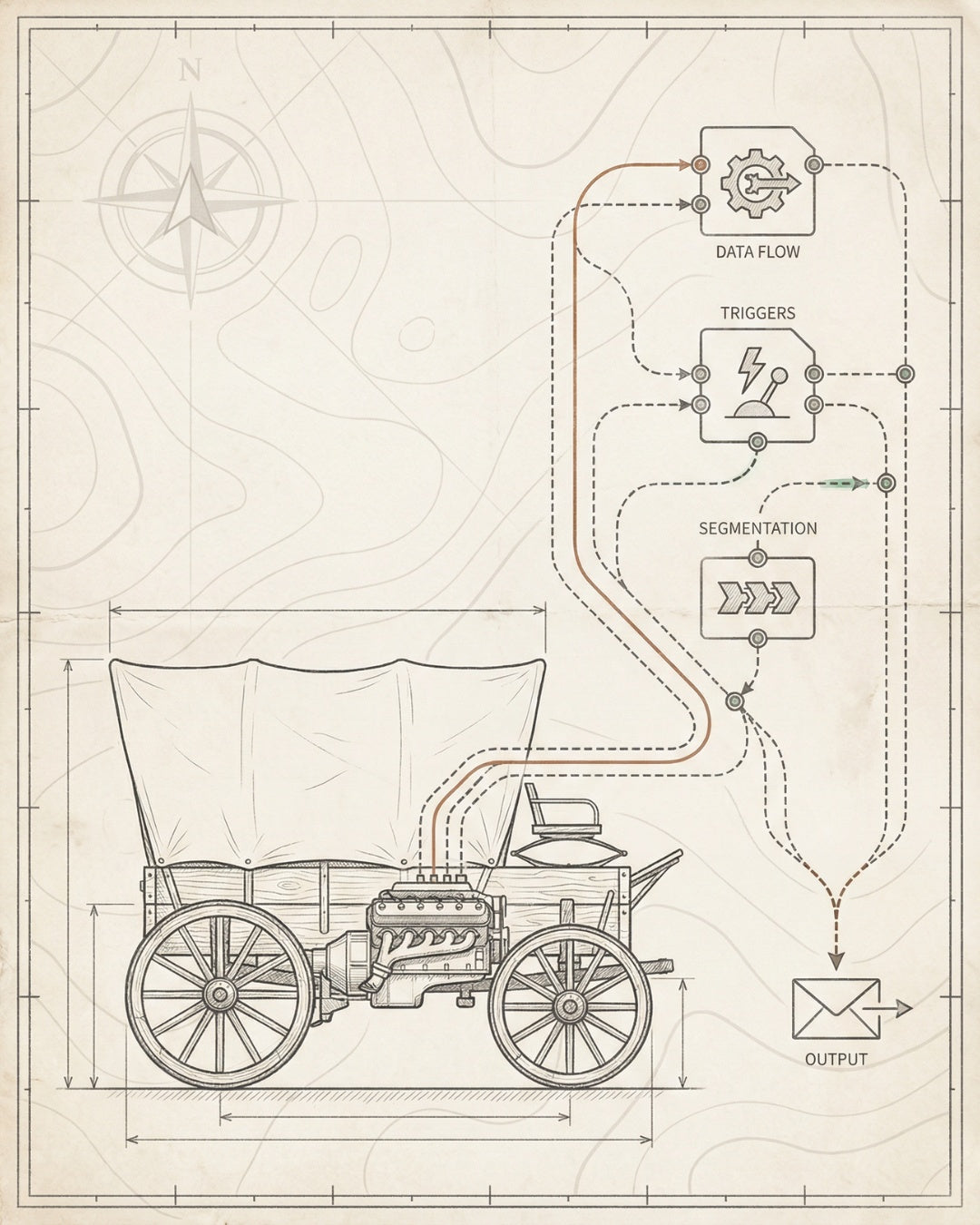
The brands that scale from $100K to $10M without rebuilding their SEO every 12 months? They’re not optimizing harder. They’re building dynamic ecommerce SEO patterns — infrastructure that adapts as catalog size, traffic volume, and business complexity change.
This is the difference between SEO as a project and SEO as a system. Between optimization and architecture. Between what breaks at scale and what compounds.
Pattern 01 Static SEO breaks at scale. Dynamic patterns adapt to revenue stage, catalog size, and traffic volume without constant rebuilds.
Pattern 02 Site architecture should evolve: flat structure for early-stage, hub-and-spoke for mid-stage, siloed taxonomy for advanced brands.
Pattern 03 Internal linking becomes dynamic — redistributing equity based on product performance, inventory levels, and seasonal demand.
Pattern 04 Content systems scale with templates and structured data. Quality at volume, not manual optimization for every SKU.
Pattern 05 Technical optimization becomes progressive — crawl budget, indexation strategy, and Core Web Vitals adapt to traffic thresholds.
What We’re Building
- Revenue-Stage Architecture: How Site Structure Evolves
- Adaptive Internal Linking Systems
- Scalable Content Infrastructure
- Progressive Technical Optimization
- AI Search Readiness at Scale
- Implementation: Building Dynamic Patterns
- Frequently Asked Questions
PATTERN 01
Revenue-Stage Architecture: How Site Structure Evolves
Your site architecture shouldn’t look the same at $100K as it does at $5M. Different revenue stages demand different structural patterns. Not because the fundamentals change, but because the constraints do — catalog size, crawl budget, internal linking complexity, and user navigation all shift as you scale.
Here’s the framework we use when mapping technical SEO for ecommerce at different revenue thresholds:
Revenue Stage Architecture Pattern Key Characteristics Primary Focus
$0–$250K Flat Structure 2-3 click depth max, minimal categories, direct product access from homepage Speed to index, quick wins, foundation building
$250K–$1M Hub-and-Spoke Category hubs with product clusters, topic-based content layers, strategic facets Keyword expansion, topical authority, user segmentation
$1M–$5M Siloed Taxonomy Deep category hierarchies, attribute-based navigation, programmatic landing pages Long-tail capture, crawl budget optimization, entity relationships
$5M+ Multi-Dimensional Cross-linked silos, dynamic facets, AI-driven internal linking, geo/audience segmentation Maximum coverage, crawl efficiency, personalization at scale
Why This Matters
A flat structure at $100K gets you indexed fast. Everything’s two clicks from the homepage. Google crawls your entire catalog in days. But scale that same structure to 5,000 SKUs and you’ve created a navigation nightmare — bloated menus, no topical clustering, and zero crawl prioritization.
Conversely, if you launch with a complex siloed taxonomy at $100K, you’re over-engineering. You don’t have the content volume to fill those silos. You’re creating empty category pages that dilute authority instead of concentrating it.
Dynamic ecommerce SEO patterns mean your architecture evolves with revenue milestones. You don’t rebuild from scratch — you add layers. The flat structure becomes the core. Hub-and-spoke grows around it. Silos emerge as product lines mature. This is what we call the Compound Visibility Stack — each layer builds on the last without breaking what’s underneath.

How to Identify Your Current Stage
Run this quick diagnostic:
- Average click depth to product pages: If it’s >4 clicks for most products, your structure is too deep for your catalog size
- Indexation ratio: Pages indexed ÷ pages submitted in sitemap. Below 70%? You have crawl waste or thin content
- Category page performance: Are category pages ranking and converting, or just organizational containers? If the latter, you need hub-and-spoke
- Orphaned page count: Products with zero internal links pointing to them. More than 5%? Your linking system isn’t scaling
The goal isn’t to rush to the most complex architecture. It’s to match structure to catalog maturity. Build what you need now. Design for what’s next. This is the first principle of ecommerce SEO best practices at scale.
PATTERN 02
Adaptive Internal Linking Systems
Static internal linking is a liability at scale. You manually link your top 20 products to high-authority pages. It works. Rankings climb. Then your inventory shifts. The product you linked everywhere goes out of stock. A new SKU launches and gets zero link equity. Seasonal demand spikes and your linking strategy is stuck in Q2.
Dynamic ecommerce SEO patterns treat internal linking as a redistribution system, not a one-time setup. Link equity flows to where it creates the most value — based on inventory, performance, and business priority.
The Three Layers of Adaptive Linking
Layer 1: Performance-Based Linking
Products that convert get more internal links. Products that rank but don’t convert get fewer. This isn’t just about clicks — it’s about teaching Google which pages deserve authority.
Implementation: Tag products in your CMS with conversion rate tiers (high, medium, low). Use those tags to trigger automated contextual links from blog content, category pages, and related product modules.
Layer 2: Inventory-Based Linking
Out-of-stock products shouldn’t be your most-linked pages. But most ecommerce stores leave old internal links in place for months, sending link equity and crawl budget to dead inventory.
Implementation: When a product goes out of stock, automatically reduce internal links (keep 1-2 for crawl continuity, remove the rest). When it’s back in stock, restore linking. Use inventory APIs to trigger link updates without manual intervention.
Layer 3: Seasonal and Campaign-Based Linking
Black Friday is in 30 days. Your gift guide content from last year is ranking. But the internal links point to last year’s products. By the time you manually update them, the campaign is half over.
Implementation: Build seasonal link templates that activate based on date ranges. Campaign products get temporary link boosts from high-authority pages during active promotion periods, then revert to baseline after.
Why This Compounds
Adaptive internal linking creates a feedback loop. High-performing pages get more authority. That authority drives more rankings. More rankings surface more conversion data. That data refines which pages get linked next. The system gets smarter over time.
This is how brands scale from 50 to 5,000 indexed products without link equity dilution. It’s not about linking everything equally — it’s about dynamic prioritization that mirrors business reality. For a deeper breakdown of internal linking strategy, check out our guide on on-page SEO for ecommerce.
PATTERN 03
Scalable Content Infrastructure
Manual content optimization doesn’t scale past 100 pages. You can hand-write product descriptions, craft unique category intros, and optimize meta tags one by one when you have 50 SKUs. At 500 SKUs, you’re six months behind. At 5,000, it’s impossible.
Dynamic ecommerce SEO patterns require template-driven content systems that maintain quality at volume. Not content farms. Not AI slop. Structured, repeatable frameworks that generate unique, valuable content programmatically.
The Content Template Stack
Here’s how we build scalable content for ecommerce brands using the ecommerce SEO strategy framework:
- Product Page Templates: Modular sections (hero, specs, benefits, FAQs, reviews) with dynamic schema markup. Each section pulls from product attributes in your CMS. Same structure, unique content based on SKU data.
- Category Page Templates: Intro paragraph (keyword-mapped), product grid, buying guide module, FAQ accordion. Template ensures consistency. Content variables (category name, top attributes, related categories) ensure uniqueness.
- Programmatic Landing Pages: Attribute combinations generate new pages (e.g., “Blue Running Shoes for Women”). Template defines structure. Product data populates content. Schema markup adapts to page type.
- Blog Content Templates: How-to guides, comparison posts, buyer’s guides — all follow repeatable structures with keyword insertion points, internal link modules, and AI-ready structured data.
Quality at Volume: The Filters
Templates alone create thin content. You need filters to ensure quality:
- Minimum Viable Content Threshold: Pages only publish if they meet word count, unique content percentage, and schema completeness requirements
- Entity Density Check: Ensure pages include enough product-specific entities (brand names, model numbers, attributes) to avoid generic fluff
- Internal Link Quota: Every page must link to and receive links from a minimum number of related pages before going live
- User Value Test: Does this page answer a search query better than a competitor’s? If not, don’t publish it
This is how you go from 100 optimized pages to 10,000 without quality collapse. It’s the difference between ecommerce SEO services that scale and agencies that hit a manual optimization ceiling.
PATTERN 04
Progressive Technical Optimization
Technical SEO priorities shift with traffic volume. At 1,000 monthly sessions, you don’t need crawl budget optimization. At 100,000 sessions, it’s critical. At 10,000 products, your sitemap structure doesn’t matter much. At 100,000 products, poor sitemap segmentation kills indexation velocity.
Dynamic ecommerce SEO patterns mean your technical infrastructure adapts to traffic and catalog thresholds. You’re not over-optimizing early. You’re not under-optimizing late. You’re building in stages that match your scale.
The Progressive Technical Roadmap
Traffic Threshold Technical Priority Why It Matters Now
0–10K sessions/month Core Web Vitals baseline, mobile usability, HTTPS, structured data foundation Google needs to trust your site before ranking it. Foundation first.
10K–50K sessions/month Crawl efficiency audit, pagination optimization, faceted nav controls, image optimization Googlebot is crawling more pages. Make sure it’s crawling the right ones.
50K–200K sessions/month Crawl budget optimization, log file analysis, render budget management, advanced schema You’re hitting crawl limits. Wasted crawls = missed rankings.
200K+ sessions/month JavaScript rendering optimization, CDN strategy, server-side rendering, international SEO infrastructure Performance at scale. Milliseconds matter. Geographic distribution matters.
Crawl Budget as a Dynamic System
Most ecommerce stores waste 40–60% of their crawl budget on low-value pages: filters, search results, pagination, out-of-stock products, duplicate content. At 10,000 sessions/month, that’s annoying. At 500,000 sessions/month, it’s revenue-destroying.
Dynamic crawl budget management means:
- Automated robots.txt updates: Block low-value URL parameters as they’re created (e.g., new filter combinations)
- Conditional canonicalization: Duplicate pages get canonical tags automatically based on URL structure rules
- Priority-based sitemaps: High-value pages (converting products, ranking categories) get submitted more frequently than low-value pages
- Crawl rate monitoring: Track Googlebot behavior in Search Console and adjust internal linking to guide crawls toward priority pages
This is the technical layer of the SEO infrastructure we install before touching content. It’s the foundation that makes rankings inevitable. For a complete breakdown, see our ecommerce SEO checklist.
PATTERN 05
AI Search Readiness at Scale
Google’s AI Overviews, ChatGPT search, Perplexity — they’re not pulling from your meta descriptions. They’re reading your structured data, entity relationships, and content hierarchy. If your ecommerce site isn’t built for AI parsing, you’re invisible in the next generation of search.
Dynamic ecommerce SEO patterns include AI-native infrastructure that adapts as your catalog changes. Not manual schema updates for every product launch. Automated, scalable systems that make your content machine-readable at volume.

The AI Search Stack for Ecommerce
1. Dynamic Structured Data
Every product page needs Product schema. Every category page needs CollectionPage schema. Every review needs Review schema. But manually adding schema to 5,000 products? Not happening.
Solution: Template-based schema that pulls from product attributes. When you add a new SKU, schema auto-generates. When you update a price, schema updates. When a product goes out of stock, availability status updates in real-time.
2. Entity Mapping
AI search engines understand entities — brands, product types, attributes, use cases. They don’t just match keywords. They map relationships.
Solution: Build an entity graph in your CMS. Tag products with brand entities, category entities, attribute entities. Link related entities across pages. This teaches AI how your catalog connects.
3. Knowledge Graph Signals
Google’s Knowledge Graph powers AI Overviews. If your brand isn’t in the graph, you’re not getting cited. Entity signals — consistent NAP data, Wikipedia presence, Wikidata entries, social profiles — build graph authority.
Solution: Claim and optimize your Google Business Profile, Wikidata entry, and Crunchbase profile. Use Organization schema with sameAs properties linking all brand entities. Build citation consistency across directories.
4. Content Hierarchy for LLMs
Large language models parse content based on HTML structure. Proper heading hierarchy (H1 → H2 → H3) isn’t just for users — it’s how AI understands content sections and extracts answers.
Solution: Enforce heading hierarchy in content templates. Use semantic HTML5 (article, section, aside tags). Structure FAQs with proper Q&A markup. Make it easy for AI to extract and cite your content.
Why This Matters More Than You Think
ChatGPT is now processing 1 billion searches per week. Perplexity is growing 10x year-over-year. Google’s AI Overviews are showing on 15% of queries. If your ecommerce site isn’t optimized for AI citation, you’re missing the next wave of organic traffic.
This is what we mean by AI search optimization — not just showing up in traditional SERPs, but being the source AI engines cite when answering product and buying intent queries. It’s the future layer of the Compound Visibility Stack.
IMPLEMENTATION
Building Dynamic Patterns: The Audit-to-Throttle Pipeline
Theory is useless without execution. Here’s how to install dynamic ecommerce SEO patterns using our Audit-to-Throttle Pipeline — the systematic build sequence we use for ecommerce brands that want infrastructure, not retainers.
Phase 1: Map Current State (Days 1–5)
Before you build anything, you need to know where you are. Run a full ecommerce SEO audit focused on:
- Revenue stage identification: What’s your current ARR? What’s your catalog size? What’s your traffic volume?
- Architecture audit: What’s your current site structure? How deep is your navigation? What’s your indexation ratio?
- Internal linking analysis: Are links static or dynamic? What’s your orphaned page count? How is link equity distributed?
- Content system review: Are you manually optimizing or using templates? What’s your content-to-SKU ratio?
- Technical baseline: Core Web Vitals, crawl efficiency, schema markup coverage, AI readiness score
This isn’t a 200-page audit document. It’s a diagnostic. What’s working? What’s breaking? What needs to evolve?
Phase 2: Build Stage-Appropriate Architecture (Days 6–15)
Based on your revenue stage, install the right architecture pattern:
- Early-stage ($0–$250K): Flatten your structure. Reduce click depth. Get every product within 3 clicks of the homepage. Focus on crawlability and indexation speed.
- Mid-stage ($250K–$1M): Add hub-and-spoke layers. Build category hubs with supporting content. Create topic clusters around product lines. Install strategic faceted navigation.
- Advanced-stage ($1M+): Implement siloed taxonomy. Build deep category hierarchies. Add programmatic landing pages. Optimize crawl budget allocation.
The key: don’t over-engineer. Build what you need now. Design for what’s next. This is the foundation of advanced ecommerce SEO — scalable from day one.
Phase 3: Install Adaptive Systems (Days 16–25)
Now you layer in the dynamic components:
- Adaptive internal linking: Set up performance-based, inventory-based, and seasonal linking rules. Automate link updates based on product data.
- Scalable content templates: Build modular content templates for product pages, category pages, and programmatic landing pages. Add quality filters.
- Progressive technical optimization: Install the technical fixes that match your traffic threshold. Don’t optimize for problems you don’t have yet.
- AI search infrastructure: Deploy dynamic schema markup, entity mapping, and knowledge graph signals. Make your site AI-readable.
This is where most agencies stop. They build the system and walk away. We go one step further.
Phase 4: Monitor and Adapt (Days 26–30 and Beyond)
Dynamic ecommerce SEO patterns require feedback loops. Set up monitoring for:
- Indexation velocity: How fast are new pages getting indexed? Is it speeding up or slowing down?
- Crawl budget efficiency: What percentage of crawls are hitting high-value pages? Where is Googlebot wasting time?
- Ranking distribution: Are rankings concentrated on a few pages or distributed across your catalog?
- Revenue per indexed page: Which pages are driving revenue? Are they getting enough link equity and crawl priority?
When you hit a revenue threshold (e.g., $250K → $1M), trigger the next architecture evolution. When traffic crosses a technical threshold (e.g., 50K → 200K sessions/month), activate the next layer of technical optimization.
This is the Audit-to-Throttle Pipeline. Audit current state. Build appropriate infrastructure. Install dynamic systems. Monitor and adapt. Repeat as you scale. For a detailed breakdown of what this looks like in practice, check out our ecommerce SEO case study.
FREQUENTLY ASKED QUESTIONS
Dynamic Ecommerce SEO Patterns: What You Need to Know
What are dynamic ecommerce SEO patterns? +
Dynamic ecommerce SEO patterns are infrastructure systems that adapt to changes in your business — revenue stage, catalog size, traffic volume, and inventory fluctuations. Unlike static SEO strategies that require manual updates, dynamic patterns use automated rules and templates to scale SEO as your store grows. This includes adaptive internal linking, scalable content templates, progressive technical optimization, and AI-ready structured data that evolves without constant rebuilding.
How do I know which site architecture pattern to use? +
Your site architecture should match your revenue stage and catalog size. Early-stage stores ($0–$250K revenue,
What is adaptive internal linking and why does it matter? +
Adaptive internal linking is a system that redistributes link equity based on product performance, inventory status, and business priorities — not static manual links. It includes performance-based linking (high-converting products get more internal links), inventory-based linking (out-of-stock products automatically lose links), and seasonal linking (campaign products get temporary link boosts). This prevents link equity waste, ensures crawl budget focuses on valuable pages, and creates a feedback loop where high-performing pages gain more authority over time.
Can I scale content without sacrificing quality? +
Yes, but only with template-driven content systems and quality filters. Scalable content uses modular templates with dynamic variables pulled from product data — same structure, unique content for each SKU. Quality is maintained through filters: minimum content thresholds, entity density checks, internal link quotas, and user value tests. This allows you to go from 100 to 10,000 optimized pages without manual optimization for every product. The key is structured frameworks, not AI-generated fluff or content farms.
When should I start optimizing for crawl budget? +
Crawl budget optimization becomes critical around 50,000 monthly sessions or 1,000+ indexed pages. Below that threshold, Google typically crawls your entire site efficiently. Above it, you start seeing crawl waste on low-value pages (filters, pagination, out-of-stock products). Signs you need crawl budget optimization: indexation ratio below 70%, Googlebot spending time on non-converting pages, new products taking weeks to get indexed, or Search Console showing crawl anomalies. The fix: robots.txt rules, conditional canonicalization, priority-based sitemaps, and log file analysis.
How do I optimize for AI search engines like ChatGPT and Perplexity? +
AI search optimization requires machine-readable infrastructure: dynamic structured data (Product, Review, Organization schema that auto-updates), entity mapping (tagging products with brand, category, and attribute entities), knowledge graph signals (consistent NAP data, Wikidata entries, sameAs properties), and proper content hierarchy (semantic HTML5, heading structure, Q&A markup). AI engines parse structured data and entity relationships, not just keywords. If your ecommerce site lacks this infrastructure, you’re invisible to AI-powered search results and citations.
What’s the difference between static SEO and dynamic SEO patterns? +
Static SEO is manual optimization: you optimize 50 product pages, build some category content, add internal links, and hope it scales. It works until your catalog grows, inventory changes, or traffic spikes — then it breaks. Dynamic SEO patterns are infrastructure systems that adapt automatically: internal links redistribute based on product performance, content templates scale with catalog growth, technical optimization evolves with traffic thresholds, and structured data updates in real-time. Static SEO is a project. Dynamic SEO is a system. One requires constant rebuilding. The other compounds over time.
How long does it take to implement dynamic ecommerce SEO patterns? +
Using the Audit-to-Throttle Pipeline, core implementation takes 30 days: 5 days for audit and mapping, 10 days for architecture build, 10 days for adaptive systems installation, and 5 days for monitoring setup. But dynamic patterns are designed to evolve — you’re not “done” after 30 days. You’re installed. Then you monitor, adapt, and layer in new optimizations as you hit revenue and traffic thresholds. This is why we work in focused 30-day cycles instead of open-ended retainers. Build the foundation. Let it compound. Add layers as you scale.
Build SEO That Scales With Revenue
Dynamic ecommerce SEO patterns aren’t a nice-to-have. They’re the difference between hitting a wall at $500K and compounding to $10M without rebuilding your SEO every year.
We engineer the infrastructure that holds. No retainers. No fluff. 30-day focused cycles.
SEO Infrastructure AI Search Optimization Get a Free Audit
Want to see how dynamic SEO patterns perform in practice? Check out our results page for case studies showing 250% average organic traffic increases and $30M+ in generated revenue. Or explore our ecommerce SEO pricing to understand how we structure 30-day cycles instead of long-term retainers.
Matt Hyder
SEO infrastructure and AI search optimization at Founding Engine.
Want SEO that actually holds?
Get a free infrastructure audit from the Founding Engine team.
Get Your Free Audit