Ecommerce Category Page SEO: The Architecture That Scales
Category pages are your highest-leverage SEO asset. Here's the infrastructure-first approach to ecommerce category page SEO best practices that compounds.
FOUNDING ENGINE / ECOMMERCE SEO INFRASTRUCTURE
Ecommerce Category Page SEO: The Architecture That Scales
Most ecommerce brands treat category pages like organizational afterthoughts. They’re not. Category pages are your highest-leverage SEO asset—the difference between ranking for 50 product-level keywords and ranking for 500 category-level queries that drive qualified traffic at scale.
Here’s the problem: Your product pages target bottom-funnel search intent. Your blog targets top-funnel awareness. But category pages? They sit in the middle—capturing commercial intent, distributing authority, and serving as the structural backbone of your entire ecommerce SEO strategy.
And most stores get them catastrophically wrong.
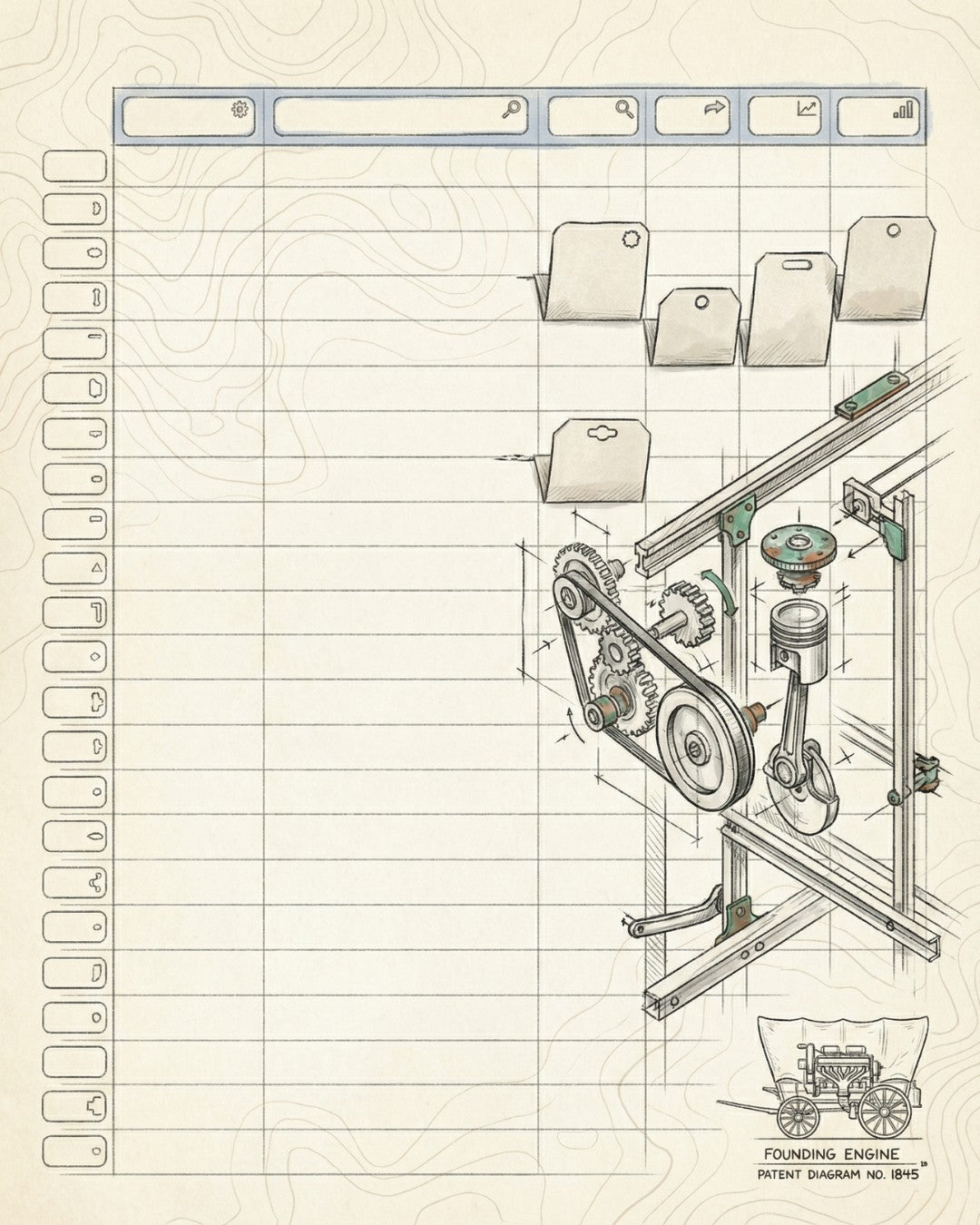
This isn’t a listicle. It’s the infrastructure-first approach to ecommerce category page SEO best practices that we install for brands generating $30M+ in organic revenue. The systems that compound. The architecture that holds.
01 / TL;DR Category pages drive 3-5x more traffic than product pages. Most brands waste this leverage with thin content and broken architecture.
02 / THE FIX Build category hierarchy like a pyramid: clear URL structure, proper canonicals, and crawl-friendly faceted navigation that doesn’t create indexation chaos.
03 / ON-PAGE Keyword-mapped title tags, unique H1s, category descriptions with information gain, and schema markup that feeds AI search engines and Google’s knowledge graph.
04 / INTERNAL LINKING Hub-and-spoke architecture distributes authority from homepage to categories, categories to products. Contextual links create topical clusters that compound rankings.
05 / PERFORMANCE Core Web Vitals matter. Lazy loading, image optimization, and mobile-first design turn category pages into ranking assets, not speed liabilities.
Table of Contents
- 1. The Category Page Hierarchy Problem
- 2. URL Structure and Crawlability
- 3. On-Page SEO Infrastructure for Category Pages
- 4. Schema Markup for Category Pages
- 5. Content Strategy: Beyond Thin Category Pages
- 6. Internal Linking Architecture
- 7. Technical Optimization: Speed, Core Web Vitals, and Mobile-First
- How to Build This: The Implementation Sequence
- Frequently Asked Questions
The Category Page Hierarchy Problem
Your site architecture is either a force multiplier or a bottleneck. There’s no middle ground.
Here’s what breaks at scale: Flat hierarchies where every category sits at the same crawl depth. Orphaned categories with no internal links. Subcategories buried five clicks from the homepage. Product pages that don’t link back to their parent categories.
Google’s crawl budget is finite. If your architecture doesn’t guide crawlers efficiently from homepage → category → subcategory → product, you’re burning budget on low-value pages while high-value category pages get ignored.
The Pyramid Principle: Your homepage is the apex. Top-level categories are the second layer (1 click away). Subcategories are the third layer (2 clicks). Products are the base (3 clicks maximum). This isn’t just UX—it’s crawl efficiency and authority distribution in one architecture.
When we run an ecommerce SEO audit, the first thing we check is crawl depth distribution. If your best-converting category is 4+ clicks from the homepage, you’ve got a structural problem that no amount of content will fix.
The Indexation Chaos You’re Creating
Most ecommerce platforms generate category variations automatically: sorted by price, filtered by color, paginated results. Without proper canonicalization, you’re asking Google to index hundreds of near-duplicate pages.
Example: A “Men’s Running Shoes” category with size filters, color filters, and price sorting can generate 50+ URL variations. If you’re not using canonical tags to point them all back to the main category URL, you’re diluting authority across dozens of pages competing against themselves.
This is why technical SEO for ecommerce starts with architecture, not content. Fix the foundation first.

URL Structure and Crawlability
URLs are not cosmetic. They’re signals—to crawlers, to users, to AI search engines parsing your site structure.
The URL Pattern That Scales
Use this structure:
- yourstore.com/category-name/ for top-level categories
- yourstore.com/category-name/subcategory-name/ for subcategories
- yourstore.com/category-name/subcategory-name/product-name/ for products
Avoid:
- Dates in URLs (this isn’t a blog)
- Product IDs or SKU numbers (not human-readable, not keyword-rich)
- Unnecessary subdirectories like /shop/ or /products/ that add crawl depth without value
- Parameters in the main URL structure (use canonicals to manage filters)
Your URL should describe the page’s position in your site hierarchy at a glance. That’s crawlability. That’s also how breadcrumb schema gets generated automatically.
Canonical Tags for Faceted Navigation
Faceted navigation (filters, sorting, pagination) is a UX win and an SEO minefield. Here’s the canonical strategy:
Scenario Canonical Strategy Why
Filtered category (e.g., ?color=blue) Canonical to main category URL Consolidates authority, prevents duplicate content
Sorted category (e.g., ?sort=price-low-high) Canonical to main category URL Same products, different order—not unique content
Paginated results (page 2, 3, etc.) Self-referencing canonical OR rel=“prev/next” (deprecated but still useful) Each page has unique products—let Google index them
High-value filter combo (e.g., “Blue Running Shoes”) Create a dedicated subcategory with unique URL If it has search volume, make it a real category
The rule: If a filtered URL doesn’t have unique content and search intent, canonical it. If it does, promote it to a real subcategory with its own on-page SEO.
Robots.txt and XML Sitemaps
Your robots.txt should block crawlers from accessing parameter-heavy URLs while your XML sitemap should include only your canonical category URLs. This creates a clean crawl path.
In your sitemap:
- Include all main category and subcategory pages
- Exclude filtered/sorted variations
- Set priority values: Homepage (1.0), Top categories (0.8), Subcategories (0.6), Products (0.4)
- Update weekly if you’re adding categories frequently
This is part of the SEO infrastructure we install before touching content. Foundation first.
On-Page SEO Infrastructure for Category Pages
On-page SEO for category pages isn’t about keyword stuffing. It’s about clarity—for users, for crawlers, for AI systems parsing your content for entity signals.
Title Tags and H1 Strategy
Your title tag and H1 should be similar but not identical. Here’s the pattern:
Title Tag: [Primary Keyword] | [Brand Name]** Example: Men’s Running Shoes | YourBrand
H1:** [Primary Keyword + Modifier]** Example: Men’s Running Shoes – Performance & Comfort
The title tag is for search results (keep it under 60 characters). The H1 is for the page itself (you have more room to add context).
Avoid:
- Generic H1s like “Products” or “Shop Now”
- Keyword-stuffed titles like “Men’s Running Shoes | Best Running Shoes for Men | Buy Running Shoes”
- Duplicate title tags across multiple categories
Category Descriptions: Information Gain, Not Fluff
Most category descriptions are 50 words of SEO theater: “Welcome to our [category] page where you’ll find the best [category] products…”
That’s not content. That’s filler.
Here’s the information gain approach:
- Lead with utility:** Answer the question “What makes this category different?” in the first 2 sentences.
- Add buying guidance: Help users choose between subcategories or product types.
- Include keyword variations naturally: Don’t force it—use related terms that add context.
- Keep it scannable: Use short paragraphs, bullet points, and subheadings.
Target 150-300 words for top-level categories, 100-200 for subcategories. Quality over quantity. If you can’t add value, don’t add words.
Pro Tip: Place category descriptions above the fold on desktop, below the product grid on mobile. This balances SEO with UX—crawlers see the content early in the HTML, but mobile users aren’t forced to scroll through text to see products.
Image Optimization for Category Pages
Category page images (banners, featured products, lifestyle shots) are often the largest assets on the page. Optimize them:
- File format: WebP for modern browsers, with JPEG fallback
- Compression: Aim for { “@context”: “https://schema.org”, “@type”: “BreadcrumbList”, “itemListElement”: [ { “@type”: “ListItem”, “position”: 1, “name”: “Home”, “item”: “https://yourstore.com” }, { “@type”: “ListItem”, “position”: 2, “name”: “Men’s Shoes”, “item”: “https://yourstore.com/mens-shoes/” }, { “@type”: “ListItem”, “position”: 3, “name”: “Running Shoes” } ] }
2. Product Schema (for products on the page)
Even though you’re on a category page, the products displayed should have Product schema. This enables rich results in Google Shopping and organic search.
Key fields:
- name: Product name
- image: Product image URL
- description: Brief product description
- offers: Price, availability, currency
- aggregateRating: Average rating and review count (if applicable)
- brand: Your brand name
This is part of our AI search optimization process. Structured data isn’t just for Google—it’s how LLMs extract facts to answer queries in AI Overviews, Perplexity, and ChatGPT.
Testing Schema Markup
Use Google’s Rich Results Test (search.google.com/test/rich-results) to validate your schema. Common errors:
- Missing required fields (especially in Product schema)
- Invalid URLs (must be absolute, not relative)
- Mismatched data (e.g., price in schema doesn’t match visible price)
- Trailing commas in JSON-LD (breaks parsing)
Fix these before launch. Schema errors don’t just prevent rich results—they signal sloppiness to Google’s quality algorithms.
Content Strategy: Beyond Thin Category Pages
The tension: Category pages need to be product-focused (UX priority) but content-rich enough to rank (SEO priority). Most brands choose one or the other. You need both.
The Hybrid Model
Here’s the structure we use:
- Above the fold: H1, brief intro (1-2 sentences), product grid
- Mid-page: Filters, sorting, pagination controls
- Below the product grid: Expanded category description (150-300 words), buying guides, related categories
- Footer area: FAQ accordion (if relevant), trust signals, related blog content
This keeps UX clean while giving crawlers the content depth they need to understand topical relevance.
When to Add Buying Guides
If your category has high consideration (e.g., “Best Running Shoes for Flat Feet”), add a buying guide section:
- What to look for (features, materials, fit)
- How to choose between subcategories
- Common questions (link to FAQ)
This isn’t blog content—it’s decision support. It belongs on the category page because it directly influences purchase intent.
For lower-consideration categories (e.g., “White T-Shirts”), keep it minimal. Don’t add content for content’s sake.
The Information Gain Test: Before adding a content block, ask: “Does this help a user make a decision, or am I just adding words for SEO?” If it’s the latter, delete it. Google’s Helpful Content system penalizes filler.
Related Categories and Cross-Linking
At the bottom of each category page, include a “Related Categories” or “You May Also Like” section that links to:
- Sibling categories (same level in hierarchy)
- Subcategories (one level deeper)
- Complementary categories (e.g., “Running Shoes” → “Running Socks”)
This creates lateral internal linking that distributes authority and helps users discover adjacent product lines. It’s UX and SEO in one module.
Internal Linking Architecture
Internal linking is how authority flows through your site. Get this wrong and your best category pages will never rank—no matter how good the content is.
The Hub-and-Spoke Model
Your homepage is the hub. Category pages are the primary spokes. Subcategories and products are secondary spokes.
Link flow:
- Homepage → Top Categories: Main navigation, featured categories, promotional banners
- Categories → Subcategories: In-page links, filters that become subcategories, related category modules
- Products → Categories: Breadcrumbs, “Back to [Category]” links, related products from the same category
- Blog → Categories: Contextual links from how-to content to relevant product categories
The goal: Every category page should be no more than 2 clicks from the homepage, and it should receive internal links from multiple sources (navigation, related categories, product pages, blog content).
Anchor Text Strategy
Use descriptive, keyword-rich anchor text for internal links to category pages:
- Good: “Shop men’s running shoes”
- Better: “Browse our collection of men’s running shoes”
- Bad: “Click here” or “Learn more”
Vary your anchor text slightly to avoid over-optimization, but keep it relevant. Google uses anchor text to understand what the linked page is about.
Authority Distribution
Not all category pages are created equal. Some have higher commercial intent, higher search volume, or better conversion rates. Prioritize these in your internal linking:
- Link to high-priority categories from the homepage (navigation + featured sections)
- Link to them from high-authority blog posts
- Use them as the “parent category” in breadcrumbs for related subcategories
This is how you signal to Google: “This category page matters. Rank it.”
For a deeper dive, see our guide on ecommerce SEO best practices that covers internal linking at scale.
Technical Optimization: Speed, Core Web Vitals, and Mobile-First
Category pages are often the slowest pages on ecommerce sites. Product grids, filters, high-res images, JavaScript-heavy frameworks—it all adds up.
And Google’s Core Web Vitals are a confirmed ranking factor. Slow category pages don’t just hurt UX—they hurt rankings.
Core Web Vitals for Category Pages
Focus on three metrics:
- Largest Contentful Paint (LCP): The time it takes for the largest visible element (usually the hero image or product grid) to load. Target:
The 30-Day Cycle: This isn’t a one-time project. It’s a system. We run 30-day focused cycles—audit, build, deploy, measure. Then repeat. That’s how SEO compounds. Not retainers. Not endless optimization. Focused sprints with measurable outcomes.
For a complete breakdown of this approach, see our ecommerce SEO checklist and case study showing how we applied this to a $5M DTC brand.
Frequently Asked Questions
How many category pages should an ecommerce store have? There’s no magic number. Focus on creating categories that map to actual search intent and have commercial value. A store with 500 products might have 20-30 well-structured categories. A store with 10,000 products might have 100+. The key: every category should target a specific keyword with search volume and represent a distinct product grouping. Avoid creating categories just to create categories—that dilutes authority and confuses users.
Should I use pagination or infinite scroll for category pages? Pagination is more SEO-friendly. Infinite scroll can work if implemented with proper URL parameters and pushState to create crawlable URLs for each “page” of products, but it’s technically complex. Pagination gives you discrete URLs that can be indexed, linked to, and optimized individually. Use rel=“prev” and rel=“next” tags (though deprecated, still useful for context) or self-referencing canonicals on paginated pages.
How do I handle out-of-stock products on category pages? Keep them visible but marked as “Out of Stock” with updated Product schema (set availability to “OutOfStock”). This maintains the category page’s content depth and lets users sign up for restock notifications. Removing out-of-stock products entirely can create thin category pages and hurt rankings. Exception: If a product is permanently discontinued, remove it and 301 redirect to a similar product or the parent category.
What’s the ideal product count per category page? 12-48 products per page is the sweet spot for most stores. Too few ( 60) and load times suffer, especially on mobile. Use pagination to break up larger categories. Test what works for your audience—fashion brands often show more products per page, while high-consideration categories (electronics, furniture) perform better with fewer, more detailed listings.
Should category descriptions be above or below the product grid? Above the product grid in the HTML source code (for crawlers), but you can use CSS to position it below the grid visually on mobile (for UX). This gives crawlers early access to the content while keeping mobile users focused on products. On desktop, placing a brief intro above the grid and expanded content below works well. Test both and measure engagement metrics.
How do I optimize category pages for AI search engines like ChatGPT and Perplexity? Use structured data (Product schema, BreadcrumbList schema) to make your content machine-readable. Write clear, factual category descriptions that answer “what is this category” in the first sentence. Include entity signals (brand names, product types, materials, use cases) that LLMs can extract. Add FAQ sections that directly answer common questions. AI search engines prioritize content that’s easy to parse and cite—schema markup and clear information architecture are your leverage points. Learn more about our AI search optimization process.
What’s the difference between a category page and a collection page? Terminology varies by platform (Shopify calls them “collections,” others call them “categories”), but functionally they’re the same: pages that group related products. From an SEO perspective, treat them identically—same URL structure, same on-page optimization, same schema markup. The key is consistency: pick one term and use it across your site architecture, internal linking, and schema markup.
How often should I update category page content? Update category descriptions when you add new subcategories, change product offerings significantly, or target new keywords. Otherwise, leave them stable—Google values content consistency. Update schema markup whenever product details change (price, availability, ratings). Refresh images seasonally if relevant (e.g., winter gear vs. summer gear). The goal isn’t constant change—it’s keeping the page accurate and aligned with current inventory and search intent.
Build Category Pages That Rank and Convert
Category pages are infrastructure, not content projects. They require technical precision, strategic architecture, and performance optimization that compounds over time.
We’ve built this system for 50+ ecommerce brands generating $30M+ in organic revenue. No retainers. No fluff. 30-day focused cycles.
Matt Hyder
SEO infrastructure and AI search optimization at Founding Engine.
Want SEO that actually holds?
Get a free infrastructure audit from the Founding Engine team.
Get Your Free Audit