Ecommerce SEM SEO Consultant: Systems That Scale Revenue
Why hiring an ecommerce SEM SEO consultant isn't about retainers—it's about installing infrastructure. The systems-first approach to organic growth that compounds.
**

TL;DR — Founder Takeaways
The Problem
Most ecommerce SEO consultants bill hours, not outcomes. You get reports and recommendations—not installed systems that compound. The retainer model keeps you dependent.
The Shift
Infrastructure-first consulting means building the 4-Layer SEO Foundation: crawlability, indexability, rankability, convertibility. Systems that hold under scale, not monthly to-do lists.
The Model
30-day sprint cycles replace retainers. Audit-to-Throttle Pipeline: diagnose, build foundation, install content architecture, activate distribution. Then you own it.
AI Search Layer
Modern ecommerce SEM SEO includes AI Overview optimization, entity signals, structured data for LLMs. ChatGPT and Perplexity are discovery engines—your consultant should architect for them.
The Outcome
Compound visibility: 250% average organic traffic increase, $30M+ revenue generated across 50+ brands. Not from content volume—from infrastructure that makes rankings inevitable.
The Retainer Problem: Why Most Ecommerce SEO Consulting Fails
You’ve been here: three months into a $5,000/month retainer, and you have a Notion board full of recommendations. Your consultant sends monthly reports with charts trending up (or sideways). You’re told “SEO takes time.” The work feels like it’s happening, but nothing’s actually installed.
Here’s what most ecommerce SEM SEO consultants won’t tell you: the retainer model keeps you dependent by design**. Monthly recurring revenue means delivering just enough value to keep the contract, but never building the infrastructure that would let you own the channel.
The traditional agency playbook looks like this:
- Month 1: Audit and strategy deck (you pay for diagnosis)
- Month 2-3: Content briefs and keyword research (you pay for planning)
- Month 4-6: On-page optimization and link outreach (you pay for execution)
- Month 7+: “Ongoing optimization” and reporting (you pay for monitoring)
What you don’t get: a technical foundation that holds. A content architecture that scales. An internal linking system that distributes authority. A measurement framework that tells you when to throttle spend.
The gap isn’t effort—it’s infrastructure thinking. Most consultants optimize pages. The ones who move the needle build systems. There’s a reason our average client sees 250% organic traffic growth—we install the foundation first, then everything compounds.
Builder’s Note: If your consultant can’t draw you a systems diagram of how crawlability, indexability, rankability, and convertibility connect—you’re paying for tasks, not architecture. Ask them to map your SEO infrastructure before signing anything.

What an Ecommerce SEM SEO Consultant Actually Builds
Let’s reframe the question. You’re not hiring someone to “do SEO.” You’re hiring someone to engineer the infrastructure that makes organic revenue inevitable.
That means building the 4-Layer SEO Foundation—a sequential system where each layer enables the next:
Layer 1: Crawlability
Before Google can rank you, it has to find you. This layer is pure technical architecture:
- Robots.txt configuration: Unblock critical paths, block noise (filters, search results, duplicate parameters)
- XML sitemap optimization: Prioritize product and category pages, exclude low-value URLs, set proper change frequencies
- Site speed and Core Web Vitals: LCP under 2.5s, FID under 100ms, CLS under 0.1—non-negotiable for ecommerce at scale
- JavaScript rendering: If you’re on a headless platform, ensure Googlebot can execute your JS and see your content
Most ecommerce SEO audits find the same crawl budget killers: faceted navigation creating infinite URL variations, orphaned products with no internal links, server response times over 600ms. Fix these first or everything else is theater.
Layer 2: Indexability
Crawlable doesn’t mean indexable. This layer controls what Google stores in its index:
- Canonical tag strategy: Consolidate duplicate product pages (color/size variants), handle HTTP vs. HTTPS, manage www vs. non-www
- Meta robots directives: Strategic noindex on low-value pages (cart, checkout, account), index on revenue-driving pages
- Content uniqueness: Manufacturer descriptions kill indexation—rewrite product copy or use schema to differentiate
- Pagination and infinite scroll: Implement rel=“next/prev” or use load-more patterns that don’t break crawling
The test: run a site:yourdomain.com search. If Google has indexed 10,000 pages but you only have 500 products, you have an indexation bloat problem. If Google shows 100 pages but you have 5,000 products, you have an indexation suppression problem. Both kill rankings.
Layer 3: Rankability
Now we’re into on-page SEO for ecommerce and content architecture:
- Keyword mapping: One primary keyword per page, semantic clusters for supporting terms, search intent alignment (commercial vs. informational)
- Internal linking architecture: Hub-and-spoke model for category → product flow, contextual links from blog to products, authority distribution via strategic anchor text
- Schema markup: Product schema with price, availability, reviews; BreadcrumbList for navigation; Organization and LocalBusiness for entity signals
- Content depth: Not word count—information gain. Answer the query better than position 1-3 or don’t publish
This is where technical SEO for ecommerce meets content strategy. Your consultant should be mapping your product taxonomy to keyword clusters, not just optimizing title tags.
Layer 4: Convertibility
Organic traffic without conversion is just an expensive vanity metric. This layer connects SEO to revenue:
- Landing page optimization: CTA placement, trust signals (reviews, badges, guarantees), mobile UX that doesn’t tank on 5G
- Conversion funnel mapping: Track assisted conversions from organic—most ecommerce has 3-7 day consideration cycles
- Email capture infrastructure: Exit intent, scroll-triggered, time-delayed popups with keyword-specific offers
- Measurement framework: GSC → GA4 → revenue attribution, cohort analysis by landing page, LTV by organic channel
The best ecommerce SEO services don’t stop at rankings. They engineer the full funnel from SERP to checkout. That’s the difference between an SEO consultant and an SEO architect.
Systems Check: Can your consultant explain how fixing your site speed (Layer 1) enables better indexation (Layer 2), which improves rankability (Layer 3), which increases conversion rates (Layer 4)? If they’re optimizing layers in isolation, you’re not building infrastructure—you’re patching holes.
The Compound Visibility Stack for Ecommerce
The 4-Layer Foundation is what you build. The Compound Visibility Stack (CVS) is how you scale it. This is the framework we use at Founding Engine to engineer organic growth that doesn’t plateau at 6 months.
Think of CVS as a flywheel with four components—each one amplifies the others:
Stack Layer 1: Website Foundation
Your platform, hosting, and technical architecture. This is the bedrock:
- Platform choice: Shopify for speed-to-market, headless (Astro, Next.js) for custom architecture, avoid WordPress + WooCommerce unless you have dedicated dev resources
- Hosting performance: CDN (Cloudflare, Fastly), image optimization (WebP, lazy loading), server response time under 200ms
- Mobile-first design: 70%+ of ecommerce traffic is mobile—if your CLS is above 0.1 on mobile, you’re bleeding revenue
We build every site on performance-first platforms because technical debt compounds negatively. A slow site in month 1 is a disaster in month 12 when you’re at 10x traffic.
Stack Layer 2: Content Architecture
Not blog posts—structured content systems:
- Product page templates: Keyword-optimized H1/title patterns, schema-ready markup, internal link modules
- Category page strategy: SEO-rich category descriptions (300-500 words above the fold), faceted navigation that doesn’t create indexation chaos
- Content hub model: Educational content (guides, comparisons) that ranks for top-of-funnel keywords and links to product pages
- User-generated content: Reviews, Q&A, community content—Google rewards fresh, authentic signals
Your ecommerce SEO strategy should map content types to buyer journey stages. Awareness → Consideration → Decision. Most brands only optimize for decision-stage keywords and wonder why growth plateaus.
Stack Layer 3: Technical Distribution
This is where SEM meets SEO. Distribution isn’t just backlinks—it’s visibility infrastructure:
- Google Merchant Center: Product feed optimization, shopping ads that feed organic visibility signals
- Google Search Console: Performance monitoring, index coverage tracking, Core Web Vitals diagnostics
- Structured data: Product, Review, BreadcrumbList, Organization—feed the knowledge graph
- Email + SMS: Owned channels that drive repeat traffic signals (Google rewards returning visitors)
The SEM + SEO integration point: paid search data tells you which keywords convert. Use that to prioritize organic content. Run shopping ads to test product positioning, then optimize organic product pages based on CTR data.
Stack Layer 4: AI Search Optimization
The newest layer—and the most misunderstood. AI search optimization isn’t about keyword density. It’s about entity recognition and knowledge graph signals:
- AI Overview citations: Structured answers that LLMs can parse and cite (think FAQ schema, HowTo schema, Q&A content)
- Entity markup: Use schema.org types to define your brand, products, and relationships—help AI understand context
- Conversational content: Write for voice search and chat interfaces—natural language, question-answer format
- Perplexity & ChatGPT visibility: These tools scrape structured data—if you’re not marked up, you’re invisible
We’re seeing AI search traffic grow 40% quarter-over-quarter for brands that install proper entity signals. This isn’t future-proofing—it’s present-day revenue.
Stack Test: Score your current setup. Website foundation (0-10), Content architecture (0-10), Technical distribution (0-10), AI search optimization (0-10). If any layer scores below 6, that’s your bottleneck. Fix it before scaling the others.

When to Hire vs. When to Build In-House
Not every brand needs an ecommerce SEM SEO consultant. Some need a fractional hire. Some need a full-time team. Here’s the decision matrix we use with founders:
Revenue Stage Team Capacity Recommended Model Why
$0-$100K Solo founder or 1-2 person team DIY + audit checklist Install the foundation yourself. Use tools (Screaming Frog, GSC) and checklists. Hire for execution when you hit $100K.
$100K-$500K Small team, no dedicated SEO Sprint-based consultant (30-60 day cycles) You need infrastructure installed, not ongoing retainers. 30-day sprint model builds the foundation, then you own it.
$500K-$2M Marketing lead + 1-2 execution roles Fractional SEO director + consultant You need strategy + execution. Fractional director sets roadmap, consultant installs systems, your team maintains.
$2M-$5M Marketing team of 3-5 In-house SEO manager + agency for technical Hire full-time for content and optimization. Partner with agency for advanced technical SEO and infrastructure builds.
$5M+ Mature marketing team Full in-house SEO team (2-4 people) Own the channel. Hire strategist, technical SEO, content lead. Use agencies for specialized projects (migrations, AI search).
The Hybrid Model That Works
Most brands in the $500K-$5M range benefit from a hybrid approach:
- Consultant installs infrastructure (technical foundation, content architecture, measurement framework) in 30-60 day sprints
- In-house team executes (content production, on-page optimization, performance monitoring)
- Consultant provides quarterly audits (technical health checks, algorithm update responses, new opportunity identification)
This model gives you ownership without overhead. You’re not paying $10K/month for someone to write meta descriptions. You’re paying for architecture, then running it yourself.
Our ecommerce SEO pricing reflects this: fixed-scope projects, not open-ended retainers. We build the system, train your team, then step back. You own the asset.
Decision Framework: If you have technical debt (site speed issues, indexation problems, broken architecture), hire a consultant to fix the foundation. If you have a solid technical base but need content velocity, hire in-house. Don’t hire for execution when you need infrastructure—it’s like hiring a painter when your foundation is cracked.
The Sprint Model: 30-Day SEO Infrastructure Cycles
Here’s what we learned after working with 50+ ecommerce brands: retainers create dependency, sprints create ownership.
The sprint model is simple: fixed scope, fixed timeline, fixed deliverable. 30 days to install one layer of infrastructure. Then you own it. Then we move to the next sprint—or you run it yourself.
The Audit-to-Throttle Pipeline
This is the build sequence we use at Founding Engine. It’s sequential because each sprint unlocks the next:
Sprint 1: Technical Foundation Audit (Days 1-30)
- Deliverable: Technical SEO audit with prioritized fix list
- What we build: Crawlability and indexability baseline—robots.txt, sitemap, canonical strategy, Core Web Vitals report
- Outcome: You know exactly what’s broken and what to fix first
- Cost range: $3K-$8K depending on site size
Sprint 2: Foundation Build (Days 31-60)
- Deliverable: Implemented technical fixes + content architecture blueprint
- What we build: Fix critical crawl/index issues, install schema markup, set up GSC/GA4 tracking, map keyword clusters to site architecture
- Outcome: Your site is crawlable, indexable, and ready for content
- Cost range: $5K-$12K depending on complexity
Sprint 3: Content Infrastructure (Days 61-90)
- Deliverable: Optimized product/category templates + internal linking system
- What we build: SEO-ready product page templates, category page optimization, hub content strategy, internal link architecture
- Outcome: Your content system is installed—now you can scale production
- Cost range: $6K-$15K depending on catalog size
Sprint 4: Distribution Activation (Days 91-120)
- Deliverable: AI search optimization + measurement dashboard
- What we build: Entity markup, AI Overview optimization, structured data for LLMs, performance tracking dashboard
- Outcome: You’re visible in AI search, and you have a system to measure compound growth
- Cost range: $5K-$10K
Why Sprints Beat Retainers for Lean Teams
The math is simple:
- Retainer model: $5K/month × 12 months = $60K for ongoing optimization (you never own the system)
- Sprint model: $20K-$40K total for 4 sprints (you own the infrastructure, run it forever)
After sprint 4, you have a choice: run it in-house, or do quarterly maintenance sprints ($3K-$5K each). Either way, you’re not locked into a $60K/year dependency.
This is the model behind our 250% average organic traffic growth. We install systems that compound, not deliverables that expire.
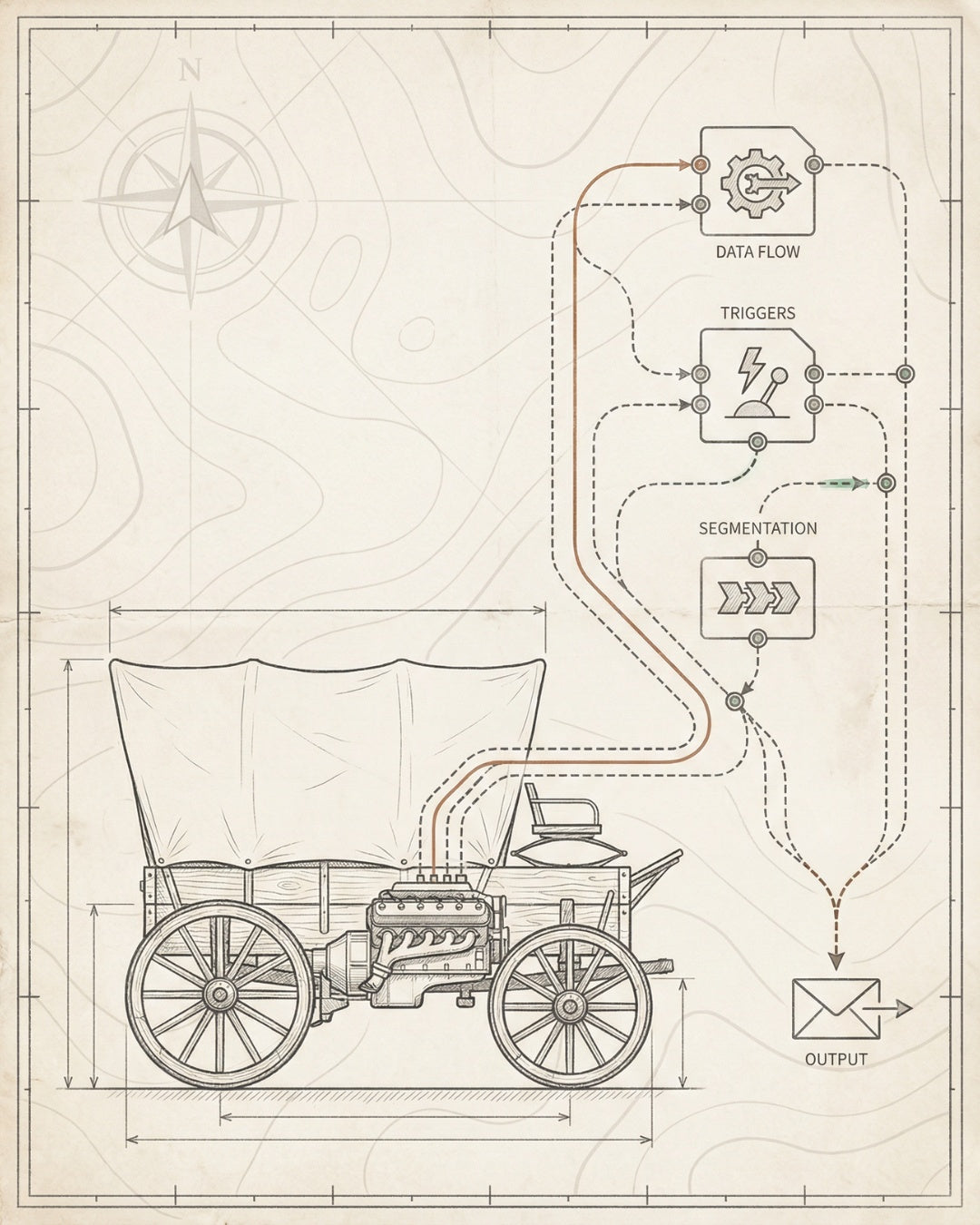
AI Search Optimization for Ecommerce
If your ecommerce SEM SEO consultant isn’t talking about AI search, they’re optimizing for 2019. Here’s what changed:
Google’s AI Overviews now appear on 15-20% of commercial queries. ChatGPT has 100M+ weekly active users asking shopping questions. Perplexity is becoming the research engine for high-intent buyers. If you’re not architected for AI discovery, you’re invisible to a growing percentage of your market.
The AI Search Opportunity for Ecommerce
Traditional SEO optimizes for the 10 blue links. AI search optimizes for citation and synthesis. When a user asks ChatGPT “best running shoes for flat feet,” the AI doesn’t show a SERP—it synthesizes an answer and cites sources.
Your goal: be the cited source.
How to Architect for AI Search
1. Entity Markup and Knowledge Graph Signals
AI models understand entities, not just keywords. Use schema.org markup to define:
- Your brand: Organization schema with logo, social profiles, contact info
- Your products: Product schema with detailed attributes (color, size, material, use case)
- Your relationships: Brand → Product → Category → Review hierarchy
Example: Instead of just saying “running shoes,” mark up the product with category: “Athletic Footwear”, sport: “Running”, terrain: “Road”. AI models use these signals to match queries to products.
2. Structured Answers for AI Overview Citations
AI Overviews pull from content that’s formatted for synthesis:
- FAQ schema: Question-answer pairs that AI can extract and cite
- HowTo schema: Step-by-step guides that AI can summarize
- List-based content: “Top 5,” “Best for,” “Comparison” formats that AI can parse
Write like you’re feeding a knowledge base, not a blog. Clear, structured, citation-ready.
3. Conversational Content for Voice and Chat
AI search queries are longer and more natural than traditional search:
- Traditional: “running shoes flat feet”
- AI search: “What are the best running shoes for someone with flat feet who runs on pavement?”
Optimize for natural language. Use question-based H2s. Write in second person. Structure content as if you’re answering a founder’s Slack DM.
4. Perplexity and ChatGPT Visibility
These platforms scrape the web and synthesize answers. To show up:
- High authority: Backlinks still matter—AI models weight authoritative sources higher
- Structured data: Schema markup helps AI parse your content correctly
- Freshness: Recently updated content gets prioritized in AI citations
- Depth: Comprehensive answers (1,500+ words with examples) beat thin content
We’re tracking AI search visibility as a core metric now. Brands with proper entity markup and structured content are seeing 30-40% of their organic traffic come from AI-assisted search.
AI Search Audit: Ask your consultant: “How are you optimizing for AI Overview citations?” If they say “write better content,” they don’t understand the technical layer. If they talk about entity markup, structured data, and knowledge graph signals—they’re building for the next 5 years, not the last 5.
Implementation Blueprint: Installing Your SEO System
You’ve read the strategy. Now here’s the build sequence—the exact steps to install ecommerce SEO infrastructure that compounds. This is the blueprint we hand to clients after sprint 1.
Phase 1: Audit Current State (Week 1)
Technical Audit
Tools: Screaming Frog, Google Search Console, PageSpeed Insights
- Run a full-site crawl—identify crawl errors, broken links, redirect chains, orphaned pages
- Check robots.txt and XML sitemap—ensure critical pages are crawlable and included
- Audit Core Web Vitals—LCP, FID, CLS scores for top 20 landing pages
- Review indexation status in GSC—compare indexed pages vs. submitted pages, identify suppression issues
Content Audit
Tools: Ahrefs, SEMrush, Google Analytics
- Map current keyword rankings—identify pages ranking 5-15 (quick win opportunities)
- Analyze top landing pages—CTR, bounce rate, conversion rate by page type
- Identify content gaps—keywords competitors rank for that you don’t
- Review internal linking—find high-authority pages with no outbound links (wasted authority)
Deliverable
Prioritized fix list with impact scores (High/Medium/Low) and effort estimates. Start with high-impact, low-effort wins.
Phase 2: Fix the Foundation (Weeks 2-4)
Technical Fixes
- Crawlability: Fix robots.txt blocks, optimize sitemap (remove low-value URLs, add priority tags), resolve server errors (5xx codes)
- Indexability: Implement canonical tags on duplicate pages, add noindex to low-value pages (filters, search results), fix meta robots conflicts
- Site speed: Compress images (WebP format), enable lazy loading, minify CSS/JS, implement CDN if not already active
- Mobile optimization: Fix CLS issues (set explicit width/height on images), improve tap target sizing, test checkout flow on mobile
Schema Implementation
- Install Product schema on all product pages (price, availability, SKU, reviews)
- Add BreadcrumbList schema for navigation hierarchy
- Implement Organization schema on homepage (logo, social profiles, contact info)
- Add Review/AggregateRating schema where applicable
Validate all schema with Google’s Rich Results Test. Fix errors before moving forward.
Phase 3: Build Content Infrastructure (Weeks 5-8)
Keyword Mapping
- Map primary keywords to product/category pages (1 keyword per page)
- Identify semantic clusters—group related keywords under pillar pages
- Create content hub structure—educational content that links to product pages
On-Page Optimization
- Product pages: Optimize title tags (keyword + benefit + brand), write unique descriptions (300+ words), add keyword-rich H1/H2 structure
- Category pages: Add SEO-rich descriptions above product grid (400-600 words), optimize faceted navigation (use canonical or noindex for filter combinations)
- Blog/content hub: Write pillar content for top-of-funnel keywords, include internal links to product pages, optimize for featured snippets
Internal Linking System
- Build hub-and-spoke architecture—category pages link to products, products link to related products
- Add contextual links from blog content to product pages (use descriptive anchor text)
- Create automated related product modules (based on tags or categories)
- Fix orphaned pages—ensure every page has at least 3 internal links pointing to it
Reference our ecommerce SEO best practices guide for detailed templates.
Phase 4: Install Distribution (Weeks 9-12)
Google Search Console Setup
- Verify property and submit sitemap
- Set up email alerts for critical issues (crawl errors, security issues, manual actions)
- Configure URL inspection for key pages—monitor indexation status
AI Search Optimization
- Add entity markup (Organization, Product, Brand schemas)
- Create FAQ content with FAQ schema (target “People Also Ask” queries)
- Write conversational content for voice search (question-based H2s, natural language)
- Optimize for AI Overview citations (structured answers, list-based content)
Performance Tracking
- Set up GA4 custom events—track organic landing page conversions, scroll depth, engagement time
- Create ranking tracking dashboard—monitor keyword positions weekly
- Build organic revenue attribution model—track assisted conversions, multi-touch attribution
- Set throttle benchmarks—define when to scale content production (e.g., when organic traffic hits 10K/month)
Ongoing Maintenance (Monthly)
- Review GSC performance—identify new ranking opportunities (impressions but low CTR)
- Monitor Core Web Vitals—fix regressions before they impact rankings
- Update top-performing content—refresh stats, add new sections, improve depth
- Audit internal links—ensure new products are properly linked from category pages
This is the Audit-to-Throttle Pipeline in action. Install the system once, maintain it monthly, scale it as revenue grows.
Implementation Checklist: Download our complete ecommerce SEO checklist for a step-by-step task list. Use it to audit your current state or hand it to your consultant as a scope document.

FAQ: Hiring an Ecommerce SEM SEO Consultant
How much does an ecommerce SEM SEO consultant cost? +
Pricing varies by model. Traditional retainers run $3K-$15K/month with 6-12 month commitments. Sprint-based consulting (our model) runs $5K-$15K per 30-day cycle with no long-term contract. For a full infrastructure build (4 sprints), expect $20K-$50K total depending on site complexity and catalog size. The sprint model gives you ownership—you pay for the system, not ongoing hours. See our detailed pricing breakdown for scope examples.
What’s the difference between an SEO consultant and an SEO agency? +
Consultants typically work solo or with a small team, focus on strategy and architecture, and charge project-based or fractional fees. Agencies have larger teams, offer full-service execution (content, links, technical), and usually require retainers. For ecommerce brands under $5M revenue, a consultant or small agency (like Founding Engine) is more cost-effective—you get senior-level strategy without paying for account managers and junior execution staff. Above $5M, a full-service agency makes sense if you need content velocity and link building at scale.
How long does it take to see results from ecommerce SEO? +
Technical fixes (site speed, indexation issues) can show impact in 2-4 weeks. Content optimization and new pages take 8-12 weeks to rank (Google’s crawl and indexation cycle). Full infrastructure builds (our 4-sprint model) typically show measurable traffic growth by month 4-6, with compounding growth continuing for 12-24 months. The key variable: site authority. If you have existing domain authority and backlinks, results come faster. If you’re a new site, expect 6-12 months to build momentum. Our case studies show the typical growth curve.
Should I hire an ecommerce SEO consultant or build an in-house team? +
Depends on revenue and team capacity. Under $500K revenue: hire a consultant for infrastructure, run execution yourself. $500K-$2M: use a fractional SEO director + consultant for technical builds. $2M-$5M: hire an in-house SEO manager, partner with a consultant for advanced technical work. Above $5M: build a full in-house team (2-4 people) and use consultants for specialized projects (migrations, AI search, algorithm recovery). The hybrid model works best for most brands—consultant installs the system, in-house team maintains it. See our decision matrix above for details.
What should I look for when hiring an ecommerce SEM SEO consultant? +
Ask these questions: (1) Can you show me a systems diagram of how you build SEO infrastructure? (If they can’t draw the 4-Layer Foundation, they’re task-focused, not systems-focused.) (2) What’s your experience with my platform (Shopify, headless, etc.)? (3) How do you measure success beyond rankings? (Look for revenue attribution, conversion tracking, organic LTV.) (4) What’s your approach to AI search optimization? (If they’re not talking about entity markup and structured data, they’re behind.) (5) Can I see a case study with similar revenue/catalog size? Red flags: anyone promising “page 1 in 30 days,” anyone who won’t explain their technical process, anyone who only talks about content and links without mentioning crawlability or indexation.
What’s the ROI of hiring an ecommerce SEO consultant? +
For context: our average client sees 250% organic traffic growth and generates $30M+ in organic revenue across 50+ brands. Typical ROI timeline: invest $20K-$40K in infrastructure (4 sprints), see $5K-$10K/month in new organic revenue by month 6, break even by month 4-8, then compound from there. The key is compound growth—unlike paid ads, organic infrastructure keeps working without ongoing spend. A well-built SEO system installed in year 1 can generate 10x+ ROI over 3 years. Compare that to paid search (break-even to 2x ROI) or paid social (1.5-3x ROI). The math favors infrastructure over media spend for brands with 6+ month LTV cycles.
Do I need technical knowledge to work with an ecommerce SEO consultant? +
No, but it helps to be systems-literate—you should understand how your
Matt Hyder
SEO infrastructure and AI search optimization at Founding Engine.
Want SEO that actually holds?
Get a free infrastructure audit from the Founding Engine team.
Get Your Free Audit