Ecommerce SEO Guide: Build Infrastructure, Not Campaigns
A systems-first ecommerce SEO guide for founders. Learn the 4-layer foundation that drives rankings, revenue, and compound visibility—no retainers required.
SYSTEMS-FIRST SEO
Ecommerce SEO Guide: Build Infrastructure, Not Campaigns
Most ecommerce brands treat SEO like a marketing campaign. They hire an agency. They publish blog posts. They wait for rankings. And when traffic plateaus or Google updates hit, everything collapses.
The problem isn’t effort. It’s architecture.
This ecommerce SEO guide isn’t about tactics you execute once. It’s about the infrastructure you install once and scale forever. The kind of systems that survive algorithm updates, support AI search visibility, and compound revenue over time—not just traffic spikes.

01 / 05
Most ecommerce SEO fails because it’s built on campaigns, not infrastructure. Campaigns expire. Infrastructure compounds.
02 / 05
The 4-Layer Foundation: Crawlability → Indexability → Rankability → Convertibility. Miss one layer, the entire stack collapses.
03 / 05
Technical architecture beats content volume every time. A well-structured 50-page store outranks a messy 500-page store.
04 / 05
AI search requires structured data and entity signals, not just keywords. Google’s AI Overview pulls from markup, not meta descriptions.
05 / 05
Build once in 30-day sprints, scale forever—no retainers. Infrastructure doesn’t need monthly maintenance. It needs precision installation.
What’s Inside This Guide
- Why Most Ecommerce SEO Strategies Collapse Under Scale
- The 4-Layer SEO Foundation Every Store Needs First
- Technical Infrastructure: The Architecture That Holds
- Content Systems vs. Content Projects
- AI Search Optimization: Beyond Google
- The Audit-to-Throttle Pipeline: Implementation Framework
- Measuring What Compounds: Metrics That Matter
- Frequently Asked Questions
Why Most Ecommerce SEO Strategies Collapse Under Scale
You’ve seen this pattern. A brand launches. SEO starts working. Traffic grows. Then—somewhere between 100 and 500 products—everything slows down. Rankings stall. Indexation issues appear. Pages cannibalize each other. Core Web Vitals tank.
The diagnosis is always the same: the foundation wasn’t built to scale.
Most ecommerce SEO services treat symptoms, not systems. They optimize product pages one by one. They write blog posts without internal linking architecture. They add schema markup without fixing crawl budget. They chase rankings without understanding why Google can’t index half the site.
The reality: SEO that doesn’t account for site architecture, crawl efficiency, and structured data from day one will break when you hit 200+ SKUs, launch new collections, or expand to multiple product categories.
This isn’t a content problem. It’s an infrastructure problem. And infrastructure problems don’t get fixed with more blog posts.
The Three Failure Modes
1. Campaign-Based SEO: Agencies sell you monthly retainers to “do SEO.” They publish content. They build links. But they never install the technical foundation that makes rankings inevitable. When the retainer ends, so does the growth.
2. DIY Without Systems: Founders follow checklists. They optimize meta tags. They submit sitemaps. But without a systematic approach to technical SEO for ecommerce, they’re optimizing on top of broken architecture.
3. Content Without Structure: Brands publish 50 blog posts before fixing their product page templates. They chase long-tail keywords without building topical authority. They create content that Google can’t connect to products that convert.
All three approaches share the same flaw: they treat SEO as a series of tasks instead of a system you install once and compound forever.
The 4-Layer SEO Foundation Every Store Needs First
Before you write a single product description or publish a blog post, you need a foundation that holds. At Founding Engine, we call this the 4-Layer SEO Foundation. It’s the sequence that makes everything else work.

The 4-Layer SEO Foundation
Layer 1: Crawlability — Can Google’s bots access and navigate your site efficiently?
Layer 2: Indexability — Does Google understand which pages to index and which to ignore?
Layer 3: Rankability — Are your pages structured to compete for target keywords?
Layer 4: Convertibility — Do ranked pages drive revenue, not just traffic?
Miss one layer, and the entire stack collapses. You can’t rank pages Google can’t crawl. You can’t convert traffic from pages that don’t match search intent. And you can’t scale SEO on a foundation that wasn’t designed for growth.
Layer 1: Crawlability
Crawlability is about efficiency. Google allocates a crawl budget to your site—how many pages it will crawl per day. If your site wastes crawl budget on duplicate URLs, broken links, or irrelevant pages, Google won’t discover your best content.
What breaks crawlability:
- Poorly configured robots.txt files that block important pages
- Infinite scroll or JavaScript-rendered content without fallbacks
- Broken internal links and orphaned pages
- Slow server response times (TTFB > 600ms)
- Redirect chains and 404 errors
How to fix it: Audit your site architecture. Ensure every important page is linked from your homepage within 3 clicks. Clean up your robots.txt. Fix broken links. Optimize server response time. Use XML sitemaps to guide Google to priority pages.
Layer 2: Indexability
Indexability is about control. Just because Google can crawl a page doesn’t mean it should index it. Ecommerce sites generate thousands of URLs—filtered product pages, sort variations, paginated collections. Most of them shouldn’t be indexed.
What breaks indexability:
- Duplicate content across product variants and filtered URLs
- Missing or incorrect canonical tags
- Thin content on category or collection pages
- No noindex tags on utility pages (cart, checkout, account)
- Parameter handling issues in Google Search Console
How to fix it: Implement canonical tags on every product and collection page. Use noindex on filtered, sorted, and paginated URLs. Consolidate duplicate content. Check Google Search Console for indexation errors and fix them systematically.
Layer 3: Rankability
Rankability is about structure. Once Google can crawl and index your pages, it needs to understand what they’re about and why they should rank. This is where on-page SEO for ecommerce and structured data come in.
What breaks rankability:
- Generic product titles and descriptions
- Missing or poorly implemented schema markup
- Weak internal linking between related products and categories
- No topical authority (isolated product pages with no supporting content)
- Slow page speed and poor Core Web Vitals
How to fix it: Optimize ecommerce product pages with keyword-rich titles, unique descriptions, and structured data (Product, Review, BreadcrumbList schema). Build internal linking systems that connect products to collections and blog content. Improve Core Web Vitals—LCP under 2.5s, CLS under 0.1, INP under 200ms.
Layer 4: Convertibility
Convertibility is about revenue. Traffic doesn’t matter if it doesn’t convert. Your SEO strategy needs to prioritize pages that drive sales, not just impressions.
What breaks convertibility:
- Ranking for keywords that don’t match buyer intent
- Landing pages with poor UX or slow load times
- No clear CTAs or trust signals on product pages
- Ranking blog content that doesn’t link to products
How to fix it: Prioritize commercial keywords (product names, category terms, “buy X” queries). Optimize landing pages for conversion—clear CTAs, trust badges, reviews, fast checkout. Use internal links to guide blog traffic to product pages. Track organic revenue in Google Analytics, not just traffic.
Technical Infrastructure: The Architecture That Holds
Technical SEO is the difference between a site that ranks and a site that scales. Most ecommerce brands get the basics right—they have an SSL certificate, they submit a sitemap—but they miss the architecture that makes SEO compound over time.
Here’s what technical SEO infrastructure actually looks like for an ecommerce store:
Site Architecture & Internal Linking
Your site structure should mirror how customers think, not how your inventory management system organizes SKUs. Every product should be accessible within 3 clicks from the homepage. Every collection should link to related collections. Every blog post should funnel traffic to product pages.
The internal linking system we install:
- Hub-and-Spoke Model: Category pages act as hubs. Product pages are spokes. Blog content links to both.
- Contextual Product Links: Every blog post includes 3-5 contextual links to relevant products.
- Related Product Clusters: Product pages link to 4-6 related products based on category, use case, or customer behavior.
- Breadcrumb Navigation: Implemented with BreadcrumbList schema for AI search and user clarity.
This isn’t about adding more links. It’s about creating pathways that guide both users and crawlers to your most valuable pages.
Schema Markup & Structured Data
Schema markup is the language Google’s AI uses to understand your content. Without it, you’re invisible to AI Overviews, Google Shopping, and rich results.
Required schema for ecommerce:
- Product Schema: Name, description, price, availability, SKU, brand, image
- Review Schema: Aggregate ratings and individual reviews
- BreadcrumbList Schema: Navigation hierarchy
- Organization Schema: Brand entity signals
- FAQ Schema: For support and category pages (if applicable)
We validate every schema block with Google’s Rich Results Test before deployment. Broken schema is worse than no schema—it signals low quality to Google.
Core Web Vitals & Performance
Page speed isn’t a ranking factor. User experience is. And Core Web Vitals are Google’s proxy for UX. If your LCP is above 2.5 seconds or your CLS is above 0.1, you’re losing rankings and conversions.
Real data: Improving LCP from 4.2s to 1.8s increased organic conversion rate by 23% for a $3M Shopify brand. Same traffic. Same products. Better infrastructure.
How we optimize Core Web Vitals:
- Image optimization: WebP format, lazy loading, explicit width/height attributes
- JavaScript reduction: Remove unused scripts, defer non-critical JS
- CSS optimization: Inline critical CSS, remove unused styles
- Server optimization: CDN setup, caching strategies, TTFB under 600ms
- Font loading: Preload critical fonts, use font-display: swap
This is infrastructure work. You do it once, and it holds. Learn more about our approach to technical SEO for ecommerce.
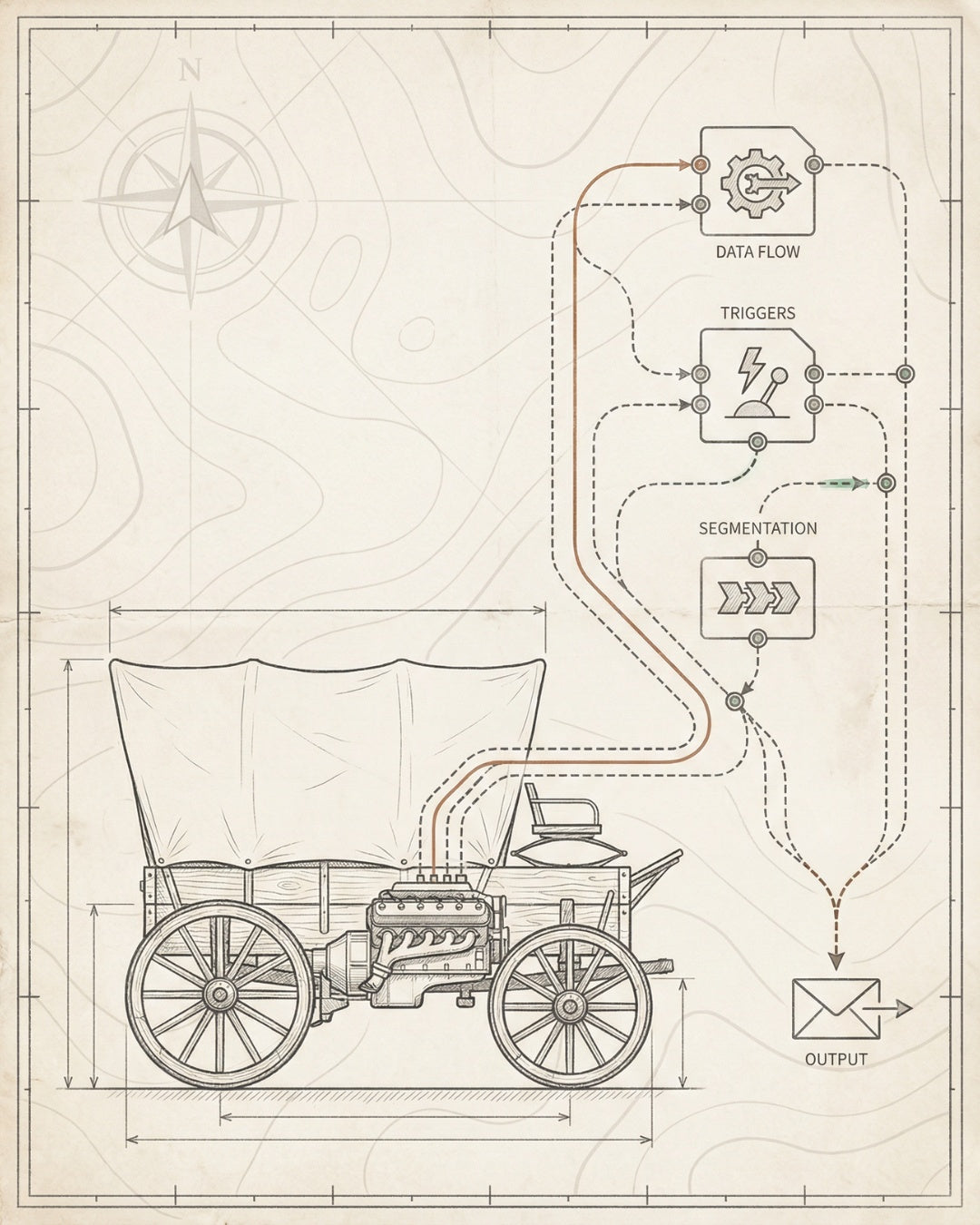
Content Systems vs. Content Projects
Most brands approach content like a project. They hire a writer. They publish 20 blog posts. They hope for traffic. Then they wonder why nothing ranks.
The problem isn’t the content. It’s the lack of a content system.
A content project is a one-time effort. A content system is infrastructure that scales. It’s the difference between writing 50 disconnected blog posts and building a topical authority engine that compounds over time.
The Content System We Install
Step 1: Keyword Mapping** We don’t start with blog ideas. We start with keyword research. Every piece of content maps to a specific keyword cluster—commercial keywords for product pages, informational keywords for blog content, navigational keywords for category pages.
Step 2: Topical Authority Architecture**** We organize content into topic clusters. Each cluster has a pillar page (comprehensive guide) and supporting pages (specific subtopics). Internal links connect the cluster. This signals to Google that you’re an authority on the topic, not just publishing random posts.
Step 3: Product Integration**** Every blog post includes contextual links to 3-5 relevant products. This isn’t promotional—it’s helpful. If you’re writing about “how to choose running shoes,” you link to your running shoe collection. If you’re writing about “best protein powders for weight loss,” you link to your products.
Step 4: Schema & AI Optimization**** Every article includes Article schema, BreadcrumbList schema, and entity markup. This makes your content eligible for AI Overviews, featured snippets, and rich results.
Content System vs. Content Project
Content Project Content System
50 random blog posts 5 topic clusters with 10 posts each
No internal linking strategy Hub-and-spoke internal linking
Generic keyword targeting Keyword-mapped content architecture
No product integration Contextual product links in every post
No schema markup Article, Product, and entity schema
Traffic that doesn’t convert Traffic that drives revenue
This is why our ecommerce SEO strategy starts with architecture, not content. You can’t build a content system without the foundation to support it.
AI Search Optimization: Beyond Google
Google isn’t the only search engine anymore. ChatGPT, Perplexity, Claude, and Google’s own AI Overviews are changing how people discover products. And if your store isn’t optimized for AI search, you’re invisible to the next generation of buyers.
AI search doesn’t work like traditional SEO. It doesn’t rank pages. It synthesizes answers from structured data, entity signals, and authoritative sources. If your content isn’t machine-readable, it won’t get cited.
How AI Search Works
When a user asks ChatGPT or Perplexity “What’s the best running shoe for flat feet?”, the AI doesn’t search for pages. It searches for entities** (brands, products, attributes) and structured data (schema markup, knowledge graphs).
If your product pages have proper schema markup, entity signals, and authoritative backlinks, your brand gets cited. If they don’t, you’re invisible.
The AI Search Optimization Stack
1. Entity Optimization** Google and AI models understand entities—people, places, brands, products. Your brand needs to exist as a recognized entity in Google’s Knowledge Graph. This means consistent NAP (name, address, phone), brand mentions across authoritative sites, and Organization schema on your homepage.
-
Structured Data for LLMs**** AI models pull from structured data, not prose. Your product pages need Product schema with detailed attributes (size, color, material, use case). Your brand needs Organization schema with social profiles and contact info. Your content needs Article schema with author and publisher entities.
-
Citation-Worthy Content**** AI models cite authoritative sources. Your content needs to be comprehensive, well-structured, and backed by data. Use lists, tables, and clear headings. Include statistics and sources. Make it easy for AI to extract and cite your content.
-
AI Overview Optimization**** Google’s AI Overviews pull from featured snippets, schema markup, and authoritative pages. To appear in AI Overviews, your content needs to directly answer specific questions, use structured data, and have strong topical authority.
Example:** A DTC supplement brand we worked with optimized product pages with detailed schema markup (ingredients, benefits, dosage). Within 60 days, their products started appearing in ChatGPT and Perplexity results for “best supplements for [specific use case].” No paid ads. Just structured data.
Learn more about our approach to AI search optimization.
The Audit-to-Throttle Pipeline: Implementation Framework
Theory doesn’t rank pages. Systems do. Here’s the exact framework we use to install SEO infrastructure for ecommerce brands—what we call the Audit-to-Throttle Pipeline.
This isn’t a 6-month retainer. It’s a 30-day sprint. We audit, we build, we deploy, we throttle. Then we hand you the keys.
Phase 1: Audit (Days 1-5)
We start with a full ecommerce SEO audit. Not a checklist. A systems diagnosis.
What we audit:
- Technical Foundation: Crawlability, indexability, site architecture, Core Web Vitals
- Content Structure: Keyword mapping, internal linking, topical authority
- Schema & Structured Data: Product, Review, Organization, BreadcrumbList schema
- AI Search Readiness: Entity signals, citation-worthy content, LLM-readable markup
- Conversion Architecture: Landing page UX, CTA clarity, funnel optimization
The output is a prioritized build sequence—what to fix first, what compounds fastest, what unlocks the next layer.
Phase 2: Foundation (Days 6-15)
We fix the technical foundation first. No content. No link building. Just infrastructure.
What we build:
- Site architecture optimization (URL structure, navigation, internal linking)
- Canonical tags and indexation control
- Schema markup installation (Product, Review, Organization, BreadcrumbList)
- Core Web Vitals optimization (image compression, JS reduction, caching)
- XML sitemap optimization and Google Search Console configuration
This is the layer that holds. Without it, everything else collapses.
Phase 3: Content & Distribution (Days 16-25)
Once the foundation is solid, we build the content system.
What we deploy:
- Keyword-mapped content architecture (topic clusters, pillar pages)
- Product page optimization (titles, descriptions, schema, internal links)
- Blog content with product integration and internal linking
- AI search optimization (entity markup, citation-worthy content)
- Conversion funnel optimization (CTAs, trust signals, UX improvements)
This is where rankings start moving. But we’re not done yet.
Phase 4: Throttle & Monitor (Days 26-30)
The final phase is about velocity. We monitor ranking movement, indexation status, and organic revenue. We throttle what’s working. We fix what’s broken.
What we track:
- Ranking velocity (how fast are target keywords moving?)
- Indexation status (are new pages getting indexed?)
- Organic revenue (not just traffic—conversions)
- Core Web Vitals (are performance metrics stable?)
- AI search citations (are you appearing in ChatGPT/Perplexity?)
Then we hand you the keys. The infrastructure is installed. It compounds from here.
Audit-to-Throttle Pipeline
Days 1-5: Audit — Systems diagnosis, prioritized build sequence
Days 6-15: Foundation — Technical SEO, schema, Core Web Vitals
Days 16-25: Content & Distribution — Keyword mapping, product optimization, AI search
Days 26-30: Throttle & Monitor — Ranking velocity, indexation, revenue tracking
This is how we’ve generated $30M+ in organic revenue for ecommerce brands. Not with retainers. With infrastructure.

Measuring What Compounds: Metrics That Matter
Most ecommerce brands track the wrong metrics. They celebrate traffic increases. They screenshot keyword rankings. They obsess over domain authority.
None of that matters if it doesn’t drive revenue.
Here are the metrics we actually track—the ones that tell you if your SEO infrastructure is working or breaking.
1. Organic Revenue (Not Traffic)
Traffic is a vanity metric. Revenue is the only metric that matters. Track organic revenue in Google Analytics. Segment by landing page. Identify which pages drive conversions. Double down on what works.
How to track it: Set up ecommerce tracking in Google Analytics 4. Filter traffic by organic source. Track revenue by landing page, product category, and keyword.
2. Ranking Velocity (Not Static Rankings)
A keyword ranking #15 that’s moving up is more valuable than a keyword ranking #5 that’s stagnant. Track ranking velocity—how fast are your target keywords moving?
How to track it: Use a rank tracker (Ahrefs, SEMrush, or SerpWatcher). Track your top 50 target keywords weekly. Measure movement—how many positions did each keyword gain or lose?
3. Indexation Coverage (Not Page Count)
Having 1,000 pages doesn’t matter if Google only indexes 200. Track indexation coverage in Google Search Console. Identify pages that should be indexed but aren’t. Fix them.
How to track it: Go to Google Search Console → Coverage Report. Check “Valid” vs. “Excluded” pages. Investigate excluded pages. Fix technical issues.
4. Core Web Vitals (Not Just Page Speed)
Page speed is a proxy. Core Web Vitals are the real ranking factors. Track LCP, CLS, and INP. If any metric is in the “Needs Improvement” or “Poor” range, you’re losing rankings and conversions.
How to track it: Use Google PageSpeed Insights or Search Console → Core Web Vitals Report. Track LCP, CLS, and INP for your top landing pages. Fix issues systematically.
5. AI Search Citations (The New Metric)
As AI search grows, traditional rankings matter less. What matters is whether your brand gets cited in AI-generated answers. Track mentions in ChatGPT, Perplexity, and Google AI Overviews.
How to track it: Manually search for your target keywords in ChatGPT and Perplexity. Check if your brand appears in the answer. Use tools like BloggedAI to monitor AI citations.
The compound metric: Organic revenue per indexed page. This tells you if your SEO infrastructure is efficient. A well-optimized 50-page store can generate more revenue than a poorly optimized 500-page store.
Frequently Asked Questions
What is the best ecommerce SEO strategy for new stores? +
Start with the 4-Layer Foundation: Crawlability → Indexability → Rankability → Convertibility. Don’t publish content until your technical foundation is solid. Focus on product page optimization, schema markup, and site architecture first. Then build content systems around high-commercial-intent keywords. Avoid the mistake of publishing 50 blog posts before fixing your product page templates.
How long does it take to see results from ecommerce SEO? +
Technical fixes (Core Web Vitals, indexation, schema) show results in 2-4 weeks. Content and topical authority take 8-12 weeks to compound. But here’s the key: if you install infrastructure correctly, results accelerate over time. A well-built SEO system generates more revenue in month 12 than month 3—without additional work. That’s the compound effect.
Do I need an SEO agency or can I do ecommerce SEO myself? +
You can DIY the basics—meta tags, product descriptions, blog posts. But technical infrastructure (site architecture, schema markup, Core Web Vitals, AI search optimization) requires expertise. The question isn’t “Can I do it?” It’s “Is this the best use of my time?” Most founders should focus on product and marketing. Let experts install the SEO infrastructure. Check out our ecommerce SEO checklist to evaluate what you can handle vs. what needs expert execution.
What’s the difference between ecommerce SEO and regular SEO? +
Ecommerce SEO prioritizes product pages, conversion architecture, and structured data (Product schema, Review schema). Regular SEO focuses on blog content and informational keywords. Ecommerce SEO also deals with unique challenges: duplicate content from product variants, crawl budget issues from large catalogs, and the need to rank commercial keywords (high buyer intent) over informational keywords. Learn more about ecommerce SEO best practices.
How much does ecommerce SEO cost? +
Traditional agencies charge $3,000-$10,000/month on retainers. At Founding Engine, we don’t do retainers. We charge for infrastructure installation—one-time builds in 30-day sprints. This typically ranges from $8,000-$25,000 depending on site complexity. The difference? You own the system. It compounds forever. No recurring fees. Learn more about our ecommerce SEO pricing.
What is schema markup and why does my ecommerce store need it? +
Schema markup is structured data that tells Google (and AI models) what your content means. For ecommerce, this includes Product schema (name, price, availability), Review schema (ratings), and BreadcrumbList schema (navigation). Without schema, you’re invisible to AI Overviews, Google Shopping, and rich results. With schema, you get star ratings in search results, product cards, and AI citations. It’s non-negotiable for modern ecommerce SEO.
How do I optimize product pages for SEO? +
Start with keyword-rich titles (include product name + primary keyword). Write unique, detailed descriptions (300+ words). Add Product schema with all attributes (price, availability, SKU, brand). Include high-quality images with descriptive alt text. Add customer reviews with Review schema. Build internal links from related products and blog content. Optimize Core Web Vitals (LCP under 2.5s). Read our full guide on SEO for ecommerce product pages.
What’s the difference between technical SEO and on-page SEO for ecommerce? +
Technical SEO is the foundation—site architecture, crawlability, indexation, Core Web Vitals, schema markup. It’s the infrastructure that makes ranking possible. On-page SEO is the content layer—product titles, descriptions, keyword optimization, internal linking. You need both. Technical SEO without on-page SEO is like building a highway with no cars. On-page SEO without technical SEO is like building cars with no roads. Explore our approach to advanced ecommerce SEO.
Ready to Install SEO Infrastructure That Compounds?
We don’t do retainers. We build systems. 30-day sprints. SEO infrastructure that holds. AI search visibility that scales. Revenue that compounds.
Matt Hyder
SEO infrastructure and AI search optimization at Founding Engine.
Want SEO that actually holds?
Get a free infrastructure audit from the Founding Engine team.
Get Your Free Audit