Ecommerce SEO Keyword Research: The Infrastructure Build
Stop chasing keywords. Build a research system that compounds. The full-step framework ecommerce brands use to map keywords to revenue — not just rankings.
ECOMMERCE SEO INFRASTRUCTURE • 12 MIN READ
Ecommerce SEO Keyword Research: The Infrastructure Build
Most ecommerce brands treat keyword research like a one-time deliverable. They pay an agency $3K for a spreadsheet with 500 rows, volume numbers, and difficulty scores. Then they wonder why nothing ranks six months later.
The problem isn’t the keywords. It’s the system — or lack of one.
Keyword research for ecommerce isn’t about finding terms. It’s about building infrastructure that maps search demand to your product catalog, routes commercial intent to conversion paths, and scales as you add SKUs. It’s architecture, not a list.
This is the full-step framework we install for brands before we touch a single piece of content. It’s how we’ve driven $30M+ in organic revenue and helped stores achieve a 250% average traffic increase. Not through more keywords — through better systems.
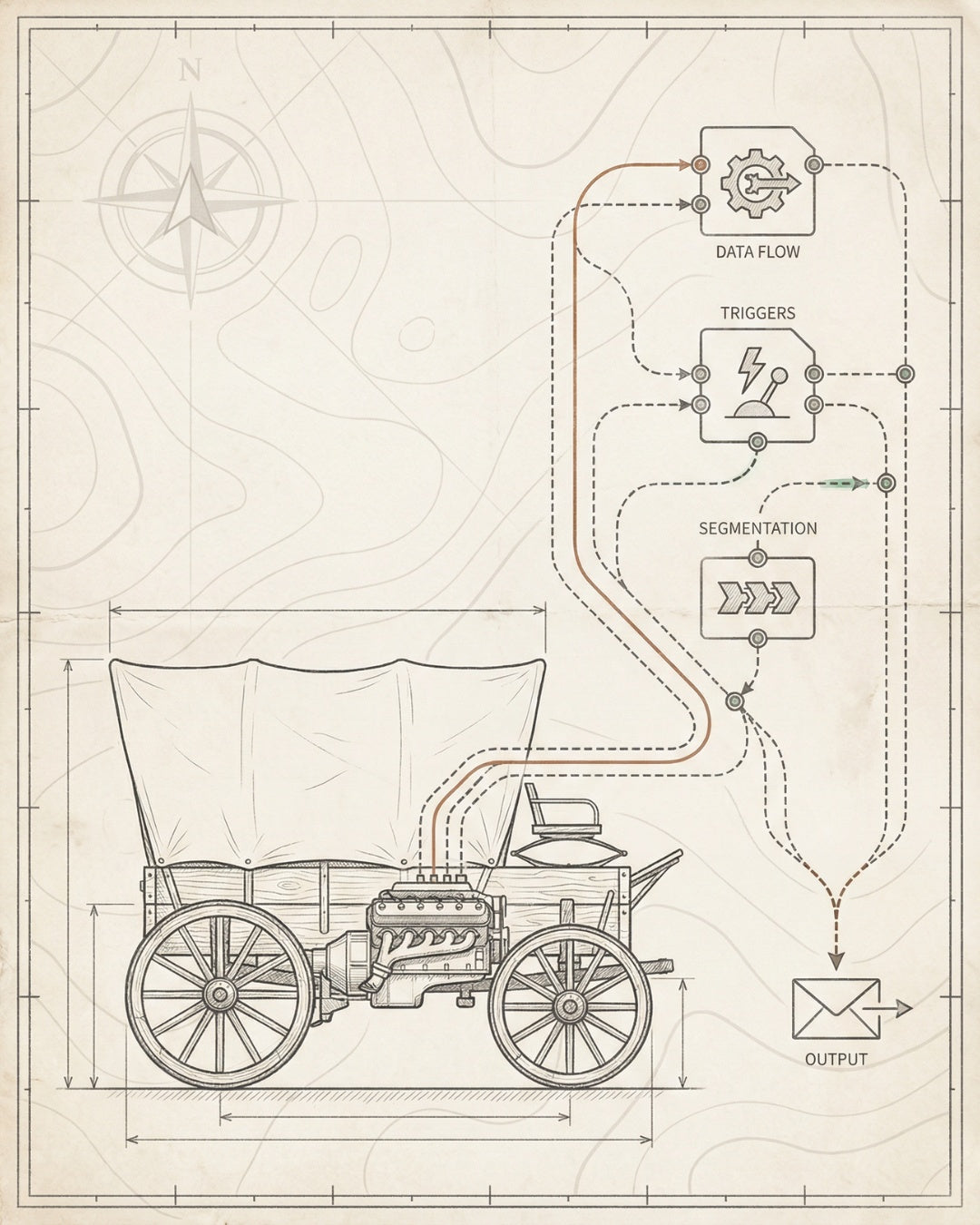
TL;DR — The Keyword Infrastructure Blueprint
01 Research Is Infrastructure Stop treating keyword research as a one-time task. Build a system that maps search demand to product architecture and compounds as your catalog scales.
02 The 4-Layer Foundation Product ontology → Search demand mapping → Commercial intent hierarchy → Content-to-conversion architecture. Each layer builds on the last. Skip one, the system breaks.
03 Intent Beats Volume A 200-search/month term with transactional intent outperforms a 5K-search informational term every time. Map keywords to conversion proximity, not just traffic potential.
04 AI Search Changes the Game Keyword research now includes entity mapping for AI Overviews. Structure your research to feed both traditional rankings and LLM citation engines from day one.
05 Build Once, Scale Forever The keyword-to-URL matrix becomes your growth blueprint. Add products, expand categories, launch new collections — the system tells you exactly what to optimize.
What We’re Building
- Why Most Ecommerce Keyword Research Fails
- The 4-Layer Keyword Research Foundation
- Full-Step Research Process for Ecommerce
- Tools and Systems Stack
- AI Search and Entity Optimization
- Implementation Framework: The 30-Day Sprint
- Common Mistakes and How to Avoid Them
- FAQ
Why Most Ecommerce Keyword Research Fails
Here’s what usually happens: A brand hires an agency or freelancer. They get a Google Sheet with columns for keyword, volume, difficulty, and CPC. Maybe there’s a tab for “informational” and another for “transactional.” The deliverable looks professional. The brand feels like they got something.
Then they try to use it.
The spreadsheet doesn’t tell them which keywords map to which product pages. It doesn’t explain how to structure collections. It doesn’t connect search demand to their actual catalog architecture. It’s data without a build plan.
That’s the agency deliverable trap. You get research that looks complete but has no implementation logic. It’s like getting a pile of lumber without blueprints.
The Real Problem: Most keyword research is built for content sites, not ecommerce. Content sites can create pages around any keyword. Ecommerce stores have constraints — you can’t rank for “leather jackets” if you don’t sell leather jackets. Your keyword strategy has to reverse-engineer from your product catalog, not ignore it.
Product-First vs. Search-First Thinking
Here’s the tension: Your product team thinks in categories, SKUs, variants, and attributes. Your customers think in problems, use cases, comparisons, and outcomes. Keyword research is the translation layer.
Most brands make one of two mistakes:
- Product-first only: They optimize for exact product names and brand terms. High conversion, zero discovery. You rank for searches people already know to make.
- Search-first only: They chase high-volume keywords with no product fit. You rank for terms that don’t convert because you’re not actually selling what people want.
The system we’re building does both. It starts with your product ontology (what you sell), maps it to search demand (what people search), and routes it through commercial intent (what converts). That’s the foundation of scalable ecommerce SEO strategy.
The Missing Layer: Commercial Intent Mapping
Volume and difficulty don’t tell you if a keyword makes money. A term with 10K monthly searches might be purely informational. A term with 200 searches might be bottom-funnel gold.
Commercial intent is the missing layer in most ecommerce SEO keyword research. It’s the difference between “how to clean leather boots” (informational, low intent) and “buy waterproof leather boots online” (transactional, high intent).
We segment every keyword by intent proximity to conversion:
Intent Type Example Query Conversion Proximity Priority
Transactional “buy leather boots” Immediate High
Commercial Investigation “best leather boots for winter” Near-term High
Informational “how to waterproof leather boots” Mid-funnel Medium
Navigational “[your brand] boots” Brand-aware Protect
This isn’t academic. It changes what you build. Transactional keywords map to product and collection pages. Commercial investigation maps to comparison content and buying guides. Informational maps to blog content with internal links to products.
Without this layer, you’re optimizing blind. With it, you’re building a conversion engine.

The 4-Layer Keyword Research Foundation
This is the framework we install before we touch tools. It’s conceptual infrastructure — the logic that makes the research actionable. Think of it as the blueprint before the build.
Each layer builds on the previous one. Skip a layer, and the system collapses. This is how SEO infrastructure actually works.
Layer 1: Product Ontology (What You Sell)
Start by reverse-engineering your product catalog into a searchable taxonomy. This isn’t your internal SKU system. It’s how customers would mentally categorize what you sell.
Map out:
- Primary categories: Top-level product groups (e.g., “boots,” “sneakers,” “sandals”)
- Subcategories: Refinements within categories (e.g., “leather boots,” “hiking boots,” “Chelsea boots”)
- Attributes: Filters and variants (e.g., “waterproof,” “size 10,” “black”)
- Use cases: Problem-solution framing (e.g., “boots for snow,” “boots for wide feet”)
This becomes your keyword ontology. Every term you research has to map back to something in this structure. If it doesn’t, you either need to add a product or skip the keyword.
Product Ontology Example: Outdoor Apparel Brand
Category: Jackets** Subcategories:** Rain jackets, down jackets, fleece jackets, windbreakers** Attributes:** Waterproof, insulated, packable, breathable** Use Cases:** Hiking jackets, travel jackets, winter jackets, running jackets
Each of these becomes a keyword cluster with its own search demand profile and content requirements.
Layer 2: Search Demand Mapping (What People Search)
Now you map real search behavior to your product ontology. This is where tools come in — but the ontology tells you what to research.
For each category and subcategory, extract:
- Head terms: Broad, high-volume keywords (e.g., “leather boots”)
- Body terms: Mid-tail with modifiers (e.g., “waterproof leather boots”)
- Long-tail terms: Specific, lower-volume queries (e.g., “waterproof leather boots for wide feet”)
- Question keywords: How/what/which queries (e.g., “which leather boots are waterproof”)
The goal isn’t to find every possible keyword. It’s to map the demand landscape so you know what search volume exists for each part of your catalog. This informs content prioritization and URL architecture decisions.
Layer 3: Commercial Intent Hierarchy (What Converts)
This is where most ecommerce SEO keyword research stops being a spreadsheet and starts being a revenue system. You’re not just collecting keywords — you’re building a conversion pathway.
Segment your keyword list by intent (transactional, commercial investigation, informational, navigational). Then prioritize based on:
- Conversion proximity: How close is this searcher to buying?
- Product-market fit: Do we have exactly what they’re searching for?
- Competitive density: Can we realistically rank for this in 90 days?
- Lifetime value potential: Is this a one-time buyer or a repeat customer segment?
This creates your priority matrix. High-intent + strong product fit + winnable competition = build immediately. Everything else gets sequenced based on resource constraints and growth goals.
Layer 4: Content-to-Conversion Architecture (How It Scales)
The final layer connects keywords to URLs and URLs to conversion paths. This is the implementation blueprint.
For every keyword cluster, define:
- Target URL type: Product page, collection page, category page, or content page
- Primary keyword: One main term per URL (no keyword cannibalization)
- Supporting keywords: Related terms the page can rank for naturally
- Internal linking strategy: How this page connects to products and other content
- Conversion mechanism: Add to cart, email capture, or navigation to product
This matrix becomes your build queue. It’s what separates effective ecommerce SEO from random optimization. You know exactly what to build, in what order, and why.

Full-Step Research Process for Ecommerce
Now we get tactical. This is the step-by-step process we run for every ecommerce client. It’s repeatable, scalable, and designed to integrate with your existing product roadmap.
Time investment: 20-30 hours for the initial build. Then 2-4 hours per month for maintenance and expansion as you add products.
Step 1: Reverse-Engineer Your Product Catalog
Pull your entire product catalog into a spreadsheet. Include:
- Product names and SKUs
- Categories and subcategories
- Attributes and variants (color, size, material, etc.)
- Current URLs and page types
Then translate this into customer language. Your internal taxonomy might say “Men’s Outerwear > Technical Shells.” Customers search for “waterproof jackets for hiking.” Build a translation map.
This is your source of truth. Every keyword you research has to connect back to a product or category in this map. If it doesn’t, you’re researching keywords you can’t monetize.
Step 2: Map Competitor Visibility Gaps
Identify your top 3-5 direct competitors (brands selling similar products to similar customers). Run a competitive keyword gap analysis to find:
- Keywords they rank for that you don’t
- Keywords where they outrank you significantly
- Product categories they dominate in search
Filter this list for relevance — only keep keywords that map to products you actually sell. This becomes your “low-hanging fruit” list: terms where demand is proven, competition is defined, and you have product-market fit.
This is part of a comprehensive ecommerce SEO audit process that identifies both opportunities and technical blockers.
Step 3: Build the Intent Pyramid
Take your keyword list and segment it into the four intent categories. Use search modifiers as signals:
- Transactional: “buy,” “shop,” “order,” “price,” “cheap,” “deals”
- Commercial investigation: “best,” “top,” “review,” “comparison,” “vs”
- Informational: “how to,” “what is,” “guide,” “tips,” “why”
- Navigational: Brand names, specific product names
Manually review ambiguous terms. “Leather boots” could be transactional or informational depending on SERP features. Check what Google is ranking — if you see product pages, it’s transactional. If you see guides and articles, it’s informational.
This segmentation drives your content strategy. Transactional keywords need optimized product and collection pages. Informational keywords need blog content that links to products. Don’t build the wrong content type for the intent.
Step 4: Create the Keyword-to-URL Matrix
This is the infrastructure piece most brands skip. It’s also the most valuable.
Build a master spreadsheet with these columns:
Primary Keyword Intent Type Search Volume Target URL URL Type Status
waterproof hiking boots Transactional 2,400 /collections/waterproof-hiking-boots Collection Live
best hiking boots for wide feet Commercial 590 /blog/best-hiking-boots-wide-feet Content Planned
how to waterproof leather boots Informational 1,200 /blog/waterproof-leather-boots-guide Content Draft
This matrix becomes your build queue and your measurement framework. You know what to optimize, what to create, and how to track progress. It’s the difference between random SEO tasks and systematic infrastructure deployment.
This approach is core to our technical SEO for ecommerce methodology — everything maps to a URL with a defined purpose.
Step 5: Install Tracking Infrastructure
Research without measurement is guesswork. Set up tracking before you start building:
- Google Search Console: Verify your domain, submit sitemaps, monitor impressions and clicks by query
- Rank tracking: Track your priority keywords (top 50-100 terms) with a tool like Ahrefs, SEMrush, or Accuranker
- Analytics: Set up custom reports for organic landing pages, conversion paths, and revenue attribution
- Internal dashboards: Build a simple view that shows keyword → ranking → traffic → revenue for your top terms
This infrastructure lets you measure velocity: how fast are you moving from unranked → page 2 → page 1 → top 3. That’s the metric that matters, not absolute rankings.
Tools and Systems Stack
Tools don’t replace strategy, but the right stack makes execution faster. Here’s what we use and why.
Core Research Tools
- Ahrefs: Best for competitor analysis, keyword gap identification, and SERP feature tracking. Use it to reverse-engineer what’s already working in your niche.
- SEMrush: Strong for keyword clustering and intent classification. The Keyword Magic Tool is useful for expanding seed terms into full topic clusters.
- Google Keyword Planner: Free, accurate volume data for Google Ads. Use it to validate search demand for niche terms other tools don’t track well.
- AnswerThePublic / AlsoAsked: Question-based keyword discovery. Useful for informational content planning and FAQ schema opportunities.
What You Don’t Need
Most brands over-tool. You don’t need five keyword research platforms. Pick one primary tool (Ahrefs or SEMrush) and supplement with free tools for specific use cases.
You also don’t need AI keyword generators that spit out hundreds of irrelevant terms. The bottleneck isn’t finding keywords — it’s mapping them to your product catalog and building the content infrastructure to rank for them.
The Research-to-Implementation Pipeline
Here’s the system flow we use:
- Research: Extract keywords using Ahrefs/SEMrush based on product ontology
- Filter: Remove irrelevant terms, segment by intent, prioritize by commercial value
- Map: Assign each keyword cluster to a target URL in the keyword-to-URL matrix
- Queue: Sequence build order based on technical dependencies and resource capacity
- Build: Create or optimize pages following on-page SEO for ecommerce best practices
- Measure: Track ranking movement, traffic, and revenue attribution
- Iterate: Expand keyword clusters, add supporting content, refine internal linking
This pipeline turns research into revenue. It’s not a one-time project — it’s a continuous system that scales as your catalog grows.

AI Search and Entity Optimization
Keyword research is evolving. Google’s AI Overviews, ChatGPT search, and Perplexity are changing how people discover products. Your research system needs to account for this.
Traditional keyword research optimizes for blue links. AI search optimization targets citations, entity recognition, and structured knowledge. You need both.
How Keyword Research Changes for AI Overviews
AI Overviews pull from multiple sources to synthesize answers. To get cited, you need:
- Entity clarity: Your brand, products, and categories need to be clearly defined entities that LLMs can recognize
- Structured data: Schema markup that tells AI systems what your content is about and how it relates to search queries
- Authoritative signals: Content depth, citations, and brand mentions that signal expertise
- Answer-focused formatting: Clear, concise answers to specific questions that AI can extract and cite
This doesn’t replace traditional keyword optimization. It augments it. You’re still targeting “waterproof hiking boots,” but now you’re also ensuring your product pages have structured data that tells AI systems you’re an authoritative source for that query.
Our AI search optimization service handles this layer — entity mapping, structured data implementation, and LLM visibility tracking.
Entity Mapping vs. Traditional Keyword Targeting
Traditional keyword targeting: Optimize a page for “best running shoes for flat feet.”
Entity mapping: Define your brand as an entity, connect it to the “running shoes” category entity, map “flat feet” as an attribute entity, and structure your content so AI systems understand the relationships.
In practice, this means:
- Using consistent terminology across your site (don’t call them “running shoes” on one page and “athletic footwear” on another)
- Implementing Product schema with detailed attributes
- Building topical authority through interconnected content clusters
- Creating FAQ content that directly answers voice search and AI queries
The keyword research process stays the same. The implementation layer expands to include entity signals and structured data.
Structured Data Integration Points
Every keyword cluster should map to a schema type:
Content Type Schema Type AI Search Benefit
Product Pages Product schema Product rich results, price visibility in AI answers
Category Pages CollectionPage schema Category authority signals for LLMs
How-To Guides HowTo schema Step-by-step answer extraction for AI Overviews
Comparison Content Article + Product schema Citation in comparison queries
FAQ Pages Article (not FAQPage) Direct answer sourcing for voice and AI search
This isn’t optional anymore. Brands that ignore structured data and entity optimization will lose visibility as AI search grows. This is part of advanced ecommerce SEO — staying ahead of the curve, not reacting to it.
Implementation Framework: The 30-Day Sprint
Research is worthless without execution. Here’s how we sequence the build in 30-day cycles — the same sprint model we use for all SEO infrastructure projects.
Week 1: Audit and Foundation
- Complete product catalog mapping (Layer 1)
- Run competitive keyword gap analysis (Step 2)
- Set up tracking infrastructure (Step 5)
- Audit current keyword rankings and identify quick wins
Deliverable: Keyword-to-URL matrix with priority queue and baseline metrics.
Week 2: High-Intent Optimization
- Optimize existing product and collection pages for transactional keywords
- Fix technical blockers (canonicals, indexation issues, site speed)
- Implement Product schema on priority pages
- Build internal linking from content to products
Deliverable: 10-20 optimized pages targeting high-commercial-intent keywords.
Week 3: Content Infrastructure Build
- Create 3-5 high-priority content pieces (buying guides, comparisons, how-tos)
- Implement HowTo and Article schema
- Build internal linking architecture connecting content to products
- Set up email capture flows on content pages
Deliverable: Content cluster supporting top product categories with conversion paths installed.
Week 4: Distribution and Measurement
- Submit updated sitemap to Google Search Console
- Monitor indexation and ranking movement
- Identify crawl and rendering issues
- Build reporting dashboard for keyword → traffic → revenue
Deliverable: Live tracking system and 30-day performance report with next sprint priorities.
The Audit-to-Throttle Pipeline
This is our core methodology: Audit (identify what’s broken and what’s opportunity) → Build (fix technical foundation and create content infrastructure) → Throttle (scale what’s working, cut what’s not).
Keyword research feeds the entire pipeline. The audit tells you what keywords you’re losing to competitors. The build phase optimizes for those terms. The throttle phase expands into adjacent keyword clusters as you prove ROI.
Learn more about this approach in our ecommerce SEO checklist.
Common Mistakes and How to Avoid Them
These are the errors we see most often when auditing ecommerce stores. They’re all preventable with the right system.
Mistake 1: Keyword Cannibalization at Scale
You have five different pages all targeting “leather boots.” Google doesn’t know which one to rank, so none of them do well. This happens when you don’t map one primary keyword per URL.
Fix: Use the keyword-to-URL matrix. One primary keyword per page. Related terms can rank naturally, but each URL needs a clear primary target. If you have multiple pages competing, consolidate or differentiate (e.g., “leather boots” on the collection page, “best leather boots for winter” on a buying guide).
Mistake 2: Ignoring Search Volume Context
A keyword shows 10K monthly searches. You build a page. It ranks. You get 50 visitors. What happened?
Search volume is modeled, not actual. It’s an estimate based on click data, and it doesn’t account for SERP features that steal clicks (featured snippets, shopping ads, local packs). Always check the actual SERP before committing resources.
Fix: Manually review the SERP for your target keywords. If there are 4 ads, a shopping carousel, and a featured snippet, your organic click-through rate will be low even if you rank #1. Adjust your traffic projections accordingly.
Mistake 3: Building Content Before Architecture
You create 50 blog posts targeting informational keywords. They rank. Traffic goes up. Revenue doesn’t. Why?
Because you built content without conversion architecture. There’s no internal linking to products. No email capture. No path from “how to clean leather boots” to “buy leather boot cleaner.”
Fix: Build the architecture first. Optimize product and collection pages. Set up internal linking systems. Then add content that feeds into that architecture. Content without infrastructure is just traffic without revenue.
This is why we emphasize SEO for ecommerce product pages as the foundation — product pages convert, content supports.
Mistake 4: Treating Keyword Research as a One-Time Project
You do keyword research once. Six months later, you’ve added 50 new products. None of them have keyword mapping. You’re flying blind again.
Fix: Make keyword research part of your product launch process. Every new product or category gets keyword research before it goes live. This ensures your catalog expansion is search-optimized from day one, not retrofitted months later.
Mistake 5: Ignoring Long-Tail Compound Effects
You focus only on high-volume head terms. You ignore the 50-search/month long-tail keywords. Over time, those long-tail terms compound into significant traffic — but only if you have the infrastructure to capture them.
Fix: Build scalable page templates (collection pages, category pages, blog post templates) that can target long-tail variations without manual optimization. Use programmatic SEO where appropriate. The goal is to capture the long tail systematically, not one keyword at a time.
Frequently Asked Questions
How long does ecommerce SEO keyword research take? +
The initial research and infrastructure build takes 20-30 hours for most ecommerce stores with 50-500 products. This includes product catalog mapping, competitive analysis, keyword extraction, intent segmentation, and building the keyword-to-URL matrix. Ongoing maintenance is 2-4 hours per month as you add products and expand categories. The key is building a system once, then scaling it — not redoing research from scratch every quarter.
What’s the difference between keyword research for ecommerce vs. content sites? +
Content sites can create pages around any keyword. Ecommerce stores have product constraints — you can only target keywords for products you actually sell. Ecommerce keyword research has to reverse-engineer from your product catalog, map commercial intent to conversion paths, and prioritize transactional keywords over informational ones. The research process also needs to account for product page optimization, collection architecture, and internal linking to products — not just blog content.
Should I target high-volume or low-competition keywords first? +
Neither. Target high-intent keywords with strong product-market fit first, regardless of volume or competition. A 200-search/month transactional keyword that perfectly matches a product you sell will generate more revenue than a 10K-search informational keyword with weak conversion paths. Prioritize based on commercial intent and conversion proximity, then filter for competitive feasibility. The goal is revenue, not traffic.
How do I avoid keyword cannibalization across product and collection pages? +
Use the keyword-to-URL matrix to assign one primary keyword per page. Collection pages should target broader category terms (e.g., “leather boots”). Product pages should target specific product keywords (e.g., “waterproof leather hiking boots size 10”). If you have multiple pages that could target the same keyword, choose the one with the strongest conversion path and use the others to target related but distinct terms. Internal linking should reinforce the hierarchy: collection pages link to product pages, not the other way around.
What tools do I actually need for ecommerce keyword research? +
One primary tool (Ahrefs or SEMrush) for keyword extraction and competitive analysis. Google Keyword Planner for volume validation. Google Search Console for actual search query data. That’s it. You don’t need five different keyword tools. The bottleneck isn’t finding keywords — it’s mapping them to your product catalog and building the content infrastructure to rank for them. Invest in execution, not more tools.
How does AI search change keyword research strategy? +
AI search (Google AI Overviews, ChatGPT, Perplexity) adds an entity and citation layer to traditional keyword research. You still target the same keywords, but now you also need to ensure your content has structured data, clear entity definitions, and answer-focused formatting that LLMs can extract and cite. This means implementing Product schema on product pages, using consistent terminology across your site for entity recognition, and creating FAQ content that directly answers common queries. The keyword research process stays the same — the implementation layer expands.
When should I hire an agency vs. doing keyword research in-house? +
Do it in-house if you have 20-30 hours to invest in the initial build and the technical knowledge to map keywords to URL architecture. Hire an agency if you need the system built fast, want expert competitive analysis, or lack the internal resources to execute on the research. The key differentiator: agencies should deliver implementation systems (keyword-to-URL matrices, build queues, tracking dashboards), not just spreadsheets. If you’re getting a deliverable without a build plan, you’re getting the wrong service. Learn more about our approach to ecommerce SEO services.
How often should I update my keyword research? +
Update your keyword research every time you add a new product category or launch a significant product line. For existing categories, review quarterly to identify new keyword opportunities, track competitive shifts, and refine your priority queue. The keyword-to-URL matrix should be a living document that evolves with your catalog, not a static deliverable you revisit once a year. Set up a monthly review process to check ranking movement, identify quick wins, and adjust your build queue based on performance data.
Build Keyword Infrastructure That Compounds
Stop chasing keywords. Start building systems. We install the research infrastructure that maps search demand to revenue — not just rankings. 30-day sprints. No retainers. Built for ecommerce brands that want to own their organic channel.
SEO Infrastructure AI Search Optimization Start a Project

Matt Hyder
SEO infrastructure and AI search optimization at Founding Engine.
Want SEO that actually holds?
Get a free infrastructure audit from the Founding Engine team.
Get Your Free Audit