Ecommerce SEO Specialists: What They Build vs. What They Bill
Most ecommerce SEO specialists sell hours. The best ones install infrastructure. Here's how to evaluate who builds systems vs. who just optimizes pages.

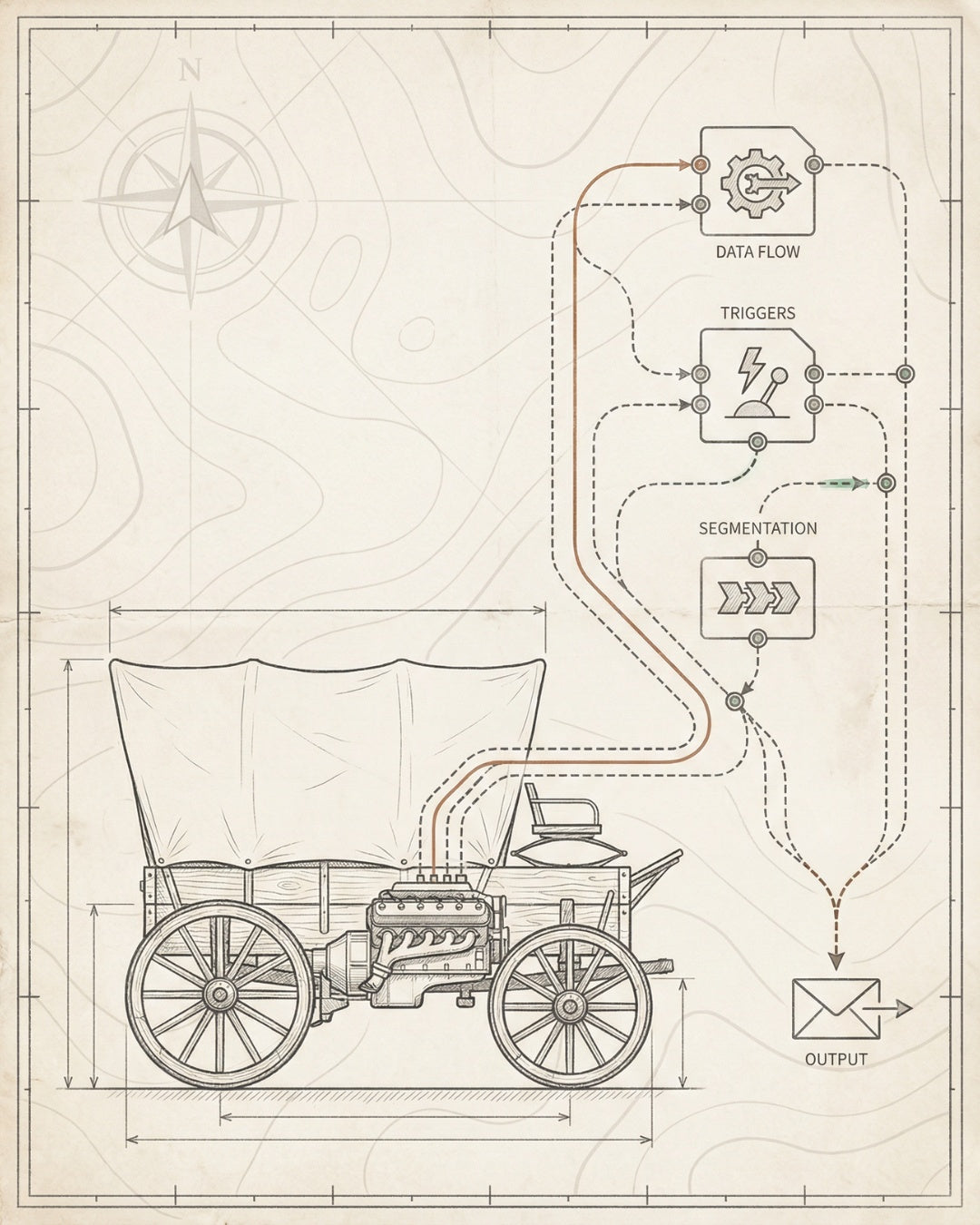
01/05 Most ecommerce SEO specialists bill for tasks. The best ones install systems that compound. The difference: one delivers reports, the other builds revenue infrastructure.
02/05 Infrastructure-first SEO means fixing the foundation before touching content. Crawlability, indexability, rankability, convertibility — in that order. No shortcuts.
03/05 The Compound Visibility Stack: Website × Content × Technical × Distribution. Each layer multiplies the others. Build them in sequence, and organic revenue becomes inevitable.
04/05 AI search is the new frontier. Most specialists ignore entity markup, knowledge graphs, and LLM optimization. That’s where the next 3 years of traffic growth lives.
05/05 Audit-to-Throttle in 30 days: Fix foundation, install content architecture, layer AI signals, configure distribution. Then scale. Sprint model beats retainers every time.
The Two Types of Ecommerce SEO Specialists (and Why Most Are Type One)
There are two kinds of ecommerce SEO specialists. The first type sells you optimization. The second type builds you infrastructure. The difference isn’t semantic — it’s the gap between renting visibility and owning your organic channel.
Type One: The Task Executor. They audit your site, hand you a spreadsheet with 200 rows, optimize your product pages, write some blog posts, and send monthly reports showing keyword movement. They’re billing hours. They’re managing tasks. They’re not building systems.
You know you’re dealing with Type One when the contract says “ongoing optimization” and the deliverables list looks like a project management board. They’re good at what they do. But what they do doesn’t compound.
Type Two: The Infrastructure Builder. They start with the foundation — crawlability, site architecture, Core Web Vitals, schema markup. They install content systems, not content. They configure internal linking as a distribution network, not a checklist item. They build once, and it scales forever.
The difference shows up six months later. Type One’s work plateaus. Type Two’s work compounds. One gives you rankings. The other gives you a revenue engine.
Most ecommerce SEO services operate in Type One mode because it’s easier to sell and easier to staff. But if you’re building a brand that needs to own its organic channel — not rent it — you need Type Two thinking.
The Tell: Ask your specialist what they’re building in the first 30 days. If the answer is “optimizing pages,” you’re getting tasks. If the answer is “installing crawl architecture and schema infrastructure,” you’re getting systems.

What Infrastructure-First SEO Actually Looks Like
Infrastructure-first SEO isn’t a philosophy. It’s a build sequence. It’s the recognition that you can’t rank what you can’t crawl, you can’t optimize what you can’t index, and you can’t scale what isn’t structured.
The framework is simple: Crawlability → Indexability → Rankability → Convertibility. Four layers. Sequential. Non-negotiable. Most ecommerce SEO specialists skip straight to layer three (rankability) and wonder why the results don’t stick.
Layer One: Crawlability
Can Google’s bot actually access your pages? Sounds basic. It’s not. Broken robots.txt files, orphaned URLs, redirect chains, slow server response times, JavaScript rendering issues — these are the silent killers of ecommerce SEO. You can have the best product pages in your category, and if Googlebot can’t efficiently crawl them, you don’t exist.
Infrastructure-first specialists start here. They audit your technical SEO for ecommerce at the server level. They fix crawl budget waste. They eliminate redirect loops. They configure your sitemap as a crawl priority map, not a dump of every URL on your site.
Layer Two: Indexability
Crawlable doesn’t mean indexable. Duplicate content, thin pages, canonical tag misconfigurations, noindex accidents — these block Google from adding your pages to the index. If it’s not indexed, it can’t rank.
The infrastructure play here: canonical URL architecture, faceted navigation handling, parameter management, and strategic use of noindex for low-value pages. This is where ecommerce SEO audits either find gold or expose disaster.
Layer Three: Rankability
Now you can talk about keywords. Now you can optimize content. But rankability isn’t just about on-page SEO — it’s about structured authority. Internal linking architecture. Schema markup. Entity relationships. Topic clustering. Content depth.
Infrastructure-first specialists don’t write blog posts in isolation. They build content systems. They create hub-and-spoke architectures. They install on-page SEO for ecommerce as a repeatable framework, not a one-time optimization.
Layer Four: Convertibility
Rankings without revenue are vanity metrics. The fourth layer connects SEO to business outcomes. Conversion rate optimization, user experience signals, Core Web Vitals, page speed, mobile usability — these determine whether your organic traffic turns into customers or bounces.
This is where performance-first website design intersects with SEO. The infrastructure holds because it was built to convert, not just to rank.
The Compound Visibility Stack: How Systems Beat Tactics
The Compound Visibility Stack (CVS) is the mental model that separates infrastructure builders from task executors. It’s four layers that multiply each other: Website × Content × Technical × Distribution.
Each layer is a multiplier, not an addition. A 10% improvement in site speed (Website) doesn’t just make pages faster — it improves crawl efficiency (Technical), increases time-on-page (Content), and boosts conversion rates (Distribution). The effects compound.
Layer 1: Website (The Foundation)
Your site architecture, URL structure, navigation hierarchy, internal linking topology. This is the skeleton. If it’s broken, nothing you build on top of it will scale. Most ecommerce SEO specialists treat this as a one-time setup. Infrastructure builders treat it as the load-bearing structure of your entire organic channel.
Layer 2: Content (The Signal)
Not blog posts. Not product descriptions. Content systems. Keyword mapping, topic clustering, hub-and-spoke architecture, entity-based optimization. Content that signals topical authority to Google and contextual relevance to AI search engines.
The infrastructure play: create content templates, not one-offs. Build a content production system that can scale without degrading quality. Install SEO for ecommerce product pages as a repeatable framework.
Layer 3: Technical (The Amplifier)
Schema markup, Core Web Vitals, mobile optimization, structured data, crawl efficiency, indexation management. This layer amplifies everything else. Good content with bad technical SEO gets buried. Average content with excellent technical SEO can outrank better-written competitors.
Infrastructure-first ecommerce SEO specialists install technical systems that run in the background, continuously optimizing without manual intervention. Automated schema generation. Dynamic internal linking. Performance monitoring dashboards.
Layer 4: Distribution (The Accelerant)
How your content gets discovered. Google Search Console optimization, AI search visibility (Perplexity, ChatGPT, AI Overviews), social signals, email integration, backlink architecture. Distribution turns great SEO into traffic velocity.
The CVS framework is why Founding Engine clients see 250% average organic traffic increases. We’re not optimizing pages. We’re installing systems that multiply each other.

Evaluating an Ecommerce SEO Specialist: The Decision Framework
You’re comparing proposals. One specialist quotes $3,000/month for “ongoing optimization and content creation.” Another quotes $15,000 for a 30-day infrastructure build with no retainer. How do you evaluate?
Here’s the decision framework we use when founders ask us to audit their current SEO partner or evaluate a new one:
Evaluation Criteria Task-Based Specialist Infrastructure-First Specialist
Pricing Model Monthly retainer, ongoing Fixed-scope sprints, defined deliverables
First 30 Days Focus Keyword research, content optimization Technical foundation, crawl architecture
Deliverables Reports, optimized pages, blog posts Systems, frameworks, infrastructure
Success Metric Keyword rankings, traffic growth Organic revenue, compounding visibility
Technical Depth Surface-level audits, generic fixes Server-level optimization, custom builds
AI Search Strategy ✕ Not addressed ✓ Entity markup, LLM optimization
Scalability Linear (more hours = more output) Exponential (systems scale without more hours)
Long-Term Value Stops when you stop paying Compounds after engagement ends
The tell is in the questions they ask. Task-based specialists ask about your keyword targets and content calendar. Infrastructure specialists ask about your tech stack, server configuration, current crawl budget, and business model.
Another tell: look at their ecommerce SEO pricing structure. If it’s open-ended monthly retainers with vague deliverables, you’re buying labor. If it’s fixed-scope sprints with defined systems to install, you’re buying infrastructure.
The Question to Ask: “What will you build in the first 30 days, and what will still be working 12 months after you’re done?” If they can’t answer the second part, they’re not building infrastructure.
What to Expect in the First 30 Days (Audit-to-Throttle Pipeline)
The Audit-to-Throttle Pipeline is how we compress what most agencies spread over six months into a 30-day sprint. It’s not about working faster. It’s about sequencing correctly and eliminating waste.
Here’s what infrastructure-first ecommerce SEO specialists actually build in the first month:
Days 1-7: Foundation Audit
Technical crawl analysis. Server response time audit. Indexation status review. Core Web Vitals baseline. URL structure evaluation. Schema markup inventory. Internal linking topology map. This isn’t a report. It’s a build plan.
The output: a prioritized technical debt ledger and a crawl efficiency roadmap. We’re documenting what’s broken and what’s blocking compounding growth. Every ecommerce SEO checklist item gets a severity score and a sequence position.
Days 8-14: Technical Foundation Build
Fix critical crawl blockers. Implement canonical URL architecture. Configure sitemap as a crawl priority system. Optimize robots.txt. Eliminate redirect chains. Install Core Web Vitals monitoring. Deploy schema markup infrastructure.
This is where most specialists stop and call it a “technical SEO audit deliverable.” Infrastructure builders see this as the foundation that everything else builds on. No shortcuts. No “we’ll fix that later.” The foundation either holds or it doesn’t.
Days 15-21: Content Architecture Installation
Keyword mapping to site structure. Hub-and-spoke content topology. Internal linking automation. Entity-based content templates. Product page optimization framework. Category page schema deployment.
We’re not writing content yet. We’re installing the system that makes content production scalable and SEO-effective. This is the difference between advanced ecommerce SEO and basic optimization.
Days 22-28: AI Search Layer + Distribution Config
Entity markup for knowledge graph signals. Structured data for LLM consumption. AI Overview optimization. Perplexity and ChatGPT visibility configuration. Google Search Console integration. Performance dashboard setup.
This is the layer most ecommerce SEO specialists ignore entirely. It’s also where the next three years of organic growth lives. AI search optimization isn’t optional anymore — it’s the new baseline.
Days 29-30: Throttle Handoff
Systems documentation. Team training. Performance baseline dashboard. 90-day roadmap. Handoff to internal team or next sprint planning.
The infrastructure is installed. Now you can throttle — scale content production, expand to new categories, layer in paid distribution. The foundation holds because it was built to.
The AI Search Layer Most Specialists Ignore
AI search isn’t coming. It’s here. Google’s AI Overviews, ChatGPT’s SearchGPT, Perplexity’s answer engine — these are fundamentally different ranking systems than traditional SERP algorithms. And most ecommerce SEO specialists are ignoring them.
Traditional SEO optimizes for keyword matching and backlink authority. AI search optimizes for entity recognition, contextual relevance, and structured knowledge. The tactics that got you to page one in 2020 won’t get you cited in AI Overviews in 2026.
Entity Markup: Teaching AI Who You Are
Entities are the nouns of the semantic web. Google doesn’t just want to know what your page is about — it wants to know what your page is. Product entities, brand entities, organization entities, person entities.
Infrastructure-first specialists install entity schema across your entire site. Product schema on product pages. Organization schema on your homepage. Person schema on your About page. Review schema on testimonials. This isn’t about rich snippets (though you get those). It’s about making your brand machine-readable to AI systems.
Knowledge Graph Connections
AI search engines pull from knowledge graphs — structured databases of entities and their relationships. If your brand isn’t in the graph, you’re invisible to AI search.
The play: build entity relationships through structured data, Wikipedia presence (if applicable), consistent NAP (name, address, phone) citations, and authoritative backlinks from entities already in the graph. This is advanced territory that most best ecommerce SEO agencies don’t touch.
LLM-Optimized Content Structure
Large language models don’t read like humans. They parse structure, extract facts, and prioritize sources with high confidence scores. That means your content needs to be written for both human readers and machine parsing.
Tactics: clear hierarchical headings, fact-based declarative sentences, structured lists, definition blocks, citation-ready formatting. Think Wikipedia’s writing style, not blog fluff.
AI Overview Optimization
Google’s AI Overviews cite 3-5 sources per query. Getting cited is the new page-one ranking. The selection criteria: authoritative domain, structured content, entity recognition, and contextual relevance to the query intent.
Infrastructure specialists optimize for citation probability, not just ranking position. That means building topical authority clusters, installing comprehensive schema, and structuring content for extractability.
This is the layer we install in every SEO infrastructure engagement. It’s not a nice-to-have. It’s the difference between owning your organic channel in 2026 and renting it from algorithm updates.
How to Build This: Implementation Roadmap
You’ve read the strategy. Now here’s the build sequence. This is the exact roadmap we use when installing SEO infrastructure for ecommerce brands. You can run this internally, or you can hire infrastructure specialists to install it for you.
Step 1: Run a Foundation Audit (Week 1)
What to do: Audit your site’s crawlability, indexation status, and Core Web Vitals baseline. Use Google Search Console, Screaming Frog, and PageSpeed Insights. Document every technical blocker.
What to look for:
- Crawl errors and blocked resources in Search Console
- Pages crawled but not indexed (indexation issues)
- Redirect chains and orphaned URLs
- Core Web Vitals failures (LCP, CLS, INP)
- Missing or broken schema markup
- Duplicate content and canonical issues
Output: A prioritized technical debt ledger with severity scores. This is your build plan. Reference our ecommerce SEO best practices guide for audit methodology.
Step 2: Fix Technical Blockers (Week 2)
What to do: Address critical crawl and indexation issues before touching content. Fix robots.txt misconfigurations, eliminate redirect chains, implement canonical URL architecture, optimize sitemap structure.
Priority sequence:
- Fix crawl blockers (robots.txt, server errors, slow response times)
- Resolve indexation issues (duplicate content, thin pages, noindex accidents)
- Implement canonical tags correctly across all page types
- Optimize Core Web Vitals (compress images, eliminate render-blocking resources)
- Deploy basic schema markup (Product, Organization, BreadcrumbList)
This is the foundation. If you skip this step, everything you build on top will be unstable. Most ecommerce SEO tips focus on content. Infrastructure builders focus here first.
Step 3: Install Content Architecture (Week 3)
What to do: Build your keyword-to-URL mapping, create hub-and-spoke content topology, install internal linking automation, deploy entity-based content templates.
Content infrastructure components:
- Keyword map: assign primary and secondary keywords to every page type (product, category, blog)
- Hub-and-spoke structure: create pillar pages that link to cluster content
- Internal linking rules: automate contextual links from new content to pillar pages
- Schema templates: create reusable schema markup for each page type
- Entity optimization: identify your brand’s core entities and build content around them
The goal isn’t to write content yet. It’s to install the system that makes content production scalable and SEO-effective. Reference our ecommerce SEO strategy framework for content architecture planning.
Step 4: Layer AI Search Signals (Week 4)
What to do: Implement entity markup, configure knowledge graph signals, optimize for AI Overviews and LLM citation, deploy structured data for machine parsing.
AI search optimization checklist:
- Install comprehensive entity schema (Product, Organization, Person, Review)
- Create structured FAQ content for AI Overview targeting
- Build knowledge graph connections (Wikipedia links, authoritative citations)
- Format content for LLM extractability (clear headings, fact-based sentences, structured lists)
- Deploy JSON-LD structured data across all page types
This is the layer that future-proofs your SEO. AI search is growing faster than traditional SERP traffic. Install this infrastructure now, and you’re positioned for the next three years of search evolution.
Step 5: Configure Distribution Systems (Ongoing)
What to do: Connect Google Search Console, set up performance monitoring dashboards, install conversion tracking, configure email capture flows, establish ranking velocity metrics.
Distribution infrastructure:
- Google Search Console: monitor impressions, clicks, CTR by query and page
- Core Web Vitals dashboard: track LCP, CLS, INP over time
- Ranking tracker: monitor keyword positions and velocity
- Conversion tracking: connect organic traffic to revenue in GA4
- AI search monitoring: track citations in AI Overviews, Perplexity, ChatGPT
The infrastructure is installed. Now you throttle — scale content production, expand to new product categories, layer in paid distribution. The foundation holds because it was built to.
Need help installing this? This is exactly what we build in our SEO Infrastructure engagements. 30-day sprints. Fixed scope. No retainers. The systems we install keep working long after the engagement ends.

Frequently Asked Questions
What’s the difference between an ecommerce SEO specialist and a general SEO agency? +
Ecommerce SEO specialists understand product page optimization, category architecture, faceted navigation, inventory-based content challenges, and conversion-focused technical SEO. General SEO agencies often treat ecommerce like blog SEO with a shopping cart attached. The technical requirements are completely different — crawl budget management, duplicate content from product variants, schema markup for products and reviews, site speed under catalog scale. If your specialist hasn’t built SEO for stores with 1,000+ SKUs, they’re learning on your dime.
How much should I expect to pay for ecommerce SEO services? +
Retainer-based ecommerce SEO specialists typically charge $2,000-$10,000/month for ongoing optimization. Infrastructure-first specialists charge $10,000-$50,000 for fixed-scope builds (30-90 day sprints) with no ongoing retainer. The retainer model bills for labor. The sprint model bills for systems. Our take: if you’re paying monthly indefinitely, you’re renting visibility. If you’re paying for infrastructure installation, you’re buying an asset. See our ecommerce SEO pricing breakdown for detailed cost analysis.
What should an ecommerce SEO audit include? +
A real ecommerce SEO audit covers: technical crawlability (robots.txt, sitemap, server response), indexation status (duplicate content, thin pages, canonical issues), site architecture (URL structure, internal linking, navigation), Core Web Vitals (LCP, CLS, INP), schema markup implementation, mobile optimization, page speed analysis, content quality assessment, and competitive gap analysis. Most agencies deliver a spreadsheet of issues. Infrastructure specialists deliver a build plan with sequenced priorities. The audit should answer: what’s broken, what’s blocking growth, and what to build first. Reference our ecommerce SEO audit methodology.
How long does it take to see results from ecommerce SEO? +
Technical fixes show results in 2-4 weeks (faster indexing, improved crawl efficiency). Content optimization shows results in 6-12 weeks (ranking improvements, traffic growth). Infrastructure builds compound over 6-12 months (exponential growth, sustained revenue increases). The timeline depends on your starting point. If your site has major technical debt, expect 60-90 days to fix the foundation before seeing ranking velocity. If your foundation is solid, you can see traffic growth within 30 days of content deployment. The key metric: are you building systems that compound, or optimizing pages that plateau?
What’s the difference between on-page SEO and technical SEO for ecommerce? +
On-page SEO optimizes individual pages: title tags, meta descriptions, header structure, keyword placement, content quality, internal links. Technical SEO optimizes the site infrastructure: crawlability, indexation, site speed, mobile optimization, schema markup, URL architecture, Core Web Vitals. Both are necessary. Technical SEO is the foundation — if Google can’t crawl or index your pages, on-page optimization is irrelevant. On-page SEO is the signal — it tells Google what your pages are about and why they should rank. Infrastructure-first specialists fix technical issues before touching on-page elements. See our guides on technical SEO for ecommerce and on-page SEO for ecommerce.
Do I need an ecommerce SEO specialist if I’m on Shopify? +
Yes. Shopify handles some technical SEO basics (mobile optimization, SSL, basic schema), but it doesn’t optimize your site architecture, internal linking, crawl efficiency, or content strategy. Shopify’s default setup is SEO-functional, not SEO-optimized. You still need: custom schema markup for products and reviews, optimized URL structure, strategic internal linking, Core Web Vitals optimization, faceted navigation handling, and content architecture. Most Shopify stores leave 60-80% of their organic potential on the table because they assume the platform “does SEO.” It doesn’t. It provides the foundation. You still need to build the infrastructure.
What’s AI search optimization and why does it matter for ecommerce? +
AI search optimization prepares your site for AI-powered search engines: Google’s AI Overviews, ChatGPT’s SearchGPT, Perplexity’s answer engine. These systems rank based on entity recognition, structured data, and contextual relevance — not just backlinks and keywords. For ecommerce, this means: comprehensive product schema, entity markup for your brand, knowledge graph connections, LLM-readable content structure, and citation-optimized formatting. AI search is growing faster than traditional SERP traffic. Brands that optimize for it now will own the organic channel in 2026-2028. Brands that ignore it will become invisible. See our AI search optimization service for implementation details.
Should I hire an in-house SEO specialist or work with an agency? +
Depends on your stage. Pre-$5M revenue: hire infrastructure specialists to install systems, then manage internally or with a part-time contractor. $5M-$20M revenue: hybrid model — external specialists for infrastructure builds, internal team for content execution and maintenance. $20M+: in-house SEO team with external specialists for audits and advanced builds. The mistake: hiring a full-time SEO generalist too early. You don’t need someone to “do SEO” full-time. You need someone to install infrastructure, then hand it off. Most ecommerce brands get better ROI from 30-day sprint engagements than 12-month retainers. Build the systems. Train your team. Scale internally.
Ready to Install SEO Infrastructure That Compounds?
We don’t sell retainers. We build systems. 30-day sprints. Fixed scope. Infrastructure that keeps working long after we’re done.
Matt Hyder
SEO infrastructure and AI search optimization at Founding Engine.
Want SEO that actually holds?
Get a free infrastructure audit from the Founding Engine team.
Get Your Free Audit