Ecommerce Site SEO Strategy That Compounds Revenue
Stop treating SEO like a campaign. Build an ecommerce site SEO strategy that works like infrastructure—technical foundation, AI visibility, and systems that scale without retainers.
**
ECOMMERCE SEO INFRASTRUCTURE
Ecommerce Site SEO Strategy That Compounds Revenue

Most ecommerce founders treat SEO like a marketing campaign. They hire an agency, get a 47-page audit, and watch their team drown in a backlog of “optimizations” that never seem to move the needle.
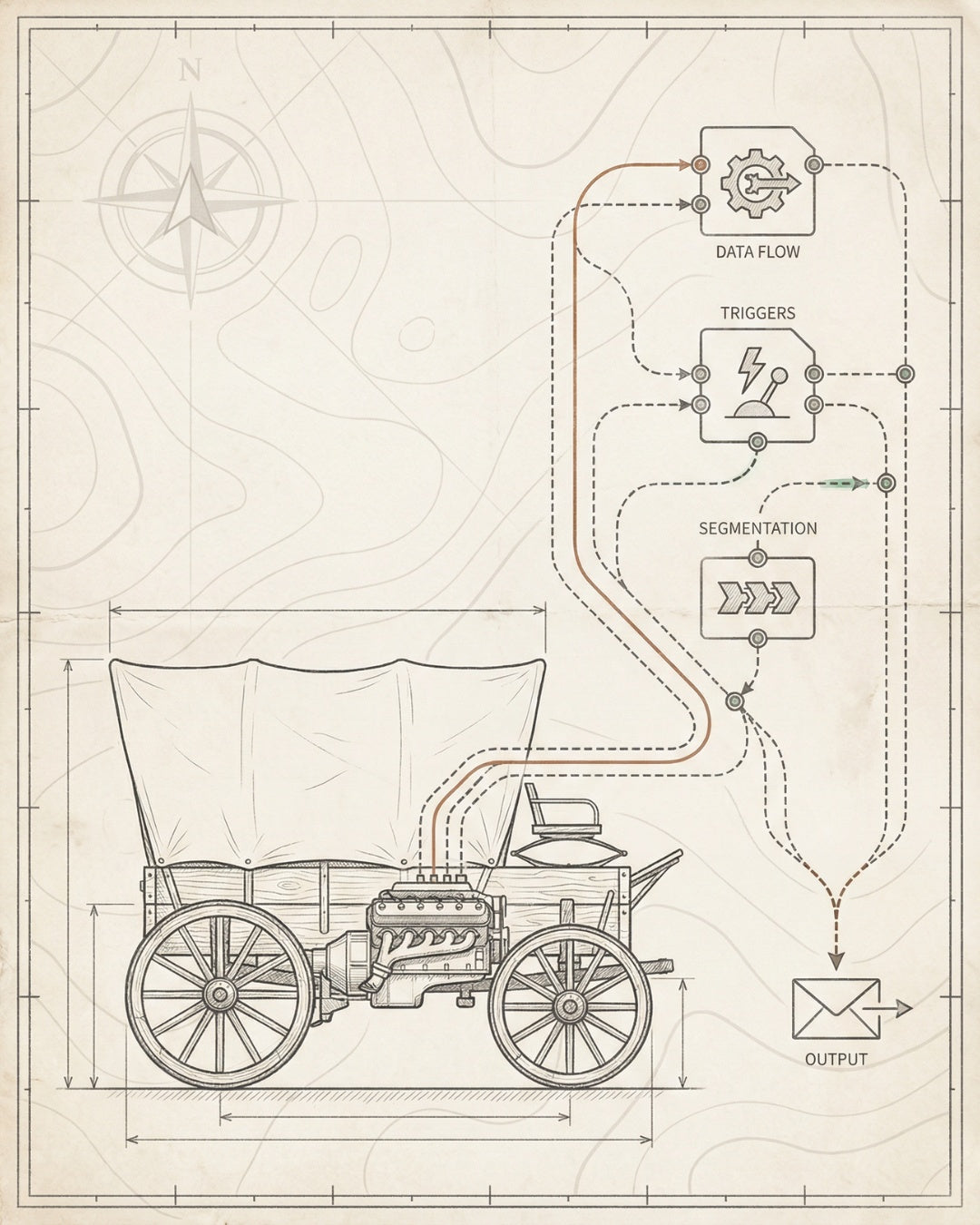
Here’s what they’re missing: SEO isn’t a campaign. It’s infrastructure.**
A real ecommerce site SEO strategy doesn’t start with content. It starts with architecture. With systems that make rankings inevitable, not accidental. With technical foundations that hold under scale—not retainer bloat that collapses when you stop paying.
At Founding Engine, we’ve generated $30M+ in organic revenue for ecommerce brands by building SEO like engineers, not marketers. We don’t deliver task lists. We install systems. And those systems compound.
This is the ecommerce site SEO strategy we build for brands that want to own their organic channel—not rent it.
Strategy ≠ Task List
Most ecommerce SEO audits are expensive to-do lists. A real strategy is infrastructure—technical foundation, site architecture, and systems that compound over time.
4-Layer Foundation First
Crawlability → Indexability → Rankability → Convertibility. Fix the foundation before touching content. Technical architecture makes rankings inevitable.
Architecture That Scales
URL structure, internal linking systems, and category hierarchy designed for 1,000+ products. Build once, scale forever.
AI Search Visibility Layer
Schema markup, entity signals, and structured data for Perplexity, ChatGPT, and AI Overviews. Optimize for machines reading your site, not just humans.
30-Day Sprints, Not Retainers
Audit-to-Throttle Pipeline: build focused systems in 30-day cycles. No retainer bloat. Just infrastructure that holds and compounds.
What You’ll Learn
- The 4-Layer Foundation Every Ecommerce Site SEO Strategy Needs
- Site Architecture That Scales With Your Catalog
- Product Page SEO Infrastructure (Not Just Optimization)
- Content Systems That Drive Discovery and Conversion
- AI Search Visibility Layer
- Technical SEO for Ecommerce at Scale
- How to Build Your Ecommerce Site SEO Strategy (Implementation Blueprint)
- FAQ: 8 Questions Founders Ask About Ecommerce Site SEO Strategy
The 4-Layer Foundation Every Ecommerce Site SEO Strategy Needs
Before you write a single product description or build a single backlink, your ecommerce site needs a foundation that actually holds. Most agencies skip this part because it’s not sexy. It doesn’t generate quick wins for the monthly report.
But without it, everything else collapses.
We call it the 4-Layer SEO Foundation, and it’s the first thing we install for every ecommerce brand:
The 4-Layer SEO Foundation
- Crawlability: Can Google’s bots access and navigate your entire site? If your robots.txt is blocking critical pages, if your JavaScript is hiding content, if your internal linking is broken—Google can’t index what it can’t crawl.
- Indexability: Are your pages eligible to rank? Duplicate content, canonical tag issues, noindex directives, and thin content all prevent pages from entering Google’s index. Fix indexation before you worry about rankings.
- Rankability: Does your site signal authority and relevance? This is where schema markup, Core Web Vitals, mobile optimization, and content quality come in. You’re not just asking Google to index your pages—you’re proving they deserve to rank.
- Convertibility: Do your pages convert traffic into revenue? SEO doesn’t end at rankings. Your site architecture, UX, and product page design determine whether organic traffic becomes customers or bounces.
Most ecommerce site SEO strategies start at Layer 3. That’s why they fail. You can’t rank what isn’t indexed. You can’t index what isn’t crawlable. And you can’t convert traffic on a site that loads slowly and confuses users.
This is why we run a comprehensive ecommerce SEO audit before we build anything. We’re not looking for quick wins. We’re looking for structural problems that will sabotage everything downstream.

Site Architecture That Scales With Your Catalog
Here’s a mistake we see constantly: founders launch with 50 products, build a flat site structure, and then wonder why their site doesn’t rank when they scale to 500 products.
The problem isn’t their content. It’s their architecture.
Your site structure is the skeleton that everything else hangs on. If it’s weak, adding more products just makes the collapse worse. If it’s strong, your site gets more powerful as you scale.
URL Structure That Signals Hierarchy
Your URLs should communicate category relationships to both users and search engines. A good ecommerce site SEO strategy uses URL structure to build semantic context:
- Good: yourstore.com/category/subcategory/product-name
- Bad: yourstore.com/products/12345
The first structure tells Google exactly where this product lives in your catalog. The second is a dead end—no context, no hierarchy, no semantic relationship to other pages.
Category Hierarchy Designed for Discovery
Your category pages aren’t just navigation. They’re SEO landing pages that should rank for high-intent commercial keywords. But most ecommerce sites treat them like afterthoughts—thin content, no optimization, just a grid of products.
A strong category page in an ecommerce site SEO strategy includes:
- 200-400 words of keyword-optimized content above the fold
- Schema markup (CollectionPage or ItemList schema)
- Internal links to subcategories and related content
- Faceted navigation that doesn’t create duplicate content issues
- Optimized title tags and meta descriptions targeting commercial intent
We cover this in depth in our guide to on-page SEO for ecommerce, but the key principle is this: every page in your architecture should serve a purpose in your SEO strategy.
Internal Linking Systems (Not Random Links)
Internal linking is how you distribute authority across your site. But most ecommerce brands do it randomly—“related products” widgets with no strategic logic.
A real internal linking system connects:
- High-authority pages (homepage, top category pages) to target pages you want to rank
- Content pages (blog posts, buying guides) to product and category pages
- Product pages to related products and back to category pages
This isn’t about adding more links. It’s about building link equity pathways that reinforce your site hierarchy and push authority where it matters most.
Pro Tip: Use anchor text strategically. Don’t just say “click here.” Use descriptive, keyword-rich anchor text that tells Google what the target page is about. Example: “high-performance running shoes for trail runners” instead of “shop now.”
Product Page SEO Infrastructure (Not Just Optimization)
Most ecommerce site SEO strategies treat product pages like isolated landing pages. Optimize the title, add some keywords to the description, maybe throw in a review widget, and call it done.
That’s not infrastructure. That’s task-based optimization. And it doesn’t scale.
When you have 500 products—or 5,000—you can’t manually optimize every page. You need systems that generate SEO-ready product pages at scale.
Schema Markup That Feeds AI Search
Product schema isn’t optional anymore. It’s how Google (and AI search engines like Perplexity and ChatGPT) understand what you’re selling, how much it costs, and whether it’s in stock.
Every product page should include:
- Product schema: name, image, description, SKU, brand, price, availability
- Review schema: aggregateRating, reviewCount (if you have reviews)
- Offer schema: price, priceCurrency, availability, url
- BreadcrumbList schema: shows category hierarchy in search results
This isn’t just for rich snippets (though those help CTR). It’s for AI search visibility. When ChatGPT or Perplexity answers a product question, structured data is how they pull accurate information from your site.
We build this into every site we touch. It’s part of our AI search optimization service—because ranking in traditional search isn’t enough anymore.
Title and Meta Description Patterns That Scale
You can’t write 1,000 unique meta descriptions by hand. But you can’t auto-generate garbage either.
The solution: templated patterns with dynamic variables.
Example title pattern:** [Product Name] | [Key Feature] | [Brand Name]
Example meta description pattern:
Shop [Product Name] with [Key Benefit]. [Social Proof]. Free shipping on orders over $[Threshold]. [CTA].
This gives you consistency, keyword optimization, and scalability. You’re not writing 1,000 descriptions. You’re building a system that generates 1,000 optimized descriptions.
Content That Answers Buyer Questions
Thin product descriptions don’t rank. But walls of keyword-stuffed text don’t convert.
The best product pages in an ecommerce site SEO strategy include:
- Above-the-fold clarity:** What it is, who it’s for, why it matters—in 2-3 sentences
- Feature-benefit sections: Not just specs. Why those specs matter to the buyer.
- FAQ sections: Answer common questions (and target “People Also Ask” queries)
- Use cases: Show how the product solves real problems
This is covered in our guide to SEO for ecommerce product pages, but the principle is simple: write for buyers, optimize for search engines.
Content Systems That Drive Discovery and Conversion
Here’s where most ecommerce brands get it wrong: they treat content like a side project. They start a blog, publish a few “10 Tips” posts, and wonder why it doesn’t drive revenue.
Content isn’t a side project. It’s a discovery and conversion system that connects search intent to product pages.
The Content-to-Commerce Architecture
Your content strategy should map to the buyer’s journey:
- Top of funnel (awareness): Educational blog posts, buying guides, comparison articles. Target informational keywords. Goal: capture early-stage traffic and build authority.
- Middle of funnel (consideration): Collection pages, category guides, “best of” roundups. Target commercial investigation keywords. Goal: help buyers evaluate options and build trust.
- Bottom of funnel (decision): Product pages, comparison pages, reviews. Target transactional keywords. Goal: convert traffic into customers.
Every piece of content should have a clear internal linking path to product or category pages. If a blog post doesn’t drive traffic deeper into your site, it’s not part of your ecommerce site SEO strategy—it’s just content for content’s sake.
Collection Pages as SEO Assets
Collection pages (curated product groups) are one of the most underutilized assets in ecommerce SEO. They let you target niche keywords that are too specific for category pages but too broad for individual products.
Examples:
- “Sustainable activewear for yoga”
- “Gifts under $50 for coffee lovers”
- “Beginner-friendly trail running shoes”
Each collection page should include:
- 200-300 words of optimized content explaining the collection’s purpose
- Schema markup (CollectionPage or ItemList)
- Internal links to related categories and content
- Clear CTAs to individual products
This is part of the advanced ecommerce SEO tactics we use to capture long-tail traffic and increase organic visibility across the catalog.
Buying Guides That Rank and Convert
Buying guides are high-intent content assets that target commercial investigation queries like “best [product type] for [use case].”
A strong buying guide includes:
- Clear criteria for evaluation (helps establish authority)
- Product recommendations with internal links to your product pages
- Comparison tables (great for featured snippets)
- FAQ sections targeting “People Also Ask” queries
The goal isn’t just to rank. It’s to guide buyers from research to purchase—on your site.
AI Search Visibility Layer
Google isn’t the only search engine anymore. ChatGPT, Perplexity, Claude, and AI Overviews are answering product questions—and if your site isn’t optimized for AI search, you’re invisible.
This is the newest layer of an ecommerce site SEO strategy, and most brands haven’t built it yet. That’s an opportunity.
Structured Data for LLMs
Large language models don’t read your site like humans do. They parse structured data. If your product information isn’t in a machine-readable format, AI search engines can’t cite you.
Critical schema types for AI search visibility:
- Product schema: Ensures AI engines understand what you’re selling
- Review schema: Provides social proof and trust signals
- Organization schema: Establishes brand entity and authority
- FAQPage schema: Makes your Q&A content directly citable by AI
We build this into every site as part of our AI search optimization service. It’s not optional anymore—it’s foundational.
Entity and Knowledge Graph Signals
AI search engines rely on entity recognition. They need to understand:
- What your brand is
- What products you sell
- How your products relate to categories, use cases, and competitors
Building entity signals means:
- Consistent NAP (name, address, phone) across the web
- Brand mentions on authoritative sites (Wikipedia, industry publications, review sites)
- Structured data that defines your brand and products as entities
- Internal content that reinforces semantic relationships (e.g., linking “running shoes” to “trail running” and “marathon training”)
This is systems-level SEO. It’s not about ranking for one keyword. It’s about becoming a recognized authority in your category—so AI engines cite you by default.
Optimizing for AI Overview Citations
Google’s AI Overviews (formerly SGE) pull information from sites with strong authority signals and clear, structured content.
To increase your chances of being cited:
- Use clear, concise answers to common questions (50-75 words)
- Structure content with H2/H3 headers that match question phrasing
- Include schema markup (especially FAQPage and HowTo)
- Build topical authority with comprehensive content clusters
This isn’t about gaming the system. It’s about making your content easier for machines to understand and cite.

Technical SEO for Ecommerce at Scale
Technical SEO is where most ecommerce site SEO strategies break down. Because it’s not sexy. It’s not content. It’s not links. It’s the plumbing—and when it breaks, everything else fails.
Core Web Vitals: Performance as a Ranking Factor
Google’s Core Web Vitals are non-negotiable. If your site is slow, if it shifts layout while loading, if it’s unresponsive to user input—you’re losing rankings and conversions.
The three metrics that matter:
- LCP (Largest Contentful Paint): How fast your main content loads. Target: under 2.5 seconds.
- CLS (Cumulative Layout Shift): How much your page jumps around while loading. Target: under 0.1.
- INP (Interaction to Next Paint): How quickly your site responds to user interactions. Target: under 200ms.
Fixing Core Web Vitals for ecommerce sites means:
- Optimizing images (WebP format, lazy loading, explicit width/height attributes)
- Reducing JavaScript bloat (especially from third-party apps)
- Using a CDN for faster asset delivery
- Preloading critical resources (fonts, hero images)
- Minimizing render-blocking CSS and JS
This is part of our technical SEO for ecommerce process. We don’t just audit performance—we fix it.
Crawl Budget Optimization for Large Catalogs
If you have 1,000+ products, crawl budget matters. Google doesn’t crawl every page on your site every day. It allocates a crawl budget based on your site’s authority, freshness, and technical health.
Common crawl budget killers:
- Duplicate content from faceted navigation (e.g., filter combinations creating infinite URL variations)
- Low-quality pages (thin content, out-of-stock products with no value)
- Slow server response times
- Broken internal links and redirect chains
To optimize crawl budget:
- Use noindex or canonical tags on faceted navigation pages
- Block low-value pages in robots.txt (e.g., search result pages, filtered views)
- Fix broken links and consolidate redirect chains
- Improve server response time (upgrade hosting if needed)
- Keep your XML sitemap clean—only include indexable, high-value pages
Managing Duplicate Content at Scale
Ecommerce sites are duplicate content factories. Product variants, filtered views, multiple category paths to the same product—all create duplicate content issues.
The solution: canonical tags.
Every product page should have a canonical URL that points to the primary version. If a product lives in multiple categories, pick one canonical path and use rel=canonical on all others.
Example:
- Canonical URL: yourstore.com/running-shoes/trail-runners/product-name
- Alternate URL: yourstore.com/mens-shoes/product-name (canonical tag points to the first URL)
This tells Google which version to index and rank, preventing your pages from competing against themselves.
JavaScript Rendering and SEO
If your ecommerce site is built on a JavaScript framework (React, Vue, Next.js), you need to ensure Google can render your content.
Common JavaScript SEO issues:
- Content not visible in the HTML source (only rendered client-side)
- Internal links not crawlable (JavaScript-only navigation)
- Slow rendering that delays indexation
Solutions:
- Use server-side rendering (SSR) or static site generation (SSG) for critical pages
- Implement dynamic rendering for Googlebot if SSR isn’t feasible
- Test your site with Google’s Mobile-Friendly Test and Rich Results Test to see what Google renders
We build sites on performance-first platforms (Shopify, Astro, headless setups) that are SEO-ready from day one. That’s part of our website design and build service—because you can’t bolt SEO onto a broken foundation.
How to Build Your Ecommerce Site SEO Strategy (Implementation Blueprint)
Strategy without execution is just theory. Here’s how to actually build this—step by step.
Step 1: Run a Foundation Audit
Before you build anything, you need to know what’s broken. Run a comprehensive ecommerce SEO audit that covers:
- Crawlability (robots.txt, sitemap, internal linking)
- Indexation status (Google Search Console, site: search)
- Technical health (Core Web Vitals, mobile usability, HTTPS)
- On-page SEO (title tags, meta descriptions, schema markup)
- Content quality (thin pages, duplicate content, keyword targeting)
This audit becomes your roadmap. You’re not fixing everything at once. You’re prioritizing the blockers that prevent everything else from working.
Step 2: Fix Technical Blockers First
Don’t touch content until the foundation is solid. Fix:
- Crawl errors and broken links
- Robots.txt and sitemap issues
- Canonical tag problems and duplicate content
- HTTPS and security issues
- Core Web Vitals performance issues
This is the Crawlability and Indexability layers of the 4-Layer Foundation. Without these, nothing else matters.
Step 3: Architect Site Structure for Scale
Now you build the skeleton:
- Design URL structure and category hierarchy
- Map keywords to page types (category pages, product pages, content pages)
- Build internal linking systems (content to commerce, category to product)
- Set up faceted navigation with proper canonicalization
This is the Rankability layer. You’re creating the architecture that makes rankings inevitable.
Step 4: Install Schema Markup and AI Signals
Make your site machine-readable:
- Implement Product, Review, and Offer schema on all product pages
- Add BreadcrumbList schema for category hierarchy
- Install Organization schema for brand entity signals
- Add FAQPage and HowTo schema where relevant
This is your AI search visibility layer. You’re optimizing for machines, not just humans.
Step 5: Build Content-to-Commerce Infrastructure
Now you layer in content:
- Optimize category pages with keyword-rich content
- Create collection pages for niche keywords
- Build buying guides and comparison content
- Establish internal linking from content to product pages
This is the Convertibility layer. You’re not just driving traffic—you’re guiding it to conversion.
Step 6: Optimize Core Web Vitals and Performance
Speed is a ranking factor and a conversion factor:
- Optimize images (WebP, lazy loading, explicit dimensions)
- Minimize JavaScript and CSS bloat
- Set up a CDN for faster asset delivery
- Fix layout shift issues (CLS)
- Improve server response time (LCP)
This is part of our ecommerce SEO best practices—because fast sites rank better and convert better.
Step 7: Monitor, Measure, and Throttle
SEO isn’t a one-time build. It’s a system that compounds:
- Connect Google Search Console and monitor indexation, rankings, and CTR
- Track Core Web Vitals in Google Search Console and PageSpeed Insights
- Monitor keyword rankings and organic traffic growth
- Identify high-performing pages and double down on what’s working
- Run quarterly audits to catch new issues before they compound
This is the Audit-to-Throttle Pipeline. You audit, you fix, you build, you scale. No retainer bloat. Just focused cycles that compound over time.
The 30-Day Sprint Model
At Founding Engine, we don’t do retainers. We do 30-day sprints. Each sprint has a clear objective:
- Sprint 1: Foundation audit and technical fixes
- Sprint 2: Site architecture and schema implementation
- Sprint 3: Content infrastructure and internal linking
- Sprint 4: Performance optimization and AI search visibility
After 4 sprints, you have a system that holds. No ongoing retainer. Just infrastructure that compounds.
Learn more about our approach: SEO Infrastructure

Retainer SEO vs. Infrastructure SEO: What’s the Difference?
Approach Retainer SEO Infrastructure SEO
Deliverable Monthly reports, task lists, content calendar Systems that hold and compound over time
Pricing Model Ongoing monthly retainer 30-day sprints, no retainer lock-in
Focus Activities (links built, content published) Outcomes (rankings, traffic, revenue)
Technical Depth Surface-level audits, recommendations Deep technical fixes, schema, performance
AI Search Optimization Not included (most agencies) Built-in: structured data, entity signals
Scalability Manual optimization, doesn’t scale Systems-based, scales with catalog growth
When It Stops Rankings drop, traffic declines Infrastructure holds, continues compounding
This is why we built Founding Engine differently. We’re not an agency selling hours. We’re engineers building systems. Learn more about our pricing: Ecommerce SEO Pricing
FAQ: 8 Questions Founders Ask About Ecommerce Site SEO Strategy
What’s the difference between an ecommerce site SEO strategy and a regular SEO strategy?
An ecommerce site SEO strategy is built for scale and conversion, not just traffic. It focuses on technical architecture (crawl budget, duplicate content management, faceted navigation), product page optimization (schema markup, structured data for AI search), and content-to-commerce systems (category pages, collection pages, buying guides). Regular SEO strategies often focus on blog content and backlinks—which matter, but aren’t sufficient for ecommerce sites with hundreds or thousands of products.
How long does it take to see results from an ecommerce site SEO strategy?
Technical fixes (Core Web Vitals, crawl errors, indexation issues) can show impact in 2-4 weeks. Rankings and traffic growth typically take 3-6 months, depending on your site’s authority and competition. But here’s the key: a well-built ecommerce site SEO strategy compounds over time. Month 6 is better than month 3. Month 12 is better than month 6. That’s the difference between infrastructure and campaigns.
Do I need to hire an agency or can I build this in-house?
It depends on your team’s technical depth and available time. If you have a developer who understands schema markup, Core Web Vitals, and site architecture—and a content strategist who can build keyword-mapped content systems—you can build this in-house. Most founders don’t have that bandwidth. That’s where focused execution partners like Founding Engine come in. We build the infrastructure in 30-day sprints, then hand it off. No retainer lock-in. Learn more: Ecommerce SEO Services
What’s the most important part of an ecommerce site SEO strategy?
The foundation. Specifically, the 4-Layer SEO Foundation: crawlability, indexability, rankability, convertibility. Most agencies skip straight to content and links. But if Google can’t crawl your site, if your pages aren’t indexed, if your Core Web Vitals are failing—nothing else matters. Fix the foundation first. Then build on top of it.
How does AI search optimization fit into an ecommerce site SEO strategy?
AI search is the newest layer of SEO. ChatGPT, Perplexity, and Google’s AI Overviews are answering product questions—and if your site isn’t optimized for AI visibility, you’re invisible. AI search optimization means implementing structured data (Product schema, Review schema, FAQPage schema), building entity signals, and creating machine-readable content. It’s not a separate strategy—it’s part of modern ecommerce SEO. Learn more: AI Search Optimization
What’s the ROI of an ecommerce site SEO strategy?
SEO is the highest-ROI channel for ecommerce—if you build it right. Our clients see an average 250% increase in organic traffic and $30M+ in organic revenue generated across our portfolio. But the real ROI is compounding: once you build the infrastructure, it continues generating traffic and revenue without ongoing spend. Compare that to paid ads, where traffic stops the moment you stop paying. SEO infrastructure holds. See our results: Founding Engine Results
Should I focus on product pages or category pages first?
Matt Hyder
SEO infrastructure and AI search optimization at Founding Engine.
Want SEO that actually holds?
Get a free infrastructure audit from the Founding Engine team.
Get Your Free Audit