How to Do SEO for Ecommerce: The Infrastructure Blueprint
Learn how to do SEO for ecommerce website infrastructure that compounds. Systems-first approach for founders who need rankings that hold, not retainer fluff.
**
SEO INFRASTRUCTURE
How to Do SEO for Ecommerce: The Infrastructure Blueprint
Most ecommerce brands hire SEO agencies that bill hours and ship deliverables. What they actually need is infrastructure — the kind that holds under traffic, compounds over time, and generates revenue while you sleep. Here’s how to build it.

TL;DR — The Infrastructure Blueprint
01 Most ecommerce SEO fails because it treats symptoms, not architecture. Fix the foundation first: crawlability, indexability, site structure.
02 The 4-Layer SEO Foundation is sequential: Crawlability → Indexability → Rankability → Convertibility. Skip a layer and the system breaks.
03 Technical infrastructure comes before content. Core Web Vitals, schema markup, and URL architecture determine whether your content can even compete.
04 AI search optimization is now table stakes. Entity signals, knowledge graphs, and LLM-readable structured data determine Perplexity and ChatGPT visibility.
05 The Audit-to-Throttle Pipeline: 30-day sprints that replace retainers. Build infrastructure in focused cycles, measure what compounds, scale what works.
What You’ll Learn
- Why Most Ecommerce SEO Fails (The Architecture Problem)
- The 4-Layer SEO Foundation Every Store Needs
- Technical Infrastructure: What to Build First
- Content Architecture That Scales
- AI Search Optimization for Ecommerce
- The Audit-to-Throttle Pipeline (Implementation Framework)
- Measuring What Compounds
Why Most Ecommerce SEO Fails (The Architecture Problem)
You’ve seen the pattern: hire an SEO agency, get an audit, receive a 47-page PDF with color-coded priorities, watch them publish blog posts for six months, see traffic tick up slightly, then plateau. The retainer continues. The rankings don’t compound.
The problem isn’t effort. It’s architecture.
Most ecommerce SEO services treat symptoms — thin content, missing meta descriptions, slow page speed — without addressing the structural issues that prevent those fixes from compounding. They’re adding floors to a building with no foundation.
Here’s what actually breaks at scale:
- Crawl budget waste:** Google discovers 10,000 URLs but only 2,000 matter. The rest are faceted navigation, session IDs, and parameter variations bleeding your crawl budget.
- Indexation chaos: Product pages with duplicate content, category pages cannibalizing each other, and no systematic approach to which pages should rank for which queries.
- Performance debt: Core Web Vitals failing because the site was built for aesthetics, not speed. Every new feature adds render-blocking JavaScript.
- Schema gaps: Missing or incorrect structured data means Google can’t understand your product catalog, pricing, availability, or reviews.
- Internal linking anarchy: No systematic approach to link equity distribution. Your best products get the same internal link authority as your returns policy.
These aren’t isolated issues. They’re symptoms of missing infrastructure.
The Compound Visibility Stack (CVS)
At Founding Engine, we use the Compound Visibility Stack as the foundation for every ecommerce build:
Website × Content × Technical × Distribution
Each layer multiplies the others. A fast website makes content more discoverable. Technical infrastructure makes distribution more effective. When one layer is broken, the entire system underperforms. When all four are aligned, visibility compounds exponentially.
This is why we don’t do retainers. We install infrastructure in 30-day sprints, then hand you the system. You either have the foundation or you don’t. There’s no middle ground.
The 4-Layer SEO Foundation Every Store Needs

Before you touch a single keyword or write a single product description, you need to understand the sequence. SEO for ecommerce websites isn’t a checklist — it’s a build order.
The 4-Layer SEO Foundation is sequential. Each layer depends on the one before it. Skip crawlability and your indexation strategy is irrelevant. Ignore indexability and your content won’t rank no matter how good it is.
Layer 1: Crawlability
Question: Can Google’s crawler efficiently discover and access every page that should rank?
Crawlability is the foundation. If Google can’t crawl your pages efficiently, nothing else matters. For ecommerce sites, this is where most technical debt lives:
- Robots.txt configuration: Are you accidentally blocking important pages? Are you allowing crawlers to waste time on faceted navigation?
- XML sitemap structure: Does your sitemap include only indexable pages? Is it segmented by content type (products, categories, content)?
- URL structure: Are your URLs clean, logical, and hierarchical? Or are they parameter-heavy and session-based?
- Server response codes: Are 404s properly handled? Are redirects chains slowing crawl efficiency?
- Crawl budget optimization: For large catalogs (1,000+ products), are you directing crawl budget toward high-value pages?
The technical audit we run at Founding Engine starts here. We map every crawl path, identify bottlenecks, and eliminate waste before touching content. This is technical SEO for ecommerce in its purest form.
Layer 2: Indexability
Question: Of the pages Google can crawl, which ones should be indexed and for which queries?
Indexability is strategic. You don’t want every page indexed — you want the right pages indexed for the right reasons:
- Canonical tag strategy: Consolidate duplicate content across product variations, color options, and size selectors.
- Meta robots directives: Use noindex strategically for low-value pages (filters, sort parameters, checkout flows).
- Content uniqueness: Every indexable page needs unique, valuable content. Thin product descriptions kill indexation.
- Pagination handling: Are you using rel=“next/prev”, canonical consolidation, or View All pages?
- HTTPS implementation: Mixed content issues and insecure pages won’t index properly.
This is where most ecommerce SEO audits find the biggest wins. Fixing indexation issues can double your indexed page count and eliminate keyword cannibalization overnight.
Layer 3: Rankability
Question: Of the pages that are indexed, which ones can actually compete for target queries?
Rankability is where content, technical performance, and user experience converge:
- Core Web Vitals: LCP under 2.5s, FID under 100ms, CLS under 0.1. These are table stakes, not aspirations.
- Schema markup: Product schema, review schema, breadcrumb schema, organization schema. Make your data machine-readable.
- Content depth: Product pages need more than a title and price. Add usage guides, specifications, comparison tables, and FAQs.
- Internal linking architecture: Systematic link equity distribution from high-authority pages to target pages.
- Mobile optimization: Not just responsive design — true mobile-first architecture with touch-optimized navigation.
This is where on-page SEO for ecommerce becomes infrastructure. You’re not optimizing individual pages — you’re building systems that make every new product page rankable by default.
Layer 4: Convertibility
Question: Of the users who land on ranked pages, how many convert to customers?
Convertibility closes the loop. Traffic without revenue is vanity. This layer connects SEO to business outcomes:
- User intent alignment: Does the page answer the query that brought the user there?
- Conversion path optimization: Clear CTAs, minimal friction, trust signals (reviews, guarantees, security badges).
- Page speed under load: Performance during traffic spikes, not just in lab tests.
- Cross-sell and upsell architecture: Related products, bundles, and recommendations that increase AOV.
- Exit intent capture: Email collection, cart abandonment flows, and retargeting pixels.
We measure this layer through organic revenue attribution, not just traffic. If rankings aren’t generating revenue, the system needs recalibration.
$30M+ Organic Revenue Generated
250% Avg. Traffic Increase
500+ Page 1 Rankings
Technical Infrastructure: What to Build First
When founders ask us how to do SEO for ecommerce website infrastructure, they expect a content strategy. We start with architecture.
Technical infrastructure is the difference between rankings that hold and rankings that evaporate with the next algorithm update. Here’s what to build first, in order:
1. Site Architecture and URL Structure
Your URL structure is your information architecture made visible. It should be logical, hierarchical, and keyword-informed:
- Category structure: /category/subcategory/product creates clear hierarchy and distributes link equity systematically.
- Clean URLs: No session IDs, no unnecessary parameters, no dynamically generated strings. Human-readable = crawler-readable.
- Breadcrumb navigation: Matches URL structure and uses structured data to create breadcrumb rich results.
- Faceted navigation control: Use URL parameters strategically (color, size, price) but prevent them from creating duplicate content.
This is foundational work. Changing URL structure after launch is expensive and risky. Get it right from day one.
2. Core Web Vitals and Performance
Page speed isn’t a ranking factor — it’s a prerequisite. Google’s Core Web Vitals are the minimum viable performance standard:
- Largest Contentful Paint (LCP): Under 2.5 seconds. Optimize hero images, eliminate render-blocking resources, use CDN delivery.
- First Input Delay (FID): Under 100ms. Minimize JavaScript execution time, defer non-critical scripts, use code splitting.
- Cumulative Layout Shift (CLS): Under 0.1. Reserve space for images, avoid dynamic content injection, use proper font loading.
For ecommerce, performance under load matters more than lab scores. Test with realistic product catalogs, high-resolution images, and third-party scripts (analytics, reviews, chat widgets).
We build every site at Founding Engine with performance-first architecture — headless platforms, optimized asset delivery, and edge caching. Speed is infrastructure, not optimization.
3. Schema Markup for Products
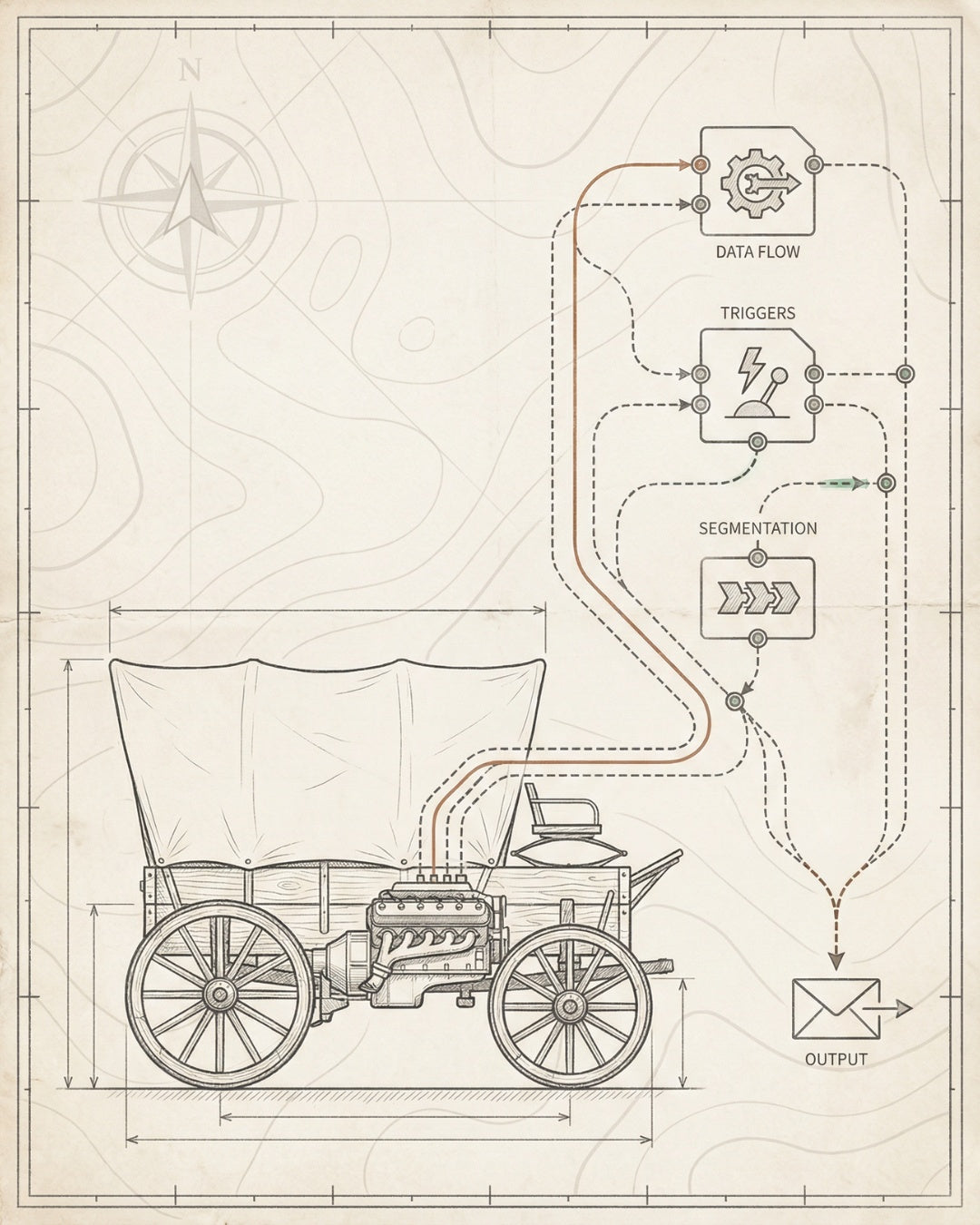
Schema markup is how you communicate with search engines and AI models. For ecommerce, these schema types are non-negotiable:
- Product schema: Name, description, image, SKU, brand, price, availability, condition. This feeds Google Shopping, rich results, and AI overviews.
- Review schema: Aggregate ratings and individual reviews. Star ratings in search results increase CTR by 15-30%.
- Breadcrumb schema: Creates breadcrumb trails in search results and helps Google understand site structure.
- Organization schema: Brand identity, logo, social profiles, contact information. Builds entity recognition.
- FAQ schema: Captures “People Also Ask” real estate (though rich results are limited to specific niches).
Schema isn’t optional. It’s the language Google and AI models use to understand your catalog. Without it, you’re invisible to AI search.
4. Mobile-First Architecture
Google indexes mobile-first. If your mobile experience is broken, your desktop rankings suffer:
- Touch-optimized navigation: Buttons and links sized for thumbs, not mouse cursors.
- Simplified checkout: Mobile checkout abandonment is 2-3x higher than desktop. Reduce friction.
- Responsive images: Serve appropriately sized images based on viewport. Don’t load 2MB desktop images on mobile.
- Readable typography: 16px minimum font size, adequate line height, sufficient contrast.
This is table stakes for ecommerce SEO best practices. Mobile isn’t a separate strategy — it’s the primary experience.
Content Architecture That Scales
Content without architecture is just blog posts. Content with architecture is a ranking system.
Here’s how to build content infrastructure that compounds:
Keyword Mapping for Product and Category Pages
Every page needs a primary keyword target and a clear intent alignment. For ecommerce, this means:
- Product pages: Target product-specific queries (“brand + product name”) and transactional modifiers (“buy,” “price,” “reviews”).
- Category pages: Target broader category queries (“men’s running shoes”) and comparison queries (“best running shoes for flat feet”).
- Content pages: Target informational queries (“how to choose running shoes”) that feed into product pages.
Map keywords to pages systematically. One primary keyword per page. No cannibalization. No overlap. This is SEO for ecommerce product pages done right.
Internal Linking Systems
Internal linking isn’t random. It’s architecture. Here’s the system:
- Hub-and-spoke model: Category pages (hubs) link to product pages (spokes). Product pages link back to categories and to related products.
- Contextual linking: Link from high-authority pages (homepage, popular categories) to pages you want to rank.
- Anchor text strategy: Use descriptive, keyword-rich anchor text. Avoid “click here” or “learn more.”
- Link equity distribution: Prioritize internal links to your best-converting products and highest-margin categories.
We automate internal linking at scale using content clusters and programmatic link insertion. Every new product page gets linked into the architecture automatically.
AI-Readable Structured Data
AI models (ChatGPT, Perplexity, Google’s AI Overviews) don’t read your site like humans do. They parse structured data. To appear in AI search results, you need:
- Clean JSON-LD schema: Properly formatted, error-free structured data that validates in Google’s Rich Results Test.
- Entity relationships: Connect your products to broader entities (brands, categories, use cases) using schema properties.
- Attribute completeness: The more product attributes you include (color, size, material, weight), the more likely AI models will surface your products.
- Knowledge graph signals: Link to authoritative sources (Wikipedia, industry databases) to strengthen entity recognition.
This is the future of search. If your content isn’t machine-readable, it’s invisible to AI.
AI Search Optimization for Ecommerce

Traditional SEO optimizes for Google’s algorithm. AI search optimization optimizes for how large language models understand and cite information.
Here’s what’s different:
Entity Signals and Knowledge Graphs
AI models don’t rank pages — they understand entities (people, places, products, brands). To appear in AI-generated answers, you need strong entity signals:
- Consistent NAP data: Name, Address, Phone number must be identical across your site, Google Business Profile, and third-party directories.
- Brand mentions: Get cited by authoritative sources. Press coverage, industry publications, and review sites strengthen your entity.
- Structured data completeness: Organization schema, product schema, and breadcrumb schema help AI models understand your brand’s scope and offerings.
- Wikipedia and Wikidata presence: If your brand has a Wikipedia page, claim and optimize it. Wikidata is the knowledge graph foundation for many AI models.
Structured Data for LLMs
Large language models prefer structured, machine-readable data over unstructured text. Here’s how to format content for AI consumption:
- JSON-LD over microdata: JSON-LD is easier for AI models to parse and doesn’t clutter your HTML.
- Complete product attributes: Include every relevant attribute in your product schema (brand, model, SKU, GTIN, color, size, material, weight, dimensions).
- FAQ structured data: Even though FAQ rich results are limited, FAQ schema helps AI models extract question-answer pairs.
- How-to structured data: For content pages, use HowTo schema to break down processes into machine-readable steps.
Perplexity and ChatGPT Visibility
Perplexity and ChatGPT don’t use Google’s index — they use their own retrieval systems. To appear in their results:
- Citation-worthy content: AI models cite sources that are authoritative, well-structured, and factually accurate. Write for citation, not clicks.
- Clear attribution: Use author bylines, publication dates, and source citations. AI models prefer content with clear provenance.
- Semantic HTML: Use proper heading hierarchy (H1 → H2 → H3), lists, tables, and semantic tags. Structure matters.
- API accessibility: Some AI models access content via APIs. Ensure your product catalog has a clean, documented API.
This is new territory. Most ecommerce brands aren’t optimizing for AI search yet. That’s the opportunity.
The Audit-to-Throttle Pipeline (Implementation Framework)
Knowing what to build is one thing. Knowing how to build it systematically is another.
The Audit-to-Throttle Pipeline is our implementation framework at Founding Engine. It replaces open-ended retainers with focused 30-day sprints:
Phase 1: Audit (Days 1-7)
We don’t audit to create work — we audit to find the highest-leverage fixes:
- Technical crawl: Full site crawl using Screaming Frog or Sitebulb. Identify crawl errors, redirect chains, broken links, and indexation issues.
- Core Web Vitals assessment: Real-user data from Google Search Console and PageSpeed Insights. Lab tests using Lighthouse and WebPageTest.
- Schema validation: Test all structured data using Google’s Rich Results Test and Schema Markup Validator.
- Competitor gap analysis: Identify keywords and content types where competitors rank but you don’t.
- Conversion path audit: Map user journeys from search to conversion. Identify drop-off points.
Output: A prioritized build queue. Not a 47-page PDF — a Notion board with sequenced tasks.
Phase 2: Foundation (Days 8-14)
Fix the technical foundation before touching content:
- Crawlability fixes: Robots.txt optimization, XML sitemap cleanup, URL structure corrections.
- Indexability strategy: Canonical tag implementation, noindex directives for low-value pages, duplicate content consolidation.
- Performance optimization: Image compression, lazy loading, JavaScript deferral, CDN setup.
- Schema installation: Product schema, review schema, breadcrumb schema, organization schema.
This is where ecommerce SEO optimization starts. Foundation first, content second.
Phase 3: Content Build (Days 15-21)
With the foundation in place, build content infrastructure:
- Keyword mapping: Assign primary keywords to product and category pages. No overlap.
- On-page optimization: Title tags, meta descriptions, H1 tags, image alt text, internal linking.
- Content expansion: Add product descriptions, usage guides, FAQs, and comparison tables to thin pages.
- Internal linking architecture: Build hub-and-spoke linking between categories and products.
Phase 4: Distribution (Days 22-28)
Connect the infrastructure to distribution channels:
- Google Search Console setup: Submit sitemaps, monitor indexation, track ranking changes.
- AI search signals: Optimize for entity recognition, knowledge graph connections, and citation-worthy content.
- Email capture flows: Install exit-intent popups, content upgrades, and cart abandonment sequences.
- Performance monitoring: Set up rank tracking, organic traffic dashboards, and revenue attribution.
Phase 5: Throttle (Days 29-30)
Measure what’s working, scale what compounds:
- Ranking velocity analysis: Which pages are gaining rankings fastest? Double down on those content types.
- Conversion rate tracking: Which landing pages convert best? Replicate that structure.
- Organic revenue attribution: Connect rankings to revenue. Kill what doesn’t convert.
After 30 days, you either have traction or you don’t. If you have traction, throttle. If you don’t, we recalibrate and run another sprint.
This is how we’ve generated $30M+ in organic revenue for 50+ brands. No retainers. No fluff. Just infrastructure that holds.
Measuring What Compounds
Most ecommerce brands measure the wrong things. They track rankings, traffic, and impressions — vanity metrics that don’t pay the bills.
Here’s what actually matters:
Ranking Velocity
How fast are you gaining rankings? Velocity matters more than absolute position:
- Position change rate: Are you moving from page 3 to page 2 to page 1? Or stuck on page 2 forever?
- Keyword expansion: Are you ranking for more keywords over time? Compound visibility means more keywords, not just better positions.
- Featured snippet capture: Are you winning position zero for high-intent queries?
Track ranking velocity weekly. If velocity stalls, the system needs recalibration.
Organic Revenue Attribution
Traffic without revenue is a hobby. Measure organic revenue directly:
- Landing page revenue: Which pages drive the most revenue? Prioritize those in internal linking and content expansion.
- Assisted conversions: Track multi-touch attribution. SEO often assists conversions that close via email or direct traffic.
- Customer lifetime value (LTV): Organic customers often have higher LTV than paid customers. Measure retention, not just acquisition.
We track organic revenue as the primary KPI. Everything else is a leading indicator.
Compound Visibility Index
We built a custom metric at Founding Engine called the Compound Visibility Index (CVI):
CVI = (Indexed Pages × Avg. Position × Organic CTR × Conversion Rate)
It’s a single number that captures whether your visibility is compounding or plateauing. If CVI is increasing month-over-month, the system is working. If it’s flat, something’s broken.
Metric Type Vanity Metrics Compound Metrics
Traffic Total sessions Organic sessions from target keywords
Rankings Total keywords ranked Ranking velocity for high-intent keywords
Conversions Total conversions Organic revenue and LTV by landing page
Visibility Impressions Compound Visibility Index (CVI)
Measure what compounds. Ignore what doesn’t.
How to Implement This (The Build Sequence)
You’ve read the theory. Here’s the execution plan for how to do SEO for ecommerce website infrastructure in 30 days:
Week 1: Audit and Foundation
- Run a full technical SEO audit using Screaming Frog or Sitebulb
- Test Core Web Vitals using PageSpeed Insights and WebPageTest
- Validate all existing schema markup using Google’s Rich Results Test
- Fix critical crawlability issues (robots.txt, sitemap, broken links)
- Implement canonical tags and noindex directives for duplicate content
Week 2: Technical Infrastructure
- Optimize Core Web Vitals (image compression, lazy loading, JavaScript deferral)
- Install product schema, review schema, and breadcrumb schema on all relevant pages
- Build clean URL structure with logical hierarchy
- Set up XML sitemaps segmented by content type
- Configure Google Search Console and submit sitemaps
Week 3: Content Architecture
- Map primary keywords to product and category pages (one keyword per page)
- Optimize title tags, meta descriptions, and H1 tags for target keywords
- Expand thin product pages with descriptions, FAQs, and usage guides
- Build internal linking architecture (hub-and-spoke model)
- Add image alt text with descriptive, keyword-rich descriptions
Week 4: Distribution and Monitoring
- Optimize for AI search (entity signals, knowledge graph connections, citation-worthy content)
- Set up rank tracking for target keywords
- Configure organic revenue attribution in Google Analytics
- Install exit-intent email capture flows
- Monitor ranking velocity and Compound Visibility Index (CVI)
This is the ecommerce SEO checklist we use for every client. It’s systematic, sequential, and designed to compound.
If you need help executing this, we install the infrastructure for you in 30-day sprints. No retainers. No fluff. Just SEO infrastructure that holds.
Frequently Asked Questions
How long does it take to see results from ecommerce SEO? +
If you’re fixing technical infrastructure (crawlability, indexability, Core Web Vitals), you’ll see indexation improvements within 2-4 weeks. Ranking improvements typically appear within 60-90 days for competitive keywords, faster for long-tail queries. The key is velocity — are you gaining rankings faster each month? If you’re building infrastructure correctly, visibility compounds exponentially after the 90-day mark.
What’s the difference between ecommerce SEO and regular SEO? +
Ecommerce SEO prioritizes product and category pages over content pages, requires product schema markup for rich results, deals with large-scale indexation challenges (1,000+ products), optimizes for transactional intent rather than informational queries, and focuses on organic revenue attribution instead of just traffic. The technical complexity is higher because you’re managing dynamic inventory, faceted navigation, and conversion optimization simultaneously.
Do I need to hire an agency or can I do ecommerce SEO myself? +
You can DIY the basics (keyword research, title tags, meta descriptions) but technical infrastructure requires specialized expertise: Core Web Vitals optimization, schema markup implementation, crawl budget management, and AI search optimization. Most founders underestimate the complexity and waste 6-12 months on surface-level fixes. If you’re doing $500K+ in revenue, the opportunity cost of DIY exceeds the cost of expert execution. Consider hiring strategically.
How much does ecommerce SEO cost? +
Traditional agencies charge $3,000-$10,000/month on retainer. At Founding Engine, we use 30-day sprint pricing: one-time infrastructure builds ranging from $8,000-$25,000 depending on site size and complexity. No retainers. You pay for infrastructure installation, not ongoing hours. For a detailed breakdown, see our ecommerce SEO pricing guide.
What’s the most important ranking factor for ecommerce sites? +
There’s no single factor — it’s the system. But if forced to prioritize: technical crawlability and indexability are foundational (you can’t rank if Google can’t crawl and index), Core Web Vitals are table stakes (slow sites don’t compete), and product schema markup is critical for rich results and AI search visibility. Content quality matters, but only after the technical foundation is solid. Most brands fail because they optimize content on a broken technical foundation.
How do I optimize product pages for SEO? +
Start with technical prerequisites: unique URLs, proper canonical tags, fast load times (LCP under 2.5s), and mobile-first design. Then add content infrastructure: keyword-optimized title tags and H1s, unique product descriptions (150+ words), high-quality images with descriptive alt text, customer reviews, FAQs, and related product links. Install product schema markup with complete attributes (price, availability, reviews, SKU). Finally, build internal links from category pages and related products. For a complete guide, see SEO for ecommerce product pages.
What is AI search optimization and why does it matter? +
AI search optimization is the process of making your content discoverable and citable by large language models (ChatGPT, Perplexity, Google’s AI Overviews). It matters because AI-generated answers are replacing traditional search results for many queries. To optimize for AI search, you need: complete structured data (JSON-LD schema), strong entity signals (brand mentions, knowledge graph connections), citation-worthy content (authoritative, well-sourced, clearly attributed), and semantic HTML structure. Learn more about our AI search optimization services.
How do I measure if my ecommerce SEO is working? +
Track these metrics in order of priority: (1) Organic revenue and revenue per session, (2) Ranking velocity for target keywords (are you moving up faster each month?), (3) Indexed pages and indexation ratio (indexed pages / total pages), (4) Core Web Vitals passing rate, (5) Organic traffic from target keywords (not total traffic), and (6) Compound Visibility Index (indexed pages × avg. position × CTR × conversion rate). Ignore vanity metrics like total impressions or keyword count. Measure what compounds and directly impacts revenue.
Matt Hyder
SEO infrastructure and AI search optimization at Founding Engine.
Want SEO that actually holds?
Get a free infrastructure audit from the Founding Engine team.
Get Your Free Audit