Modified Ecommerce SEO: The Infrastructure Build That Scales
Modified ecommerce SEO isn't a checklist—it's a custom-built infrastructure. Learn the systems-first approach that generates compound organic revenue for DTC brands.
**

Slide 1
Modified ecommerce SEO isn’t a checklist—it’s custom infrastructure built for your platform’s constraints and your catalog’s architecture.
Slide 2
The 4-Layer Foundation (Crawlability → Indexability → Rankability → Convertibility) adapts to your store’s size, platform, and technical limitations.
Slide 3
Platform-specific modifications solve technical constraints—Shopify’s URL structure, headless rendering delays, custom build indexation issues.
Slide 4
Custom internal linking distributes authority based on product margins and search volume—not just category hierarchy.
Slide 5
AI search requires modified structured data—entity signals, knowledge graph connections, and LLM-readable product catalogs built for your brand.
You’ve read the ecommerce SEO guides. You’ve installed the plugins. You’ve followed the checklists. And your organic traffic is… fine. Not compounding. Not scaling. Just fine.
Here’s why: most ecommerce SEO services apply the same template to every store. Same audit. Same recommendations. Same “best practices” that worked for a Shopify store in 2019 but break on your headless build in 2026.
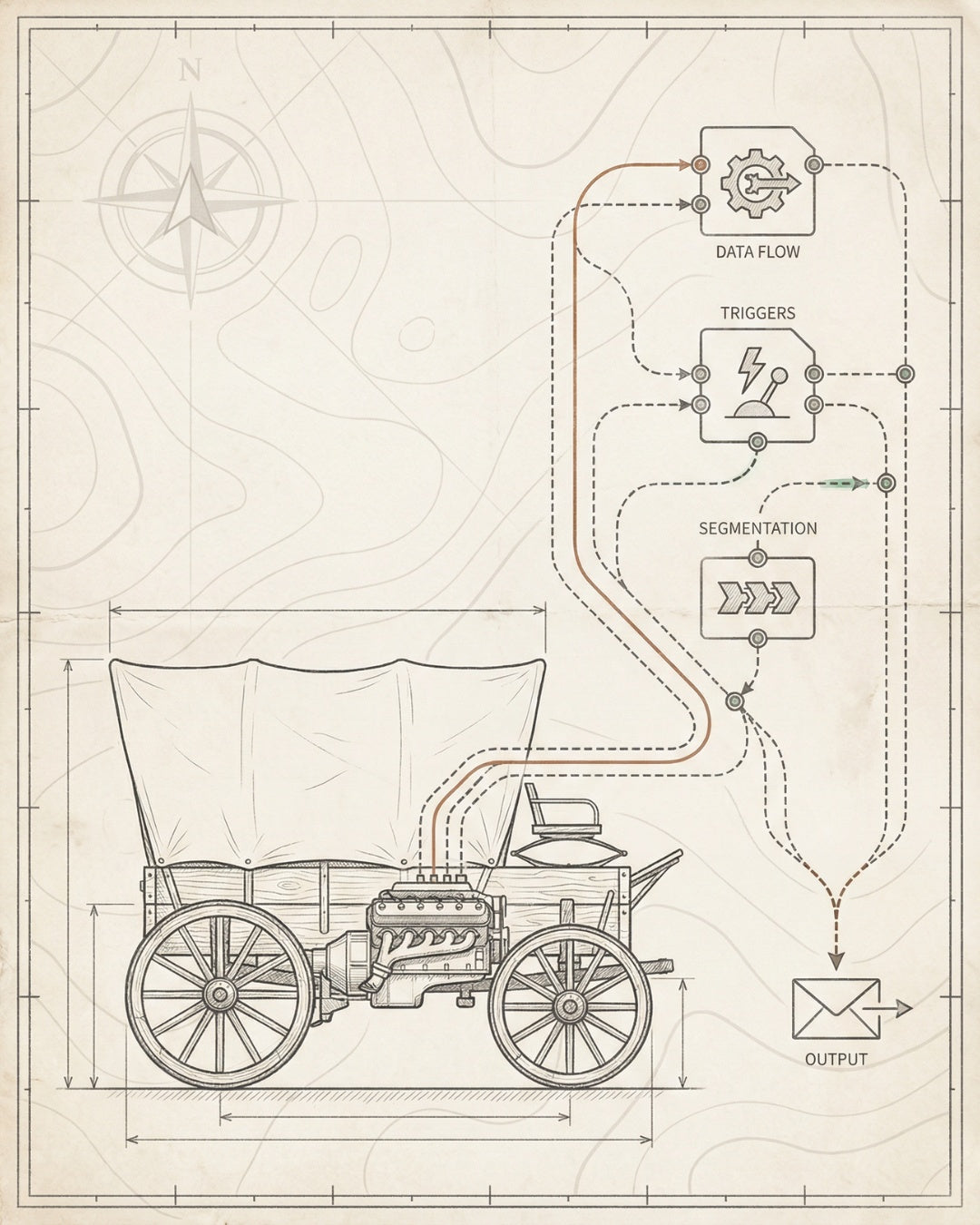
Modified ecommerce SEO is different. It’s not a checklist—it’s a custom-built infrastructure system engineered for your platform’s technical constraints, your catalog’s taxonomy, and your revenue model’s growth trajectory. It’s the difference between installing WordPress plugins and architecting a system that compounds.
This is the infrastructure approach that’s generated $30M+ in organic revenue across 50+ ecommerce brands. Not through templates. Through modified builds.
What Modified Ecommerce SEO Actually Means
Modified ecommerce SEO is the practice of customizing SEO infrastructure to fit your store’s specific technical architecture, catalog structure, and business constraints—rather than forcing your store into a one-size-fits-all template.
Think of it like this: standard ecommerce SEO is buying a pre-fab house. Modified ecommerce SEO is hiring an architect to design a custom build for your specific lot, climate, and how you actually live.
Why Templates Break at Scale
Most ecommerce SEO best practices assume:
- You’re on Shopify or WooCommerce with standard theme structures
- Your catalog has fewer than 1,000 products with simple category hierarchies
- Your internal linking can follow a basic breadcrumb pattern
- Your product pages all convert at similar rates
- Your platform handles Core Web Vitals out of the box
But what if you’re running a headless Shopify build with 10,000 SKUs across a custom taxonomy? What if your hero products have 60% margins but your long-tail has 15%? What if your platform’s JavaScript rendering creates indexation delays?
Standard templates don’t account for these variables. Modified infrastructure does.
The Modified Difference:** A standard audit might flag “duplicate content” on your variant pages. A modified approach designs a custom canonicalization strategy that preserves long-tail rankings while consolidating authority—specific to how your variants actually convert.
The Three Pillars of Modified SEO
Modified ecommerce SEO rests on three custom-built pillars:
- Platform-Specific Technical Architecture — Custom solutions for your CMS, rendering method, and hosting environment
- Catalog-Adapted Content Structure — Taxonomy, internal linking, and schema designed for your specific product relationships and margins
- Revenue-Weighted Optimization — Prioritizing SEO investments based on actual conversion data and customer LTV, not just search volume
This is what we call the Compound Visibility Stack: Website × Content × Technical × Distribution, each layer modified for your specific growth constraints.

The 4-Layer Foundation for Modified SEO
Every modified ecommerce SEO build follows the same four-layer foundation—but each layer is customized for your store’s specific architecture. This is the framework that replaced the old “technical SEO checklist” model.
Layer 1: Crawlability (Modified for Your Platform)
Standard approach: Submit a sitemap, check robots.txt, move on.
Modified approach: Design a custom crawl budget allocation strategy based on your catalog size and update frequency.
For a Shopify store with 500 products, standard crawlability works fine. For a headless build with 15,000 SKUs and daily inventory updates, you need:
- Custom sitemap segmentation by product category and update frequency
- Dynamic robots.txt rules that prevent crawl waste on filter pages and out-of-stock variants
- Server-side rendering for critical product pages, client-side for low-priority content
- Crawl budget monitoring and reallocation based on seasonal demand shifts
This is technical SEO for ecommerce at the infrastructure level—not just fixing broken links.
Layer 2: Indexability (Modified for Your Catalog)
Standard approach: Noindex duplicate pages, canonical to the main version.
Modified approach: Build a custom indexation strategy that balances long-tail discovery with authority consolidation.
Example modification: A footwear brand with color variants might:
- Index the primary product page (e.g., “Running Shoe - Black”)
- Canonical all color variants to the primary, but include variant-specific structured data
- Create separate indexed pages for high-demand colorways with unique search intent (e.g., “White Running Shoes”)
- Noindex size-only variants while preserving them in the product schema
This requires custom logic in your CMS—not a blanket rule applied to every product.
Layer 3: Rankability (Modified for Your Competition)
Standard approach: Optimize title tags, write meta descriptions, build backlinks.
Modified approach: Design a custom content and authority distribution system based on your competitive landscape and margin structure.
A modified rankability layer includes:
- Keyword mapping that prioritizes high-margin products over high-volume keywords
- Custom internal linking that distributes authority based on conversion probability, not just category hierarchy
- Entity-based content clusters that build topical authority for your brand’s specific niche
- Backlink acquisition strategies tailored to your industry’s link graph (not generic “guest posting”)
This is where advanced ecommerce SEO separates from basic optimization—you’re building a system, not optimizing pages.
Layer 4: Convertibility (Modified for Your Funnel)
Standard approach: Add CTAs, optimize product descriptions, improve site speed.
Modified approach: Build a conversion architecture that adapts to different traffic segments and search intents.
A modified convertibility layer might include:
- Custom landing page templates for different query types (informational vs. transactional)
- Dynamic pricing and promotion displays based on traffic source and user behavior
- Segment-specific trust signals (reviews for cold traffic, specs for warm traffic)
- Custom checkout flows for high-value organic segments
This requires integration between your SEO infrastructure and your conversion optimization stack—not just “SEO-friendly” product pages.
Why This Matters: A standard ecommerce SEO audit checks boxes. A modified 4-layer build creates compound growth systems that adapt as your catalog and revenue scale.
Platform-Specific Modifications That Matter
Your ecommerce platform isn’t just a hosting choice—it’s a set of technical constraints that require custom SEO solutions. Here’s how modified ecommerce SEO adapts to the three most common platform types.
Shopify: Modified URL Structure & App Bloat
Shopify’s strengths: Fast setup, reliable hosting, built-in CDN.
Shopify’s constraints that require modification:
- /collections/ and /products/ URL prefixes — Can’t be removed without custom routing, impacts keyword targeting
- App-generated code bloat — Third-party apps inject JavaScript that kills Core Web Vitals
- Limited control over rendering — Server-side rendering options are constrained
- Duplicate content from variant pages — Requires custom canonicalization logic
Modified solutions for Shopify:
- Custom Liquid templates that minimize app dependencies and control rendering priority
- Strategic use of Shopify’s metafields for structured data instead of third-party schema apps
- Custom internal linking logic that bypasses collection pages for high-priority product links
- Performance budgets that limit app installation based on Core Web Vitals impact
This is why best ecommerce SEO for Shopify looks different than best practices for headless builds—the platform dictates the modifications.
Headless: Modified Rendering & Indexation Delays
Headless strengths: Full design control, modern tech stack, performance potential.
Headless constraints that require modification:
- JavaScript rendering delays — Google has to render your pages, slowing indexation
- Client-side routing — Can break crawlability if not properly configured
- Complex build pipelines — Changes take longer to deploy, slowing iteration
- Custom everything — No built-in SEO guardrails like traditional CMS platforms
Modified solutions for headless:
- Hybrid rendering strategy: server-side for product pages, static for content, client-side for UI
- Custom prerendering service for critical pages to eliminate rendering delays
- Structured deployment pipeline with automated SEO checks before production
- Custom analytics layer to track rendering performance and indexation velocity
Headless requires the most modification—but done right, it’s the most scalable SEO infrastructure you can build.
Custom Builds: Modified Everything
If you’ve built your ecommerce platform from scratch (or heavily customized an open-source solution), every SEO decision is a modification. There are no defaults to fall back on.
Critical modifications for custom builds:
- Custom sitemap generation logic tied to your product database and inventory system
- Programmatic schema markup that adapts to your unique product attributes
- Custom canonicalization rules based on your specific URL parameter structure
- Performance monitoring integrated into your build pipeline, not bolted on later
The advantage: you control everything. The risk: everything has to be custom-built. This is where SEO infrastructure services become critical—you need engineers who understand both SEO and your tech stack.
Platform Type Primary Constraint Key Modification
Shopify URL structure & app bloat Custom Liquid templates + performance budgets
Headless (Next.js, Astro, etc.) Rendering delays & complexity Hybrid rendering + prerendering service
Custom Build No defaults, everything manual Programmatic SEO systems + integrated monitoring
WooCommerce WordPress overhead & plugin conflicts Minimal plugin stack + custom post types

Catalog Architecture & Custom Internal Linking
This is where modified ecommerce SEO gets tactical. Your catalog structure isn’t just for user navigation—it’s your internal linking architecture, your crawl budget allocation system, and your authority distribution mechanism.
Modified Taxonomy Design
Standard taxonomy: Categories → Subcategories → Products. Clean. Simple. Limiting.
Modified taxonomy: Multi-dimensional classification that serves both users and search engines.
Example: A skincare brand might have:
- Primary taxonomy (user-facing): Cleansers → Moisturizers → Serums → Treatments
- Secondary taxonomy (SEO-facing): Skin Type → Concern → Ingredient → Routine Step
- Tertiary taxonomy (authority distribution): Price Point → Margin Tier → Conversion Rate
The user sees the primary taxonomy in navigation. Search engines crawl the secondary taxonomy through internal links. Your SEO system prioritizes the tertiary taxonomy for link equity distribution.
This requires custom development—you can’t build this with standard category pages. But it’s how you rank for “best vitamin C serum for oily skin” (secondary taxonomy) while driving revenue to your highest-margin products (tertiary taxonomy).
Custom Internal Linking Systems
Standard internal linking: Breadcrumbs, related products, “you might also like.”
Modified internal linking: Strategic authority distribution based on revenue potential and ranking opportunity.
A modified internal linking system for ecommerce includes:
- Margin-weighted product links — High-margin products receive more internal links from high-authority pages
- Search volume-mapped collection links — Collection pages targeting high-volume keywords get prioritized in site architecture
- Conversion-optimized related products — “Related products” aren’t just similar items—they’re products that actually convert together based on order data
- Seasonal link reallocation — Internal linking adapts based on seasonal search trends and inventory availability
This is on-page SEO for ecommerce at the systems level—not just optimizing individual pages, but engineering how authority flows through your entire catalog.
Faceted Navigation & Crawl Budget
Faceted navigation (filters for color, size, price, etc.) is a crawl budget nightmare if not properly modified.
Standard approach: Noindex all filter pages, canonical to the main collection.
Modified approach: Selectively index high-value filter combinations while blocking crawl waste.
Example modification strategy:
- Index: /mens-running-shoes/size-11/ (high search volume, clear intent)
- Noindex, allow crawl: /mens-running-shoes/color-blue/ (discovery value, low ranking potential)
- Noindex, disallow crawl: /mens-running-shoes/size-11/color-blue/price-50-100/ (crawl waste)
This requires custom logic in your robots.txt, sitemap generation, and meta robots tags—specific to your catalog’s search demand patterns.
The Compound Effect: A standard ecommerce site might have 500 indexed pages. A modified architecture might have 2,000—but each one is strategically chosen to capture search demand while preserving crawl budget. That’s how you 3x organic traffic without 3x-ing content production.
AI Search Modifications for Product Catalogs
AI search engines (ChatGPT, Perplexity, Google AI Overviews) don’t just crawl your pages—they extract entities, relationships, and structured knowledge. Modified ecommerce SEO for AI requires a different layer of infrastructure.
Entity Signal Modifications
Standard schema markup: Add Product schema, mark it done.
Modified schema markup: Build a knowledge graph that connects your products to broader entities and relationships.
A modified entity strategy includes:
- Brand entity reinforcement — Consistent NAP (Name, Address, Phone), sameAs links to social profiles, and Organization schema on every page
- Product-to-category relationships — Explicit schema connections between products, collections, and broader category entities
- Ingredient/material entities — Structured data for product components that AI can extract and cite
- Use case entities — Connecting products to problems they solve, not just what they are
This is AI search optimization for ecommerce—making your catalog machine-readable at the entity level, not just the page level.
Structured Data Customization for LLMs
Large language models need more than basic Product schema. They need context, relationships, and comparative data.
Modified structured data for AI includes:
- Enhanced Product schema — Include material, countryOfOrigin, pattern, and other detailed attributes
- AggregateRating with review snippets — Not just the star rating, but actual review text excerpts
- Custom FAQPage schema — Product-specific questions that AI can cite directly
- HowTo schema for product usage — Step-by-step guides that AI can extract and summarize
Example: A coffee grinder product page might include:
- Product schema with burr type, grind settings, and capacity
- AggregateRating with review snippets about grind consistency
- HowTo schema for “How to grind coffee for espresso”
- FAQPage schema answering “What grind size for French press?”
When someone asks ChatGPT “best burr grinder for espresso,” your product shows up in the answer—with citations back to your site.
Knowledge Graph Connections
Modified ecommerce SEO for AI means building explicit connections between your brand and established knowledge graph entities.
Tactical modifications:
- Link to Wikipedia pages for ingredients, materials, or technologies your products use
- Reference industry standards, certifications, or testing methodologies
- Connect to established category entities (e.g., “organic skincare,” “mechanical keyboards”)
- Build topical authority through content that defines and explains your niche
This is infrastructure work—not content marketing. You’re engineering how AI understands your brand’s position in the broader product landscape.
Why This Matters Now: Google AI Overviews are appearing for 15%+ of product searches. If your catalog isn’t AI-readable, you’re invisible in those results. Modified structured data is the difference between being cited and being ignored.

The Audit-to-Throttle Build Sequence
Modified ecommerce SEO isn’t a retainer—it’s a build sequence. Here’s the 30-day sprint model that replaces the old “ongoing optimization” approach.
Week 1: Audit & Architecture Mapping
Standard audit: Run Screaming Frog, generate a 50-page PDF of issues.
Modified audit: Map your current state against your platform’s constraints and your revenue model’s priorities.
Week 1 deliverables:
- Technical crawl with platform-specific issue flagging (not generic errors)
- Catalog architecture analysis: taxonomy depth, internal linking patterns, crawl budget allocation
- Revenue-weighted keyword map: which products to prioritize based on margin × search volume
- Competitive gap analysis: where you’re losing rankings to inferior products
This becomes your build blueprint—not a to-do list, but a sequenced infrastructure plan.
Week 2: Foundation Layer Build
Week 2 is pure technical infrastructure. No content. No links. Just the foundation that makes everything else possible.
Week 2 builds:
- Custom sitemap generation logic (segmented by priority and update frequency)
- Robots.txt optimization (crawl budget reallocation based on catalog priorities)
- Canonical tag strategy (custom rules for your specific duplicate content patterns)
- Core Web Vitals fixes (platform-specific performance optimizations)
- Schema markup foundation (Organization, WebSite, BreadcrumbList)
This is the ecommerce SEO checklist that actually matters—the infrastructure layer that holds.
Week 3: Content & Internal Linking Systems
Week 3 builds the content architecture on top of your technical foundation.
Week 3 builds:
- Custom internal linking system implementation (margin-weighted, conversion-optimized)
- Collection page optimization (keyword-mapped, schema-enhanced)
- Product page template modifications (AI-readable structured data, entity signals)
- Content cluster architecture (topical authority around your niche)
This is where SEO for ecommerce product pages becomes systematic—templates, not one-off optimizations.
Week 4: AI Search & Distribution Layer
Week 4 installs the AI search optimization layer and connects your distribution systems.
Week 4 builds:
- Enhanced structured data for AI (entity relationships, knowledge graph connections)
- Google Search Console configuration (custom reports, ranking velocity tracking)
- AI search monitoring setup (ChatGPT citations, Perplexity visibility, AI Overview appearances)
- Email capture flows for organic traffic (converting visibility into owned audience)
This completes the Compound Visibility Stack: Website × Content × Technical × Distribution.
Post-Sprint: Monitor & Throttle
After the 30-day build, you enter the monitoring phase. Not “ongoing optimization”—strategic throttling.
Throttle decisions:
- What’s compounding? — Double down on content clusters and product categories showing ranking velocity
- What’s stalled? — Diagnose technical blockers or content gaps preventing movement
- What’s wasted? — Cut crawl budget and optimization effort from low-ROI pages
This is the ecommerce SEO strategy that scales: build the system, then throttle what compounds.
Why 30 Days? Because modified infrastructure needs focused build time, not diluted retainer hours. You’re installing a system, not checking boxes. Once it’s built, it compounds. That’s the difference between project-based SEO and retainer theater.
When to Modify vs. When to Follow Standards
Not everything needs to be custom. Modified ecommerce SEO is about knowing when to build custom infrastructure and when to follow established standards. Here’s the decision framework.
Always Modify: Platform-Specific Technical Constraints
If your platform has technical limitations that impact crawlability, indexability, or performance—you modify. No exceptions.
Examples:
- Shopify’s URL structure constraints → Custom internal linking to bypass /collections/ prefixes
- Headless rendering delays → Custom prerendering or hybrid rendering strategy
- WooCommerce plugin bloat → Minimal plugin stack with custom code
Cost of not modifying: Rankings ceiling at 50% of potential due to technical friction.
Modify When: Catalog Size Exceeds Standard Patterns
If you have more than 1,000 products or complex taxonomy relationships—you need custom catalog architecture.
Modification triggers:
- Multi-dimensional product attributes (size, color, material, style, use case)
- Frequent inventory changes requiring dynamic sitemap logic
- Seasonal product rotation that shifts internal linking priorities
- High SKU count with variable margins requiring revenue-weighted optimization
Cost of not modifying: Crawl budget waste, authority dilution, missed long-tail opportunities.
Follow Standards: Core Schema Markup
Don’t reinvent schema markup. Use standard Product, Organization, and BreadcrumbList schemas—then enhance them with custom properties.
Standard schema to implement without modification:
- Product schema (price, availability, SKU, brand)
- Organization schema (name, logo, sameAs links)
- BreadcrumbList schema (site navigation hierarchy)
- AggregateRating schema (review stars and count)
Modify only by adding custom properties (material, countryOfOrigin, etc.)—don’t change the core structure.
Follow Standards: Basic On-Page SEO
Title tags, meta descriptions, header hierarchy, image alt text—these don’t need custom systems. Just do them right.
Standard practices to follow:
- One H1 per page (product name or collection title)
- Title tags under 60 characters with primary keyword
- Meta descriptions 150-160 characters with value proposition
- Descriptive alt text for all images
- Logical header hierarchy (H1 → H2 → H3)
These are table stakes. Spend your modification budget on infrastructure that compounds, not reinventing basic optimization.
Decision Matrix: Modify or Standard?
SEO Component Follow Standard When… Modify When…
Technical Architecture Platform handles it well (rare) Platform has constraints (always)
Catalog Structure <500 products, simple taxonomy
1,000 products, complex relationships
Internal Linking All products similar margin/priority Variable margins, conversion rates, or search demand
Schema Markup Basic Product schema sufficient AI search visibility critical, entity relationships matter
On-Page Optimization Always (it’s table stakes) Never (don’t overcomplicate basics)
Content Strategy Commodity products, standard search intent Niche products, educational search intent, topical authority needed
The rule: Modify infrastructure. Follow standards for execution. Don’t custom-build what already works. Don’t template what needs to be custom.
How to Build This
Modified ecommerce SEO isn’t a DIY project—but you can start the build process yourself. Here’s the tactical sequence.
Step 1: Audit Your Platform’s Constraints
Before you modify anything, understand what your platform allows and restricts.
Run this audit:
- What URL structures can you control? (Can you remove /products/ prefix? Can you customize category URLs?)
- What rendering method does your site use? (Server-side, client-side, hybrid, static?)
- What’s your current crawl budget allocation? (Check Google Search Console → Settings → Crawl Stats)
- What apps or plugins are impacting performance? (Run a Core Web Vitals test, identify render-blocking resources)
Document these constraints—they determine what modifications are possible vs. what requires platform migration.
Step 2: Map Revenue-Weighted Priorities
Not all products deserve equal SEO investment. Map your catalog by margin × search volume to identify modification priorities.
Create this spreadsheet:
- Column A: Product name
- Column B: Monthly search volume for primary keyword
- Column C: Product margin (dollar amount or percentage)
- Column D: Current ranking position
- Column E: Priority score (search volume × margin × ranking opportunity)
Sort by priority score. The top 20% gets custom optimization. The middle 60% gets template optimization. The bottom 20% gets minimal effort or noindexing.
Step 3: Build the Technical Foundation
Start with the infrastructure that makes everything else possible.
Technical foundation checklist:
- Sitemap — Segment by product category, update frequency, and priority. Submit separate sitemaps for products, collections, and content.
- Robots.txt — Block crawl waste (filter pages, search results, cart pages). Allow crawl of all priority product and collection pages.
- Canonical tags — Set custom rules for variants, filters, and duplicate content patterns specific to your catalog.
- Core Web Vitals — Fix LCP (optimize hero images), CLS (set image dimensions), FID/INP (minimize JavaScript).
This is the foundation layer from the ecommerce SEO optimization framework—everything else builds on this.
Step 4: Install Custom Internal Linking
Build an internal linking system that distributes authority based on your priority map (from Step 2).
Implementation tactics:
- Modify your product page template to include “related products” based on conversion data, not just similarity
- Add contextual links from high-authority pages (homepage, top collections) to high-priority products
- Create custom collection pages that target high-volume keywords and link to priority products
- Build content clusters (blog posts, guides) that link to product categories with topical relevance
This requires template modifications in your CMS—not just adding links manually.
Step 5: Enhance Structured Data for AI
Add the schema markup layer that makes your catalog AI-readable.
Schema implementation sequence:
- Product schema with enhanced properties (material, pattern, countryOfOrigin)
- AggregateRating with review snippets
- Organization schema with sameAs links to social profiles
- BreadcrumbList for site navigation
- FAQPage for product-specific questions
- HowTo for product usage guides
Test every schema block in Google’s Rich Results Test before deploying. Invalid schema is worse than no schema.
Step 6: Monitor Ranking Velocity & Throttle
After the build, track what’s compounding and what’s stalled.
Set up these tracking systems:
- Google Search Console: Custom reports for product categories, ranking position changes, click-through rates
- Rank tracking: Monitor your priority keywords (from Step 2) weekly
- AI search monitoring: Check ChatGPT, Perplexity, and Google AI Overviews for brand mentions and product citations
- Revenue attribution: Connect organic traffic to actual revenue in your analytics platform
Throttle decisions: Double down on what’s moving. Diagnose what’s stalled. Cut what’s wasted.
When to
Matt Hyder
SEO infrastructure and AI search optimization at Founding Engine.
Want SEO that actually holds?
Get a free infrastructure audit from the Founding Engine team.
Get Your Free Audit