SEO for Fashion Ecommerce: The Infrastructure Build Plan
The technical SEO foundation fashion brands need before scaling content. Crawlability, schema, AI search signals, and the systems that compound organic revenue.
**
SEO Infrastructure
SEO for Fashion Ecommerce: The Infrastructure Build Plan

Most fashion brands approach SEO backwards. They hire a content writer, publish fifty blog posts about “summer style trends,” and wonder why organic traffic flatlines after three months.
The problem isn’t the content. It’s the foundation underneath it.
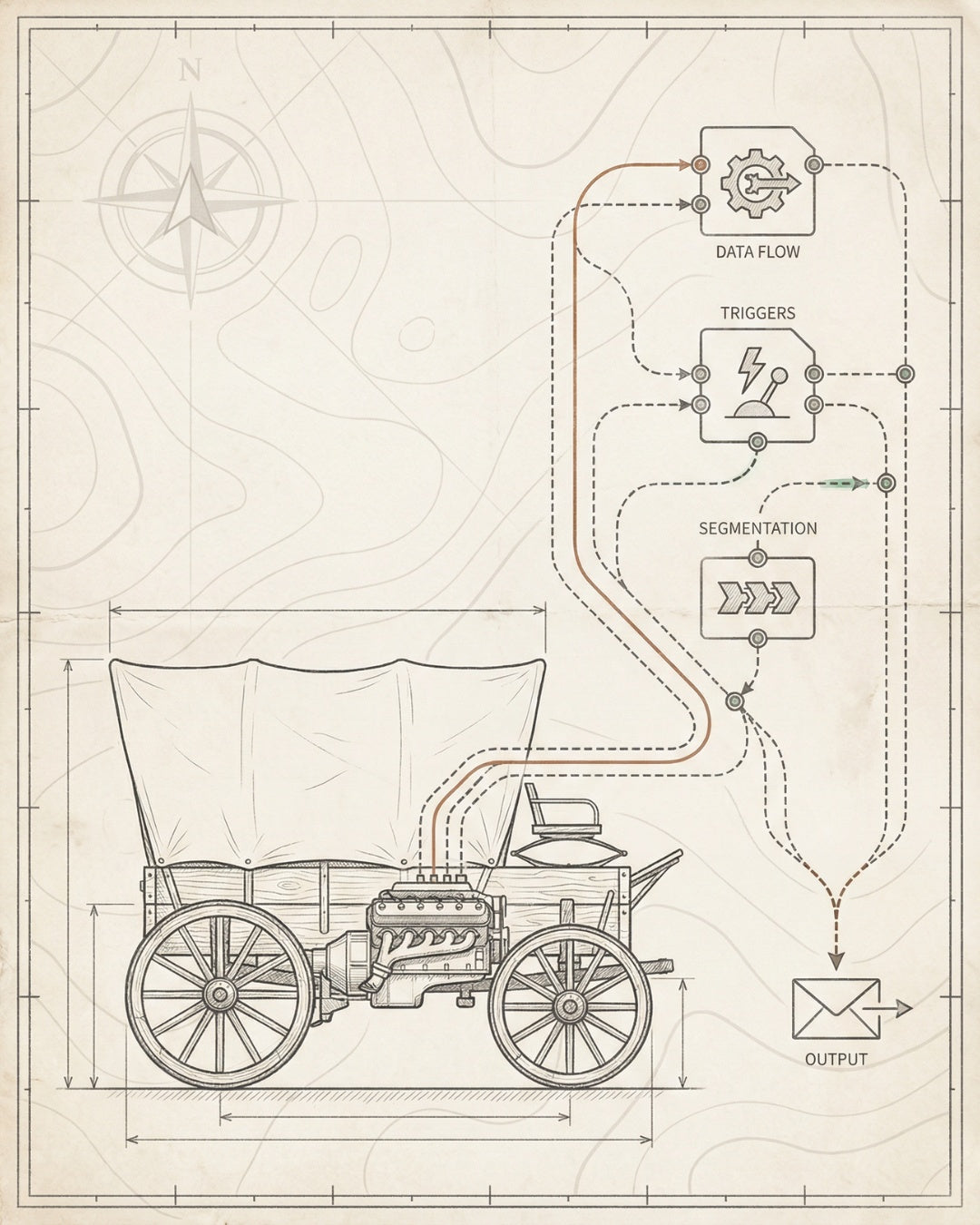
SEO for fashion ecommerce isn’t a content problem—it’s an infrastructure problem. Before you write a single product description or launch a seasonal lookbook, you need the technical systems that make rankings inevitable: crawlability, schema markup, site architecture, internal linking, and AI search signals that compound over time.
This is the build plan. Not a checklist. Not best practices. The actual infrastructure sequence we install for fashion brands before touching a single keyword.
01 / 05 Fashion SEO fails when you build content before infrastructure. Fix the foundation first: crawlability, indexability, schema, performance.
02 / 05 Product schema markup gives fashion brands a 30% CTR advantage in search results. Deploy Product, AggregateRating, and Brand schema first.
03 / 05 Site architecture determines ranking velocity. Build category hierarchies that distribute authority and prevent faceted navigation from creating duplicate content.
04 / 05 Core Web Vitals are ranking factors. Fashion sites lose 53% of mobile traffic when load times exceed 3 seconds. Optimize images, lazy loading, and LCP.
05 / 05 AI search optimization builds entity signals through structured data. Fashion brands need knowledge graph presence for Perplexity and ChatGPT visibility.
What We’re Building
- 1. The 4-Layer Foundation Fashion Stores Need First
- 2. Product Page Architecture That Ranks
- 3. Schema Markup for Fashion: The AI Search Advantage
- 4. Site Architecture for Scalable Collections
- 5. Core Web Vitals for Fashion Sites
- 6. AI Search Optimization for Fashion Brands
- 7. The 30-Day Implementation Sprint
- Frequently Asked Questions
The 4-Layer Foundation Fashion Stores Need First
Before you optimize a single product page, you need to understand the sequence. This is what we call the 4-Layer SEO Foundation**—the infrastructure stack that determines whether your fashion store can rank at scale or gets stuck in the crawl budget penalty box.
Layer 1: Crawlability
Google can’t rank what it can’t crawl. Fashion sites break crawlability in predictable ways: faceted navigation that generates infinite URL variations, orphaned product pages with zero internal links, and robots.txt files that accidentally block entire collections.
Your crawl budget is finite. If Google wastes it crawling duplicate filter combinations (/dresses?color=red&size=small&material=cotton&sort=price), it won’t reach your actual product inventory.
The fix is architectural:
- Canonicalize filter URLs — Every faceted navigation combination should canonical back to the base collection URL
- Strategic noindex on parameters — Use URL parameter handling in Search Console to tell Google which query strings to ignore
- XML sitemap hierarchy — Separate sitemaps for products, collections, and content. Update frequency matters: products daily, collections weekly, blog posts monthly
- Internal linking from high-authority pages — Every product should be reachable within 3 clicks from the homepage
Systems Note
Crawlability isn’t a one-time fix. It’s a system. When you launch a new collection, the internal linking architecture should automatically distribute authority without manual intervention. That’s what infrastructure means.
Layer 2: Indexability
Crawlable doesn’t mean indexable. Google might crawl your product pages and still choose not to index them if they’re thin content, duplicate, or lack unique value signals.
Fashion ecommerce has a specific indexability problem: product variations. When you sell the same dress in twelve colors, you’re creating twelve URLs with nearly identical content. Google sees duplication and picks one to index—usually not the one you want ranking.
The canonical strategy for fashion products:
- Variant consolidation — Use a single product page with color/size selectors instead of separate URLs per variant
- Unique content per SKU — If you must create separate variant pages, write distinct descriptions that highlight the specific color, material, or style differences
- Canonical to parent product — When variants exist, canonical tags should point to the main product URL, not the color-specific version
- Structured data differentiation — Use schema markup to signal that variants are related but distinct offers
Check indexation status in Search Console. If you have 5,000 products but only 1,200 indexed pages, you have an indexability problem—not a content problem.
Layer 3: Rankability
This is where most ecommerce SEO strategy focuses—and where most agencies waste time if layers 1 and 2 aren’t solved first.
Rankability is the combination of on-page optimization, schema markup, entity signals, and topical authority that tells Google your product pages deserve to rank for commercial queries.
For fashion ecommerce, rankability breaks down into:
- Keyword-mapped URLs — /collections/womens-leather-jackets ranks better than /collections/category-47
- Title tag formula — [Product Name] - [Key Attribute] | [Brand Name] (e.g., “Oversized Wool Coat - Camel | Brand”)
- Schema markup deployment — Product, AggregateRating, Brand, and Breadcrumb schema on every product page (more on this below)
- Image optimization — Descriptive filenames (camel-wool-coat-front.jpg, not IMG_4728.jpg) and alt text that includes product attributes
- Internal linking with descriptive anchors — Link from collection pages, related products, and content with keyword-rich anchor text
Rankability compounds when you build it as a system. Every new product should inherit the same schema structure, URL pattern, and internal linking logic without manual configuration.
Layer 4: Convertibility
SEO that doesn’t convert is just expensive traffic. Convertibility is the layer most SEO agencies ignore because it requires understanding user experience, performance optimization, and revenue attribution—not just rankings.
For fashion brands, convertibility means:
- Page speed under 2.5 seconds — Core Web Vitals are ranking factors, but they’re also conversion factors. A 1-second delay reduces conversions by 7%
- Mobile-first design — 60% of fashion ecommerce traffic is mobile. If your product images don’t load instantly on 4G, you’re losing revenue
- Clear conversion paths — Product pages should have obvious CTAs, size guides, shipping information, and trust signals (reviews, return policy)
- Exit-intent capture — Email capture flows for users who land on product pages but don’t convert immediately
This is the SEO infrastructure foundation. Crawlability → Indexability → Rankability → Convertibility. Skip a layer, and the entire stack collapses.

Product Page Architecture That Ranks
Product pages are the revenue engine of fashion ecommerce SEO. Not blog posts. Not lookbooks. Product pages.
The mistake most brands make: treating product pages like inventory listings instead of search-optimized landing pages. They copy manufacturer descriptions, use generic titles, and wonder why they rank on page three for “black leather jacket” while competitors with worse products rank first.
Here’s the product page architecture that ranks:
URL Structure
Your URL should be a breadcrumb trail of topical relevance:
- Good: /collections/womens-outerwear/leather-jackets/oversized-moto-jacket
- Bad: /products/item-8472
The URL structure signals category hierarchy to Google and distributes topical authority from collection pages down to individual products. It also makes internal linking more effective—when you link to /collections/womens-outerwear/leather-jackets/oversized-moto-jacket with anchor text “oversized moto jacket,” Google understands the topical relationship.
Title Tag Formula
Fashion product titles need to balance keyword optimization with brand differentiation. The formula:
[Primary Keyword] - [Differentiator] | [Brand]
Examples:
- Oversized Wool Coat - Camel | Everlane
- High-Rise Wide Leg Jeans - Vintage Black | Madewell
- Leather Ankle Boots - Chelsea Style | Nisolo
The primary keyword is what users search. The differentiator is what makes your product unique. The brand is what builds recognition in SERPs and drives CTR from users who’ve seen you before.
Product Descriptions
Most fashion brands write product descriptions for customers who’ve already decided to buy. That’s backwards. Product descriptions need to do three jobs:
- Rank for long-tail keywords — Include natural variations like “oversized camel coat,” “wool winter coat,” “neutral outerwear”
- Answer search intent — Address questions users type into Google: fit, material, care instructions, styling
- Convert browsers into buyers — Use benefit-driven copy, not feature lists
The structure we use:
- Opening paragraph (100-150 words): Primary keyword in first sentence, benefit-focused description, key differentiators
- Details section: Material, fit, care instructions, sizing information
- Styling suggestions: How to wear it, what to pair it with (creates internal linking opportunities to other products)
Unique content matters. If you’re dropshipping or using manufacturer descriptions, you’re competing with hundreds of other sites using identical copy. Google will pick one to rank—and it won’t be the newest store with the lowest domain authority.
Image Optimization
Fashion is a visual category. Image optimization isn’t optional—it’s the difference between ranking in Google Images (a massive traffic source for fashion) and being invisible.
The system:
- Descriptive filenames: oversized-camel-wool-coat-front-view.jpg (not DSC_4728.jpg)
- Alt text with product attributes: “Oversized camel wool coat with notch lapels and belt tie, front view”
- Multiple angles: Front, back, detail shots, styled on model, flat lay—each with unique alt text
- Compression without quality loss: Use WebP format, lazy loading for images below the fold, explicit width/height attributes to prevent layout shift
Google Images drives 22% of all web searches. For fashion brands, it’s often higher. Optimize for it.
Internal Linking
Product pages shouldn’t be dead ends. Every product page should link to:
- Parent collection page — Breadcrumb navigation that passes authority back up the hierarchy
- Related products — “You might also like” sections with descriptive anchor text, not generic “View Product” links
- Content pages — If you have a blog post about “how to style oversized coats,” link to it from relevant product pages
- Seasonal collections — Link winter coats to “Winter Essentials” collection during Q4, then update to “Transitional Outerwear” in spring
Internal linking distributes PageRank and builds topical clusters. When done systematically, it’s the difference between isolated product pages and a connected content ecosystem that compounds authority over time.
This is on-page SEO for ecommerce as infrastructure—not as a checklist you run once and forget.
Schema Markup for Fashion: The AI Search Advantage
Schema markup is the structured data layer that tells search engines—and increasingly, AI systems—what your content actually means. For fashion ecommerce, it’s the difference between appearing as a generic blue link and showing up with product images, prices, ratings, and availability directly in search results.
Product schema can increase click-through rates by 30%. That’s not a marginal optimization—it’s a competitive moat.
Product Schema Implementation
Every product page needs Product schema with these required properties:
{ “@context”: “https://schema.org/”, “@type”: “Product”, “name”: “Oversized Wool Coat - Camel”, “image”: [ “https://example.com/photos/oversized-camel-coat-front.jpg”, “https://example.com/photos/oversized-camel-coat-back.jpg” ], “description”: “Oversized wool coat in camel with notch lapels, belt tie, and relaxed fit. Made from 100% Italian wool.”, “sku”: “OWC-CAM-001”, “brand”: { “@type”: “Brand”, “name”: “YourBrand” }, “offers”: { “@type”: “Offer”, “url”: “https://example.com/collections/outerwear/oversized-wool-coat-camel”, “priceCurrency”: “USD”, “price”: “298.00”, “availability”: “https://schema.org/InStock”, “itemCondition”: “https://schema.org/NewCondition” } }


This is the baseline. But fashion brands should go deeper:
- Add color and material properties — Use additionalProperty to specify fabric composition, care instructions, country of origin
- Include size variants — List available sizes within the offers array
- Specify product dimensions — Measurements help Google understand fit and reduce returns
AggregateRating Schema
Star ratings in search results increase CTR by 15-35%. If you have product reviews, you need AggregateRating schema:
“aggregateRating”: { “@type”: “AggregateRating”, “ratingValue”: “4.7”, “reviewCount”: “89” }
This nested property goes inside your Product schema. Google requires a minimum of 2 reviews to display ratings, but aim for 10+ before expecting rich results to appear consistently.
Brand and Organization Schema
Brand schema builds entity recognition in Google’s knowledge graph. This matters for AI search—ChatGPT and Perplexity pull brand information from structured data, not just scraped text.
Deploy Organization schema on your homepage:
{ “@context”: “https://schema.org”, “@type”: “Organization”, “name”: “YourBrand”, “url”: “https://example.com”, “logo”: “https://example.com/logo.png”, “sameAs”: [ “https://www.instagram.com/yourbrand”, “https://www.facebook.com/yourbrand”, “https://www.pinterest.com/yourbrand” ], “contactPoint”: { “@type”: “ContactPoint”, “contactType”: “Customer Service”, “email”: “support@example.com” } }

The sameAs property connects your brand entity across platforms. Google uses this to build a unified brand profile in its knowledge graph—critical for appearing in AI-generated answers and brand-specific searches.
Breadcrumb Schema
Breadcrumb navigation helps users and search engines understand site hierarchy. BreadcrumbList schema makes that hierarchy machine-readable:
{ “@context”: “https://schema.org”, “@type”: “BreadcrumbList”, “itemListElement”: [ { “@type”: “ListItem”, “position”: 1, “name”: “Home”, “item”: “https://example.com” }, { “@type”: “ListItem”, “position”: 2, “name”: “Women’s Outerwear”, “item”: “https://example.com/collections/womens-outerwear” }, { “@type”: “ListItem”, “position”: 3, “name”: “Oversized Wool Coat - Camel” } ] }
This schema should appear on every product page, dynamically generated based on the category hierarchy. It reinforces the topical structure you built in your URL architecture.
The AI Search Advantage
Schema markup isn’t just for Google’s traditional search results anymore. AI systems like ChatGPT, Perplexity, and Google’s AI Overviews rely heavily on structured data to understand and cite ecommerce content.
When someone asks ChatGPT “What are the best sustainable fashion brands for winter coats?”, the AI pulls from:
- Product schema showing material composition and sustainability claims
- Brand schema establishing your entity and authority signals
- Review schema indicating customer satisfaction and social proof
Fashion brands with comprehensive schema markup get cited in AI-generated answers. Brands without it get ignored—even if their products are better.
This is why AI search optimization starts with structured data infrastructure, not content optimization. Build the machine-readable layer first, then layer content on top.

Site Architecture for Scalable Collections
Site architecture is the skeleton of SEO for fashion ecommerce. Get it right, and every new product automatically inherits topical authority and internal linking. Get it wrong, and you’re manually optimizing thousands of orphaned pages that never rank.
Fashion brands face a specific architectural challenge: collections are seasonal, trend-driven, and constantly rotating. You can’t build a rigid hierarchy that breaks every time you launch a new drop or retire last season’s inventory.
The solution is a flexible, scalable architecture that separates evergreen categories from seasonal collections.
Category Hierarchy: Evergreen Foundation
Your core category structure should be stable, keyword-mapped, and organized by product type—not by season or trend:
- Top-level categories: Women’s, Men’s, Accessories
- Second-level categories: Outerwear, Tops, Bottoms, Dresses, Shoes
- Third-level categories: Leather Jackets, Wool Coats, Denim Jackets (under Outerwear)
This hierarchy maps to search intent. When someone searches “women’s leather jackets,” they expect to land on a collection page showing all leather jackets—not a seasonal “Fall Essentials” page that happens to include a few jackets.
URL structure should mirror this hierarchy:
- /collections/womens
- /collections/womens/outerwear
- /collections/womens/outerwear/leather-jackets
Each level passes topical authority down to the next. When you build internal links from /collections/womens to /collections/womens/outerwear, you’re signaling to Google that outerwear is a subcategory of women’s clothing—building topical clusters that rank for both broad and specific queries.
Seasonal Collections: Temporary Overlays
Seasonal collections (Fall Favorites, Summer Essentials, Holiday Gift Guide) are marketing constructs, not SEO categories. They should exist as temporary collection pages that pull products from your core categories using tags or filters—not as separate URL hierarchies.
The structure:
- Seasonal collection URL: /collections/fall-favorites
- Products remain in core categories: /collections/womens/outerwear/oversized-wool-coat
- Seasonal page links to products, products link back to core categories — This preserves authority flow to evergreen pages
When the season ends, you can retire the seasonal collection without orphaning products or breaking your URL structure. The core categories remain stable, compounding authority year over year.
Faceted Navigation Without Duplicate Content
Faceted navigation (filters for color, size, price, material) is essential for user experience but catastrophic for SEO if implemented incorrectly. Every filter combination creates a new URL:
- /collections/womens/outerwear?color=black
- /collections/womens/outerwear?color=black&size=small
- /collections/womens/outerwear?color=black&size=small&material=wool
Google sees these as separate pages with near-duplicate content. Your crawl budget gets wasted, and you risk duplicate content penalties.
The fix:
- Canonical all filter URLs back to the base collection: Every filtered view should have a canonical tag pointing to /collections/womens/outerwear
- Use URL parameter handling in Search Console: Tell Google which parameters to ignore (color, size, sort) and which to crawl (page number for pagination)
- Implement AJAX filtering: Update product display without changing the URL, so filters don’t create new pages
This preserves the user experience of filtering while preventing SEO disasters.
Internal Linking Strategy
Internal linking is how you distribute authority from high-value pages (homepage, top collections) to individual products. For fashion ecommerce, internal linking should be systematic, not manual.
The architecture:
- Homepage links to top-level categories — Women’s, Men’s, Accessories (high authority, keyword-rich anchors)
- Category pages link to subcategories and featured products — Outerwear page links to Leather Jackets, Wool Coats, and 6-8 featured products
- Product pages link to related products and parent categories — Breadcrumb navigation, “You might also like,” and contextual links within descriptions
- Content pages link to relevant collections and products — Blog post about “How to Style Oversized Coats” links to /collections/womens/outerwear/wool-coats and specific coat products
Every link should use descriptive anchor text that includes target keywords. “Shop leather jackets” is better than “Click here.” “Oversized camel wool coat” is better than “View product.”
This is the internal linking infrastructure that makes technical SEO for ecommerce scalable. When you add a new product, it automatically inherits links from collection pages, related products, and breadcrumb navigation—without manual intervention.
Core Web Vitals for Fashion Sites
Page speed isn’t a nice-to-have. It’s a ranking factor and a conversion factor. Google’s Core Web Vitals—Largest Contentful Paint (LCP), Cumulative Layout Shift (CLS), and Interaction to Next Paint (INP)—directly impact both search visibility and revenue.
Fashion sites have a specific performance problem: high-resolution product images. You need visual quality to sell clothing, but unoptimized images kill page speed and tank Core Web Vitals.
The data is brutal: 53% of mobile users abandon sites that take over 3 seconds to load. For every 1-second delay, conversions drop by 7%.
Here’s how to optimize Core Web Vitals without sacrificing image quality.
Largest Contentful Paint (LCP): Get Below 2.5 Seconds
LCP measures how long it takes for the largest visible element (usually your hero image or main product photo) to load. Google’s threshold: 2.5 seconds or faster.
Fashion sites fail LCP because they load massive, uncompressed product images above the fold. The fix:
- Use WebP format: 25-35% smaller file size than JPEG with no visible quality loss
- Serve responsive images: Use srcset to deliver different image sizes based on device width—don’t serve a 2400px image to a 375px mobile screen
- Preload critical images: Add in the for above-the-fold images
- Use a CDN: Serve images from geographically distributed servers to reduce latency
Test LCP in PageSpeed Insights. If your hero image takes 4+ seconds to load, compress it, convert to WebP, and implement preloading.
Cumulative Layout Shift (CLS): Prevent Visual Instability
CLS measures how much page elements shift during loading. Fashion sites break CLS when images load without explicit dimensions, causing text to jump down the page as photos render.
The fix is simple but often ignored:
- Set explicit width and height attributes on all images:

- Use aspect-ratio CSS: Prevent layout shift by reserving space before images load
- Avoid inserting content above existing content: Don’t dynamically inject banners or promotional messages that push product images down
- Load fonts with font-display: swap: Prevent invisible text flash that causes layout shift
CLS under 0.1 is Google’s target. Anything above 0.25 is failing.
Interaction to Next Paint (INP): Make Interactions Instant
INP replaced First Input Delay (FID) as Google’s interactivity metric. It measures how quickly your site responds to user interactions—clicks, taps, keyboard inputs.
Fashion sites with heavy JavaScript (product quick-view modals, size selectors, color swatches) often have slow INP because the main thread is blocked by scripts.
The optimization strategy:
- Defer non-critical JavaScript: Load analytics, chat widgets, and marketing scripts after page interaction, not on initial load
- Code-split large bundles: Only load JavaScript needed for the current page, not your entire app bundle
- Optimize third-party scripts: Review every Shopify app, tracking pixel, and marketing tool—each one adds JavaScript overhead
- Use requestIdleCallback for non-urgent tasks: Run background tasks when the browser is idle, not during user interactions
INP under 200ms is good. Above 500ms is failing.
Mobile-First Performance
Google indexes mobile versions of sites first. If your mobile performance is slow, your rankings suffer—even on desktop.
Fashion ecommerce gets 60%+ of traffic from mobile devices. Optimize for mobile first, desktop second:
- Test on real devices: Chrome DevTools mobile emulation doesn’t replicate actual 4G network conditions
- Lazy-load below-the-fold images: Only load images as users scroll down
- Minimize render-blocking CSS: Inline critical CSS, defer non-critical stylesheets
- Reduce server response time: Use server-side caching, optimize database queries, upgrade hosting if TTFB exceeds 600ms
Core Web Vitals aren’t one-time fixes. They’re ongoing infrastructure maintenance. When you add new apps, update your theme, or launch seasonal campaigns, performance can degrade. Monitor it monthly.
This is part of ecommerce SEO best practices—not optional nice-to-haves.
AI Search Optimization for Fashion Brands
Traditional SEO optimizes for Google’s algorithm. AI search optimization optimizes for how language models understand, cite, and recommend brands.
ChatGPT, Perplexity, Google’s AI Overviews, and other LLM-powered search tools don’t just crawl and index—they interpret, synthesize, and generate answers. If your brand isn’t legible to AI systems, you won’t appear in their responses, even if you rank well in traditional search.
Fashion brands need AI search visibility because buying decisions increasingly start with conversational queries: “What are the best sustainable fashion brands for minimalist style?” or “Show me affordable alternatives to Everlane.”
Here’s how to build AI search infrastructure.
Entity Building Through Structured Data
AI systems understand entities—people, brands, products, concepts—not just keywords. Your brand needs to exist as a recognized entity in knowledge graphs.
The foundation:
- Organization schema on your homepage — Defines your brand entity with name, logo, social profiles, contact information
- Brand schema on product pages — Links individual products to your brand entity
- Consistent NAP data across platforms — Name, Address, Phone must match exactly across your site, Google Business Profile, social media, and directory listings
- Wikipedia presence (if possible) — Wikipedia is a primary source for knowledge graph data. If your brand has notable coverage, create or update your Wikipedia page
Entity signals compound. The more structured data you deploy, the stronger your brand entity becomes in Google’s knowledge graph—and the more likely AI systems are to cite you.
Structured Data for LLM Consumption
Language models parse structured data more reliably than unstructured text. If you want AI to understand your product attributes, pricing, availability, and brand positioning, you need machine-readable markup.
Deploy these schema types specifically for AI search:
- Product schema with detailed attributes — Material, color, size, care instructions, sustainability claims
- FAQPage schema — Common questions about fit, sizing, returns (helps AI answer product-specific queries)
- HowTo schema — Styling guides, care instructions, outfit assembly (positions your brand as an authority)
- Review schema — Customer ratings and testimonials (social proof signals for AI recommendations)
The more context you provide through structured data, the better AI systems can represent your brand in generated answers.
Citation Optimization for AI Overviews
Google’s AI Overviews (formerly SGE) generate answers at the top of search results and cite sources. Getting cited in AI Overviews is the new featured snippet—high visibility, zero-click traffic risk, but massive brand exposure.
Fashion brands get cited when they:
- Answer specific questions with clear, concise content — “How to wash wool coats” with step-by-step instructions
- Use structured data to mark up answers — HowTo schema for care instructions, FAQPage schema for sizing questions
- Build topical authority in niche categories — If you’re known for sustainable outerwear, AI systems are more likely to cite you for sustainability-related queries
- Earn authoritative backlinks — AI systems prioritize sources with high domain authority and editorial mentions
Track AI Overview citations in Search Console. If you’re appearing in traditional search but not in AI-generated answers, you need better structured data and more authoritative content.
Perplexity and ChatGPT Visibility
Perplexity and ChatGPT don’t use Google’s index—they have their own data sources and ranking logic. Getting recommended by these platforms requires different tactics:
- Appear in high-authority publications — Perplexity prioritizes recent articles from reputable sources. Get featured in fashion media, sustainability blogs, and industry roundups
- Build brand mentions with context — When publications mention your brand, ensure they include descriptive context (e.g., “sustainable fashion brand known for minimalist outerwear”) so AI systems understand your positioning
- Create comparison content — “Everlane vs. Reformation” or “Best alternatives to Patagonia” content gets cited in AI-generated comparisons
- Optimize for conversational queries — AI systems respond to natural language. Write content that answers questions the way people ask them, not the way they search Google
AI search optimization is early-stage infrastructure. The brands building it now will dominate visibility as AI-powered search becomes the default interface.
Matt Hyder
SEO infrastructure and AI search optimization at Founding Engine.
Want SEO that actually holds?
Get a free infrastructure audit from the Founding Engine team.
Get Your Free Audit