SEO for Large Ecommerce Sites: The Infrastructure Model
How enterprise ecommerce brands build SEO infrastructure that scales. Systems-first approach to crawl budgets, faceted navigation, and AI search visibility at scale.
**
ENTERPRISE SEO INFRASTRUCTURE
SEO for Large Ecommerce Sites: The Infrastructure Model
Most enterprise ecommerce sites don’t have an SEO problem. They have an architecture problem. Here’s how to build infrastructure that scales past 10,000 pages without breaking Google’s crawl budget or your team’s sanity.

01 / 05 Large catalogs break traditional SEO. Crawl budgets get wasted on filter pages. Indexation bloats. Rankings stall despite solid products.
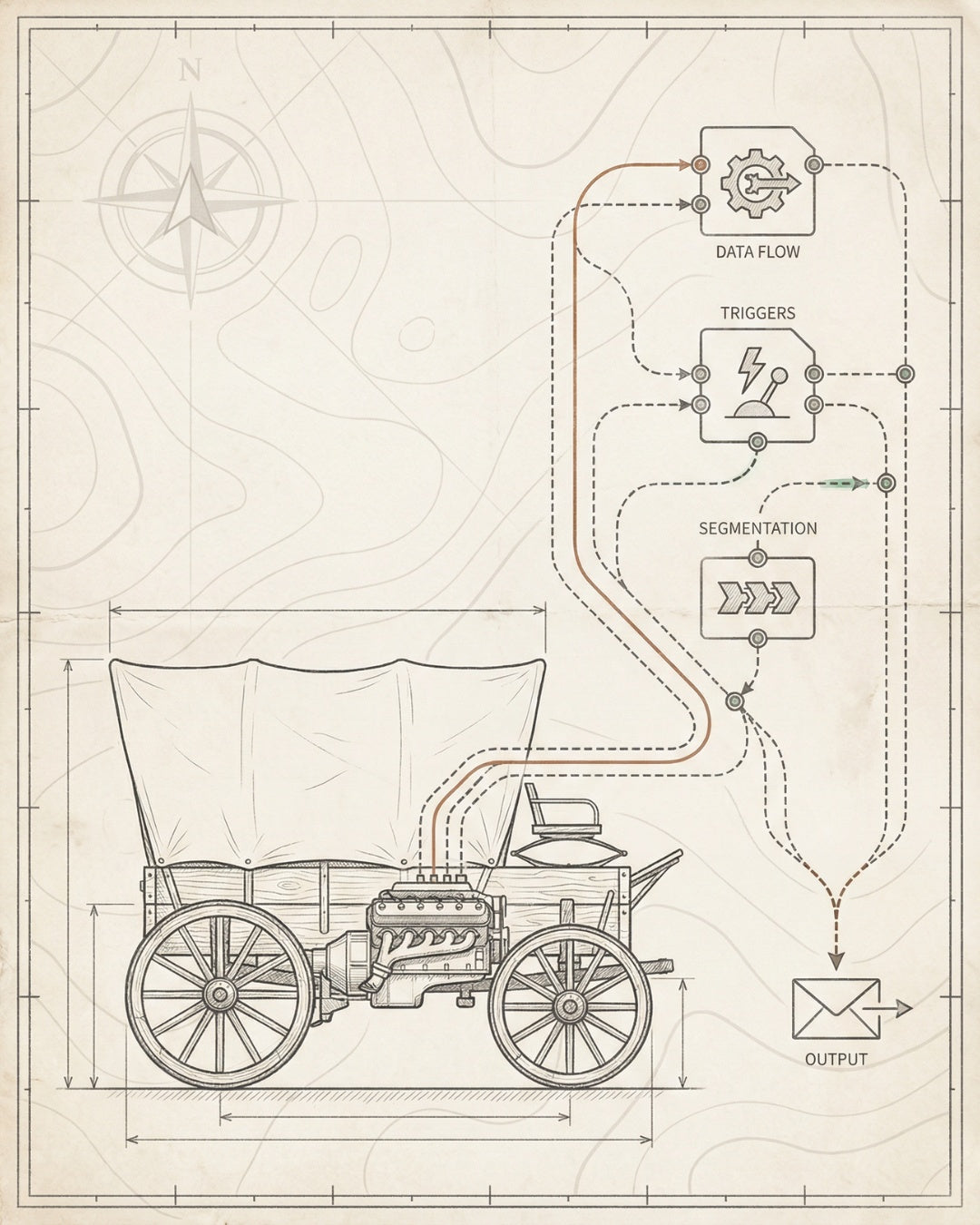
02 / 05 The solution isn’t more content. It’s systems: crawl budget allocation, faceted nav architecture, and template-based schema at scale.
03 / 05 Programmatic internal linking moves PageRank efficiently. Hub-spoke models connect products without manual work. Scales to 100K+ pages.
04 / 05 AI search changes the game for enterprise catalogs. Structured data for LLMs. Entity signals. Citations in AI Overviews and Perplexity.
05 / 05 Build it in 30-day sprints. Audit crawl state, fix faceted nav, install templates, deploy linking systems, optimize for AI. Then scale.
Table of Contents
- Why Large Ecommerce Sites Break Traditional SEO
- The Crawl Budget Problem (And How to Solve It)
- Faceted Navigation Without the Indexation Nightmare
- Category & Product Page Architecture That Scales
- AI Search Optimization for Enterprise Catalogs
- Internal Linking Systems for 10K+ Pages
- Implementation Framework: 30-Day Sprint Model
- Frequently Asked Questions
Why Large Ecommerce Sites Break Traditional SEO
You’ve got 15,000 products. Strong category structure. Solid product descriptions. Decent backlink profile. But organic traffic plateaued six months ago, and you’re watching smaller competitors rank for keywords you should own.
The issue isn’t your content or authority. It’s that traditional SEO tactics don’t scale past 5,000 pages**. What works for a 200-page DTC site creates technical debt at enterprise catalog scale.
Here’s what breaks:
- Crawl budget gets wasted on low-value pages. Google allocates a finite crawl budget based on your site’s authority and server performance. When you have faceted navigation generating thousands of filter combinations, Googlebot burns through that budget on duplicate or thin pages instead of your money pages.
- Indexation bloats uncontrollably. Check your Google Search Console. If you’re seeing 50,000+ indexed pages but only have 15,000 products, you’ve got indexation bloat. Those extra 35,000 pages are cannibalizing each other and diluting your site’s overall quality signals.
- Internal linking becomes impossible to manage manually. You can’t hand-craft contextual links across 10,000+ pages. Without a programmatic system, your deep catalog pages never accumulate enough internal PageRank to compete.
- Schema markup and structured data don’t scale without templates. Manually adding Product schema to every SKU is a non-starter. But generic, auto-generated schema often misses the nuance that actually drives rich results.
This is where most agencies fail. They apply the same ecommerce SEO tips they’d use for a 500-product store, just at higher volume. More content. More backlinks. More “optimization.” But volume isn’t strategy.
The shift: SEO for large ecommerce sites isn’t about tactics. It’s about infrastructure. You need systems that govern crawlability, manage indexation, distribute PageRank efficiently, and generate structured data programmatically. Build once, scale forever.

The Crawl Budget Problem (And How to Solve It)
Crawl budget is the number of pages Googlebot will crawl on your site in a given timeframe. For large ecommerce sites, this is the constraint that determines whether your new products get discovered in days or months.
Google determines your crawl budget based on two factors:
- Crawl demand: How popular and fresh your content is (influenced by backlinks, update frequency, and user engagement signals)
- Crawl health: Your server’s response time, error rates, and overall site speed (Core Web Vitals matter here)
If you’re running a 20,000-page catalog and Googlebot only crawls 500 pages per day, you’ve got a 40-day discovery cycle for new inventory. That’s unacceptable for fast-moving ecommerce.
How to Optimize Crawl Budget
1. Audit your crawl waste. Pull your server logs and cross-reference them with Google Search Console’s crawl stats. Identify low-value pages that are consuming crawl budget:
- Faceted navigation URLs (filters, sorts, pagination parameters)
- Out-of-stock product pages with no redirect strategy
- Duplicate content from URL parameters or session IDs
- Internal search result pages
- Admin, cart, and checkout pages that shouldn’t be crawled
2. Block low-value crawls via robots.txt. Use Disallow directives to prevent Googlebot from wasting time on parameter-heavy URLs. Example:
User-agent: *** Disallow: /*?filter=
Disallow: /*?sort=
Disallow: /search/
Disallow: /cart/
Disallow: /checkout/
- Use canonical tags strategically.** For faceted navigation pages you want indexed (e.g., “Men’s Running Shoes - Red”), use self-referencing canonicals. For filter combinations you don’t want indexed, point canonicals back to the parent category.
4. Improve crawl health. Faster server response times = higher crawl rate. Focus on:
- Server-side rendering (SSR) for JavaScript-heavy frameworks
- CDN implementation for static assets
- Database query optimization (slow product lookups kill crawl efficiency)
- Reducing redirect chains (every 301 costs crawl budget)
5. Prioritize high-value pages in your XML sitemap. Don’t submit every URL. Submit only the pages you want crawled frequently: new products, top categories, high-converting landing pages. Update your sitemap daily to signal freshness.
For more on crawl optimization fundamentals, see our guide to technical SEO for ecommerce.
Faceted Navigation Without the Indexation Nightmare
Faceted navigation (filters, sorts, attribute-based browsing) is essential for user experience on large ecommerce sites. But it’s also the #1 cause of duplicate content and indexation bloat.
Here’s the problem: A category with 5 filters, each with 4 options, generates 1,024 possible URL combinations. Most of those combinations create near-duplicate pages with minimal unique content. Google indexes them, your crawl budget tanks, and you end up with keyword cannibalization across dozens of thin pages.
The Three-Tier Faceted Navigation Strategy
Tier 1: Index-worthy filter pages. These are facet combinations with significant search demand and enough unique content to justify indexation. Examples:
- “Women’s Running Shoes - Size 8” (high search volume, clear intent)
- “Organic Cotton T-Shirts - Black” (product attribute + color has demand)
- “Laptops Under $1000” (price range filters often have search volume)
For these pages:
- Use self-referencing canonical tags
- Add unique, keyword-optimized H1s and meta descriptions
- Include supplemental content (buying guides, filter-specific copy)
- Implement full Product schema for all items on the page
- Submit to XML sitemap
Tier 2: Crawlable but not indexable. These are filter combinations that improve UX but don’t warrant indexation (e.g., “Red Running Shoes - Size 8 - On Sale”). Users need them. Search engines don’t.
For these pages:
- Canonical to the parent category or closest Tier 1 page
- Use noindex, follow meta robots tag (allows crawling for internal link discovery without indexation)
- Keep in HTML sitemap for user navigation, exclude from XML sitemap
Tier 3: Block from crawling entirely. These are parameter-heavy URLs with zero value: session IDs, tracking parameters, sort orders, pagination beyond page 3.
For these pages:
- Block via robots.txt using parameter patterns
- Use noindex, nofollow as a fallback
- Implement rel=“prev/next” for pagination (or use infinite scroll with proper JavaScript SEO handling)
Parameter Handling in Google Search Console
Use GSC’s URL Parameters tool to tell Google how to handle common parameters:
Parameter Type Example GSC Setting
Sorting ?sort=price_asc Let Googlebot decide (usually ignores)
Pagination ?page=2 Let Googlebot decide
Session IDs ?sessionid=xyz Representative URL
Tracking codes ?utm_source=email Representative URL
Valuable filters ?color=red Every URL (if Tier 1)
This three-tier approach gives you user-friendly navigation without the SEO penalties. It’s the same system we use in our advanced ecommerce SEO builds for catalogs over 10,000 SKUs.
Category & Product Page Architecture That Scales
Manual optimization doesn’t work at scale. You need template-based systems that programmatically generate optimized content, schema markup, and internal links across thousands of pages.
Category Page Template Architecture
Your category pages are hub pages. They need to:
- Rank for broad, high-volume keywords (“men’s running shoes”)
- Distribute PageRank to product and subcategory pages
- Provide clear crawl paths for Googlebot
- Convert browsers into buyers
Template components for category pages:
- Dynamic H1: Pull from category name + keyword modifier. Example: “Men’s Running Shoes | [Brand Name]”
- Introductory content block (150-300 words): Auto-generated from category attributes. Include primary keyword, semantic variations, and buying guide elements. Place above the fold for crawlability.
- Product grid with schema: Each product tile needs Product schema with name, image, price, availability, aggregateRating, and review count. Generate this server-side, not via JavaScript.
- Contextual internal links: Link to related categories, buying guides, and top-performing product pages. Use descriptive anchor text (not “click here”).
- FAQ accordion (if applicable): Pull common questions from your support data or “People Also Ask” queries. Improves dwell time and provides additional keyword coverage.
- Bottom content block (optional): Extended buying guide, comparison tables, or spec breakdowns. Useful for competitive categories.
Product Page Template Architecture
Product pages are your money pages. Template requirements:
- SEO title format: [Product Name] | [Key Attribute] | [Brand Name]. Example: “Nike Air Zoom Pegasus 40 | Men’s Running Shoe | [Brand]”
- Meta description: Pull from product short description + CTA. Include price if competitive.
- Product schema (comprehensive): Name, image, description, SKU, brand, aggregateRating, review, offers (price, priceCurrency, availability, url), itemCondition. Use the full Product schema spec from schema.org.
- Breadcrumb schema: Shows category hierarchy. Helps Google understand site structure and can appear in SERPs.
- Dynamic internal links: “Customers also viewed,” “Similar products,” “Complete the look.” These should be algorithmically generated based on product attributes, not random.
- User-generated content: Reviews are SEO gold. They add fresh, unique content and semantic keyword variations. Implement review schema with proper markup.
Content Generation at Scale
For large catalogs, you can’t write unique descriptions for every SKU. But you can’t use manufacturer descriptions either (duplicate content). The solution:
- Attribute-based content templates: Create modular content blocks that combine product attributes dynamically. Example: “[Material] construction provides durability. [Feature] ensures [benefit]. Ideal for [use case].”
- AI-assisted content generation: Use LLMs to generate unique product descriptions from structured data (attributes, specs, reviews). Requires human QA but scales efficiently.
- Tiered content strategy: Write full custom content for top 20% of revenue-generating products. Use template + AI hybrid for mid-tier. Minimal template-based content for long-tail.
This is the same approach we use in our SEO for ecommerce product pages builds. For implementation guidance, see our ecommerce SEO checklist.
AI Search Optimization for Enterprise Catalogs
AI search is changing how users discover products. Google’s AI Overviews, ChatGPT, Perplexity, and other LLM-powered search tools are now answering product queries directly — often without sending users to your site.
For large ecommerce sites, this is both a threat and an opportunity. The threat: you lose the click. The opportunity: you can become the cited source in AI-generated answers, which drives brand authority and high-intent traffic.
How AI Search Reads Ecommerce Sites
LLMs don’t “read” your site the way humans do. They parse structured data, entity signals, and semantic relationships. To optimize for AI search:
1. Implement comprehensive structured data. Beyond basic Product schema, add:
- Organization schema: Establishes your brand as an entity
- BreadcrumbList schema: Shows category hierarchy and topical authority
- AggregateRating schema: Displays review scores in AI summaries
- FAQPage schema: Helps LLMs extract Q&A content (though rich results are limited, the data is still used by AI models)
- ItemList schema: For category pages, lists all products with attributes
2. Build entity signals. LLMs understand entities (people, brands, products, concepts) and their relationships. Strengthen your entity signals by:
- Claiming and optimizing your Google Knowledge Panel
- Maintaining consistent NAP (Name, Address, Phone) across the web
- Getting mentioned on authoritative sites (Wikipedia, industry publications, review sites)
- Using schema.org’s sameAs property to link your brand entity to social profiles and external references
3. Create AI-friendly content formats. LLMs prefer content that’s easy to parse and cite:
- Comparison tables: “Best [Product Category] for [Use Case]”
- Spec sheets: Structured product specifications in table format
- Buying guides: Step-by-step decision frameworks
- FAQ sections: Direct question-and-answer pairs
4. Optimize for featured snippet formats. AI Overviews often pull from featured snippets. Target snippet-friendly formats:
- Paragraph snippets: 40-60 word answers to direct questions
- List snippets: Numbered or bulleted lists (steps, rankings, features)
- Table snippets: Comparison data in HTML tables
Measuring AI Search Visibility
Traditional rank tracking doesn’t capture AI search performance. Monitor:
- AI Overview appearances: Track queries where your site is cited in Google’s AI-generated summaries
- ChatGPT citations: Use tools like BloggedAI (our AI search monitoring platform at foundingengine.com/bloggedai) to track when ChatGPT cites your content
- Perplexity visibility: Monitor brand mentions and product recommendations in Perplexity results
- Zero-click search rate: Track the percentage of impressions that don’t generate clicks (indicates AI answer satisfaction)
For more on this, see our full guide to AI search optimization.

Internal Linking Systems for 10K+ Pages
Internal linking is how you distribute PageRank (ranking power) across your site. For large ecommerce sites, manual internal linking is impossible. You need programmatic systems that automatically create contextual links based on product relationships, category hierarchies, and user behavior.
The Hub-Spoke Internal Linking Model
This is the most scalable internal linking architecture for ecommerce:
- Hub pages: High-authority pages (homepage, main category pages, top landing pages) that receive external backlinks and accumulate PageRank
- Spoke pages: Product pages, subcategories, and long-tail content that need PageRank distribution
How it works:
- Hub pages link to relevant spoke pages using descriptive anchor text
- Spoke pages link back to their parent hub (breadcrumb navigation handles this)
- Spoke pages link to related spoke pages (lateral linking based on product attributes)
This creates a PageRank flow that prioritizes your most important pages while ensuring deep catalog pages still accumulate enough authority to rank.
Programmatic Linking Rules
Set up automated linking based on product data:
- Category-based linking: Products automatically link to their parent category, sibling categories, and related categories
- Attribute-based linking: Products with shared attributes (color, size, material, brand) link to each other in “You May Also Like” modules
- Behavioral linking: Use purchase data and browsing patterns to generate “Customers Also Bought” links (these are highly relevant and improve conversions)
- Content-to-product linking: Blog posts and buying guides automatically link to relevant products based on keyword matching and product tags
Anchor Text Strategy
For internal links, you can be more aggressive with exact-match anchor text than you can with external links. Best practices:
- Use product names as anchor text when linking to product pages
- Use category names + modifiers when linking to category pages (“men’s running shoes,” not “click here”)
- Vary anchor text slightly to avoid over-optimization (mix exact match with partial match and branded terms)
- Never use generic anchors like “learn more” or “click here” — they waste SEO value
Internal Linking Depth
Every page on your site should be reachable within 3 clicks from the homepage. For large catalogs, this requires strategic architecture:
- Homepage → Main category → Subcategory → Product (3 clicks)
- Use mega menus to expose more categories without adding clicks
- Implement “featured products” modules on the homepage to create direct 2-click paths to priority products
- Use HTML sitemaps as a fallback for deep pages (but don’t rely on this as your primary crawl path)
For implementation details, see our guide to on-page SEO for ecommerce.
Implementation Framework: 30-Day Sprint Model
Most agencies sell you a retainer and drag SEO out over 6-12 months. That’s not how we work. For large ecommerce sites, you need focused sprints that deliver infrastructure in 30-day cycles.
Here’s the build sequence we use at Founding Engine:
Week 1: Audit & Prioritization
Deliverables:
- Technical SEO audit (crawl budget analysis, indexation review, Core Web Vitals baseline)
- Faceted navigation audit (identify Tier 1, 2, and 3 pages)
- Internal linking analysis (PageRank flow, orphan pages, broken links)
- Competitor gap analysis (what are top competitors doing that you’re not?)
- Priority matrix: which fixes deliver the most impact in the shortest time
Tools: Screaming Frog, Google Search Console, server log analysis, Ahrefs or Semrush for competitive data.
See our ecommerce SEO audit guide for full methodology.
Week 2: Foundation Fixes
Deliverables:
- Robots.txt optimization (block low-value crawl paths)
- Canonical tag implementation (fix faceted nav issues)
- XML sitemap restructure (prioritize high-value pages)
- Redirect cleanup (eliminate chains, fix 404s)
- Core Web Vitals fixes (image optimization, lazy loading, server response time improvements)
This is the crawlability and indexability layer of the 4-Layer SEO Foundation.
Week 3: Template & Schema Deployment
Deliverables:
- Category page template (dynamic H1s, intro content, product grid with schema)
- Product page template (SEO titles, meta descriptions, comprehensive Product schema)
- Breadcrumb schema implementation
- Review schema integration (if you have UGC)
- AI-friendly content modules (FAQ sections, comparison tables, buying guides)
This is the rankability layer — the infrastructure that makes rankings inevitable.
Week 4: Linking Systems & Monitoring
Deliverables:
- Programmatic internal linking rules (hub-spoke model, attribute-based linking)
- Content-to-product linking automation
- Google Search Console setup and baseline tracking
- Core Web Vitals monitoring (PageSpeed Insights, CrUX data)
- AI search visibility tracking (BloggedAI integration for ChatGPT/Perplexity monitoring)
This is the convertibility layer — ensuring your infrastructure drives revenue, not just rankings.
Post-Sprint: Scale & Iterate
After the initial 30-day sprint, you have a functioning SEO system. Next steps:
- Content expansion: Add buying guides, comparison pages, and long-tail landing pages based on keyword research
- Backlink acquisition: Now that your technical foundation is solid, external links will have maximum impact
- Conversion optimization: A/B test product page layouts, CTAs, and checkout flows
- AI search optimization: Refine structured data based on AI citation performance
This is the Audit-to-Throttle Pipeline: fix the foundation, install the systems, then scale aggressively.
For pricing and service details, see our ecommerce SEO pricing breakdown and ecommerce SEO services overview.

Frequently Asked Questions
What is the biggest SEO challenge for large ecommerce sites? +
Crawl budget management and indexation control. Large catalogs generate thousands of low-value URLs through faceted navigation, filters, and pagination. Without proper architecture, Google wastes crawl budget on duplicate or thin pages instead of your money pages. The solution is a three-tier faceted navigation strategy combined with robots.txt optimization and strategic canonical tag implementation.
How do I handle faceted navigation without hurting SEO? +
Use a tiered approach: (1) Index valuable filter combinations with high search demand using self-referencing canonicals and unique content. (2) Make less valuable combinations crawlable but not indexable using noindex,follow tags and canonicals to parent pages. (3) Block parameter-heavy URLs entirely via robots.txt. This gives users the filtering they need without creating indexation bloat.
What schema markup is essential for ecommerce SEO at scale? +
Product schema (with name, image, price, availability, aggregateRating, and review) is non-negotiable. Also implement BreadcrumbList schema for category hierarchy, Organization schema for brand entity signals, and ItemList schema on category pages. For AI search optimization, add comprehensive structured data that LLMs can parse: FAQPage schema, HowTo schema for guides, and detailed product specifications in table format.
How can I scale internal linking for 10,000+ product pages? +
Use programmatic linking rules based on product data. Implement a hub-spoke model where high-authority pages (homepage, main categories) link to subcategories and products, which then link to related products based on shared attributes (color, size, brand, use case). Add behavioral linking using “Customers Also Bought” modules. Automate content-to-product linking from blog posts and buying guides using keyword matching and product tags.
Should I use AI-generated content for product descriptions? +
Yes, but with a tiered strategy. Write custom content for your top 20% revenue-generating products. Use AI-assisted generation (with human QA) for mid-tier products, pulling from structured product data and customer reviews. Use template-based content for long-tail SKUs. Never use manufacturer descriptions verbatim (duplicate content penalty). The key is creating unique, attribute-driven descriptions that scale without manual writing for every SKU.
How long does it take to see results from enterprise ecommerce SEO? +
Technical fixes (crawl budget optimization, canonical implementation) show impact within 2-4 weeks as Google recrawls your site. Template-based content and schema deployment typically show ranking improvements in 6-8 weeks. Full compound visibility (where rankings and traffic accelerate exponentially) happens around the 3-6 month mark once your infrastructure is fully indexed and internal PageRank has distributed. This is faster than traditional SEO because you’re fixing systems, not individual pages.
What’s the difference between SEO for large ecommerce sites vs. small catalogs? +
Small catalogs (under 500 products) can succeed with manual optimization: hand-written product descriptions, manual internal linking, basic schema. Large catalogs require infrastructure: programmatic content generation, automated linking systems, template-based schema, crawl budget management, and faceted navigation architecture. The shift happens around 2,000-5,000 pages. Beyond that, tactics don’t scale — you need systems.
How do I optimize for AI search on a large ecommerce site? +
Focus on structured data and entity signals. Implement comprehensive Product schema with all available attributes. Add Organization schema to establish brand entity. Create AI-friendly content formats: comparison tables, spec sheets, FAQ sections, and buying guides. Build entity signals through consistent NAP data, Knowledge Panel optimization, and authoritative backlinks. Monitor AI citations using tools like BloggedAI to track when ChatGPT and Perplexity reference your products.
READY TO BUILD?
We Engineer SEO Infrastructure for Large Ecommerce Sites
No retainers. No fluff. 30-day focused cycles that deliver crawl optimization, faceted nav architecture, programmatic linking, and AI search visibility. Built for catalogs that need to scale.
Matt Hyder
SEO infrastructure and AI search optimization at Founding Engine.
Want SEO that actually holds?
Get a free infrastructure audit from the Founding Engine team.
Get Your Free Audit