SEO Services for Ecommerce Sites That Build, Not Bill
Most ecommerce SEO services chase rankings. We install the infrastructure that makes them inevitable. Systems-first SEO for stores ready to scale organic revenue.
**
ECOMMERCE SEO
SEO Services for Ecommerce Sites That Build, Not Bill
By Matt Hyder February 14, 2026 12 min read

Most ecommerce SEO services sell you hours. We install systems.
The difference? One gives you a monthly report with keyword rankings and “recommendations.” The other gives you the infrastructure that makes rankings inevitable and compounds organic revenue over time.
If you’re an ecommerce founder evaluating SEO services, you’ve probably noticed the pattern: agencies want retainers, freelancers want task lists, and consultants want to audit your site for the third time this year. None of them are building the foundation that actually holds.
Here’s what’s broken: most SEO services for ecommerce sites treat symptoms, not architecture.** They’ll optimize your product descriptions, write blog posts, and build backlinks — but if your site structure is broken, your crawl budget is wasted, or your schema markup is missing, those tactics are building on sand.
This guide breaks down what infrastructure-first SEO services actually look like for ecommerce stores, why the retainer model is dying, and how to evaluate partners who build systems instead of delivering reports.
Slide 1: The Problem
Most ecommerce SEO services chase rankings without fixing the foundation. You get reports, not systems. Traffic spikes, then plateaus. Technical debt compounds faster than content gains.
Slide 2: The Infrastructure Gap
Crawlability, indexability, rankability, convertibility — the 4-layer foundation most agencies skip. Without this, your content and backlinks are building on broken architecture.
Slide 3: The New Model
30-day focused cycles replace monthly retainers. Install the Compound Visibility Stack: Website × Content × Technical × Distribution. Systems that scale, not campaigns that expire.
Slide 4: AI Search Changes Everything
Google AI Overviews, Perplexity, ChatGPT — your products need entity signals, structured data, and knowledge graph optimization. Traditional SEO services aren’t ready for this shift.
Slide 5: The Outcome
Infrastructure-first SEO generates compounding returns. $30M+ organic revenue across our client portfolio. 250% average traffic increase. Rankings that hold because the foundation does.
Table of Contents
- Why Most Ecommerce SEO Services Miss the Foundation
- The Infrastructure-First Model for Ecommerce SEO
- Technical SEO Services That Actually Move Revenue
- AI Search Optimization for Ecommerce Stores
- Content Strategy That Supports Product Discovery
- The 30-Day Sprint Model vs. Monthly Retainers
- How to Evaluate SEO Services for Your Ecommerce Store
- Implementation Guide
- Frequently Asked Questions
Why Most Ecommerce SEO Services Miss the Foundation
The typical ecommerce SEO engagement starts with an audit. You get a 40-page PDF highlighting technical issues, content gaps, and backlink opportunities. Then the agency puts you on a retainer and starts working through the list.
Three months later, you’ve published 20 blog posts, fixed some meta descriptions, and built a few backlinks. Traffic is up 15%. The agency calls it progress. You’re wondering why you’re not seeing more revenue.
Here’s what they didn’t tell you: they optimized content on top of broken architecture.
Most ecommerce SEO services operate in the deliverable trap. They focus on what’s easy to show in a monthly report — keyword rankings, content published, links acquired — rather than what actually compounds: infrastructure.

The 4-Layer SEO Foundation Framework
Before you touch content, before you chase backlinks, you need to build the foundation that makes rankings stick. We call this the 4-Layer SEO Foundation:
- Crawlability: Can Google’s bots efficiently discover and access your product pages? If your robots.txt is blocking categories, your XML sitemap is outdated, or your URL structure is a mess, crawl budget is wasted on low-value pages.
- Indexability: Are your product and category pages actually making it into Google’s index? Duplicate content, thin pages, and canonicalization issues kill indexation for ecommerce sites with large catalogs.
- Rankability: Do your pages have the technical and content signals to compete? This is where schema markup, internal linking architecture, Core Web Vitals, and keyword targeting come in.
- Convertibility: Are your ranking pages optimized to turn visitors into customers? Product schema, review markup, clear CTAs, and conversion-focused UX matter here.
Most agencies skip layers 1 and 2, half-ass layer 3, and ignore layer 4 entirely. Then they wonder why your rankings don’t convert or why traffic plateaus after six months.
Technical debt compounds faster than content gains. If your site architecture is broken, every blog post you publish, every backlink you acquire, and every product page you optimize is building on a foundation that won’t hold.
Reality check: If your last SEO audit didn’t include a crawl budget analysis, indexation health check, or Core Web Vitals baseline, it wasn’t a real audit — it was a content and backlink wish list.
The infrastructure-first approach flips the script. Fix the foundation first. Then scale content and distribution on top of architecture that can handle growth. This is how technical SEO for ecommerce actually works when it’s done right.
The Infrastructure-First Model for Ecommerce SEO
When we say “infrastructure,” we’re not talking about vague technical improvements. We’re talking about the systems that make organic growth inevitable and repeatable.
Infrastructure is the site architecture that scales as you add products. It’s the internal linking system that distributes authority across categories. It’s the schema markup that feeds AI search engines. It’s the Core Web Vitals optimization that keeps your product pages fast as traffic grows.
Infrastructure is what’s left after the campaign ends. It’s the difference between renting traffic and owning your organic channel.
The Compound Visibility Stack (CVS)
We’ve built ecommerce SEO strategies for 50+ brands, generating over $30M in organic revenue. The pattern that works is what we call the Compound Visibility Stack:
Website × Content × Technical × Distribution
Each layer multiplies the others. Miss one, and the whole stack underperforms. Here’s how it breaks down for ecommerce:
1. Website Layer
Your site architecture, URL structure, navigation hierarchy, and category organization. For ecommerce, this means:
- Logical category and subcategory hierarchies that match search intent
- Clean URL structures that signal relevance (e.g., /category/subcategory/product)
- Faceted navigation that doesn’t create duplicate content or crawl traps
- Internal linking systems that flow authority from high-value pages to products
2. Content Layer
Keyword-mapped product descriptions, category pages, blog content, and educational resources. The key is mapping content to the buyer journey, not just keyword volume:
- Category pages targeting high-intent commercial keywords
- Product pages optimized for branded and long-tail transactional queries
- Blog and guide content targeting informational queries that feed the funnel
- Content hubs that establish topical authority in your niche
3. Technical Layer
The engine that makes everything else work. For ecommerce, this is where most agencies fail:
- Core Web Vitals optimization (LCP, CLS, INP) for product and category pages
- Schema markup: Product, Review, Breadcrumb, Organization, FAQ
- Crawl budget optimization for large catalogs (robots.txt, pagination, canonicals)
- Mobile-first indexing optimization (most ecommerce traffic is mobile)
- Site speed optimization (every 100ms delay costs conversions)
4. Distribution Layer
How your content and products get discovered beyond Google organic search:
- AI search optimization (AI Overviews, Perplexity, ChatGPT)
- Knowledge graph and entity optimization for brand and product visibility
- Google Merchant Center and Shopping feed optimization
- Email capture systems that turn organic traffic into owned audiences

The Compound Visibility Stack is how we approach every ecommerce SEO audit and build. It’s not a checklist — it’s a system where each layer reinforces the others.
Why this matters: Most SEO services optimize one layer (usually content) and ignore the others. The CVS approach ensures that every dollar you invest compounds across the entire stack.
This is what SEO infrastructure actually means. Not a list of tasks. Not a monthly retainer. A system that scales as your catalog grows and continues to generate revenue long after the initial build.
Technical SEO Services That Actually Move Revenue
Technical SEO for ecommerce isn’t about checking boxes. It’s about building the engine that turns crawls into conversions. Here’s what actually matters when you’re running a store with hundreds or thousands of SKUs.
Core Web Vitals Optimization for Product Pages
Google’s Core Web Vitals (LCP, CLS, INP) are ranking factors, but more importantly, they’re conversion factors. A slow product page doesn’t just rank lower — it bleeds revenue.
For ecommerce sites, the biggest offenders are:
- Largest Contentful Paint (LCP): Product images loading slowly. Fix: optimize image formats (WebP), implement lazy loading correctly, use a CDN, and preload hero images.
- Cumulative Layout Shift (CLS): Elements jumping as the page loads (usually images, ads, or dynamic content). Fix: set explicit width and height attributes on images, reserve space for dynamic elements, and avoid injecting content above existing content.
- Interaction to Next Paint (INP): Slow response to user interactions (add to cart, size selection, etc.). Fix: reduce JavaScript execution time, defer non-critical scripts, and optimize third-party scripts.
We’ve seen best-in-class ecommerce SEO implementations improve conversion rates by 20-30% just by fixing Core Web Vitals. Speed is revenue.
Schema Markup for Products, Reviews, and Breadcrumbs
Schema markup is how you communicate with search engines in a language they understand. For ecommerce, these schema types are non-negotiable:
- Product Schema: Name, image, description, SKU, brand, price, availability. This feeds Google Shopping, AI Overviews, and rich results.
- Review Schema (AggregateRating): Star ratings in search results increase click-through rates by 15-35%. If you have reviews, mark them up.
- Breadcrumb Schema: Helps Google understand your site hierarchy and shows breadcrumbs in search results (better UX, better CTR).
- Organization Schema: Establishes your brand entity in Google’s knowledge graph. Include logo, social profiles, contact info.
Most ecommerce platforms (Shopify, WooCommerce, BigCommerce) have basic schema, but it’s often incomplete or improperly implemented. A proper advanced ecommerce SEO setup includes custom schema for product variants, bundles, and dynamic pricing.
Internal Linking Architecture for Category and Product Hierarchies
Internal linking is how you distribute authority across your site. For ecommerce, this means:
- Category-to-product links: Every product should be linked from its parent category page. Obvious, but often broken on large catalogs.
- Related product links: “You might also like” sections pass authority and improve crawl depth.
- Blog-to-product links: Educational content should funnel to relevant product pages with contextual anchor text.
- Breadcrumb links: Not just for UX — they create crawlable paths through your hierarchy.
The goal: ensure that your most important product pages are no more than 3 clicks from your homepage. Crawl depth matters for both bots and users.
Crawl Budget Optimization for Large Catalogs
If you have 500+ products, crawl budget becomes a bottleneck. Google won’t crawl every page on every visit, so you need to optimize what gets crawled:
- Block low-value pages: Use robots.txt to block filter pages, search result pages, and user account pages.
- Optimize your XML sitemap: Only include indexable, high-value pages. Remove out-of-stock products or redirect them to active variants.
- Fix redirect chains: Every redirect wastes crawl budget. Audit and fix chains and loops.
- Manage faceted navigation: Use canonical tags or noindex to prevent duplicate content from filter combinations.
We’ve helped ecommerce brands reclaim 40-60% of wasted crawl budget just by cleaning up their site architecture. More efficient crawls = faster indexation = better rankings.
Pro tip: Check Google Search Console’s Crawl Stats report. If your crawl rate is dropping or your crawl response time is increasing, you have technical debt that’s costing you rankings.
This is what on-page SEO for ecommerce looks like when it’s done right. Not just optimizing titles and meta descriptions — building the technical foundation that makes your entire catalog discoverable and rankable.
AI Search Optimization for Ecommerce Stores
Google AI Overviews now appear on 15% of searches. Perplexity and ChatGPT are answering product questions without sending users to your site. If your ecommerce SEO strategy doesn’t include AI search optimization, you’re already behind.
Traditional SEO optimizes for ranking in the top 10 blue links. AI search optimization is about getting cited, featured, and recommended by LLMs (large language models) when they generate answers.
AI Overview and Citation Optimization
Google’s AI Overviews pull content from multiple sources to generate answers at the top of search results. To get cited:
- Structure content in clear, answer-first formats: Use headings that match question patterns. Start paragraphs with direct answers.
- Use schema markup: FAQ schema, HowTo schema, and Product schema help LLMs understand your content structure.
- Optimize for featured snippets: AI Overviews often pull from the same content pool as featured snippets. Target paragraph and list snippets.
- Provide unique data and perspectives: LLMs prioritize sources that add new information, not rehashed content.
For ecommerce, this means your product descriptions, buying guides, and comparison content need to be structured for machine readability, not just human readability.
Entity and Knowledge Graph Signals for Brand and Products
Google’s knowledge graph connects entities (people, places, brands, products) based on relationships and attributes. To strengthen your brand’s entity signals:
- Claim and optimize your Google Business Profile: Even for ecommerce-only brands, this establishes your entity in Google’s graph.
- Build consistent NAP (Name, Address, Phone) citations: Consistency across directories and platforms reinforces your brand entity.
- Get mentioned on authoritative sites: Wikipedia, news sites, and industry publications strengthen entity recognition.
- Use Organization schema with sameAs properties: Link to your social profiles, Crunchbase, LinkedIn, etc. This helps Google connect your brand entity across the web.
For products, use Product schema with detailed attributes (brand, model, SKU, GTIN, color, size, material). The more structured data you provide, the better LLMs can understand and recommend your products.

Structured Data for LLMs (Perplexity, ChatGPT, SearchGPT)
Perplexity, ChatGPT, and other AI search tools don’t crawl the web the same way Google does. They rely on:
- Structured data: JSON-LD schema, Open Graph tags, and Twitter Cards make your content machine-readable.
- Clear content hierarchy: Headings, lists, tables, and definition lists help LLMs extract information.
- Semantic HTML: Use proper HTML5 elements (
, , - API-accessible data: If you have a product API, make it accessible (with proper authentication). Some LLMs can query APIs directly.
The shift from keyword targeting to entity mapping is happening now. Your products aren’t just competing for keyword rankings — they’re competing to be the answer that AI recommends.
The Shift from Keyword Targeting to Entity Mapping
Traditional SEO: “What keywords should I rank for?”
AI-era SEO: “How do I establish my brand and products as authoritative entities in my niche?”
This means:
- Building topical authority across your category (not just individual keyword rankings)
- Creating comprehensive, interconnected content that establishes expertise
- Earning mentions and citations from authoritative sources in your industry
- Optimizing for semantic relationships, not just exact-match keywords
We’re seeing this play out in our ecommerce SEO case studies. Brands that invest in entity optimization and AI search readiness are capturing traffic from AI Overviews and Perplexity at 2-3x the rate of competitors who only optimize for traditional SERP rankings.
Bottom line: If your SEO services don’t include AI search optimization, you’re optimizing for yesterday’s search landscape. The future of ecommerce visibility is multi-channel: Google organic, AI Overviews, Perplexity, ChatGPT, and platforms we don’t even know about yet. Build the infrastructure that works across all of them.
Learn more about our approach to AI search optimization and how we’re helping ecommerce brands prepare for the next era of search.
Content Strategy That Supports Product Discovery
Content for ecommerce isn’t about publishing blog posts for traffic. It’s about building the pathways that lead searchers from questions to products.
Most ecommerce content strategies fail because they optimize for vanity metrics (traffic, rankings) instead of revenue metrics (product page visits, conversions). Here’s how to fix that.
Keyword Mapping to Category and Product Pages
Every piece of content should have a clear purpose in your funnel. Start by mapping keywords to intent stages:
- Informational intent: “How to choose running shoes” → Blog post → Internal link to running shoe category
- Commercial intent: “Best running shoes for flat feet” → Comparison guide → Internal links to specific products
- Transactional intent: “Nike Pegasus 40 review” → Product page or detailed review → Direct CTA to product
The key is intentional internal linking. Every blog post should funnel to 2-4 relevant product or category pages with contextual anchor text.
Blog-to-Product Internal Linking Systems
Your blog isn’t a traffic silo — it’s a distribution system for product pages. Here’s the architecture that works:
- Contextual product mentions: When you mention a product category or use case, link to the relevant product page.
- Inline CTAs: “Shop [Product Category]” buttons within blog content, not just at the end.
- Related products modules: Algorithmically or manually curated product recommendations based on blog topic.
- Breadcrumb and category links: Every blog post should link back to its parent category or hub page.
We track “blog-assisted conversions” in Google Analytics for every client. On average, 25-40% of ecommerce conversions involve a blog touchpoint in the customer journey. That’s the power of content that’s architected for discovery, not just traffic.
Content Hubs That Establish Topical Authority
Instead of scattering blog posts across random topics, build content hubs around your core product categories:
Example: Running Shoe Store
- Hub page: “Complete Guide to Running Shoes” (targets “running shoes” + related terms)
- Spoke 1: “How to Choose Running Shoes for Your Foot Type”
- Spoke 2: “Trail Running Shoes vs. Road Running Shoes”
- Spoke 3: “Best Running Shoes for Beginners”
- Spoke 4: “How Often Should You Replace Running Shoes?”
Each spoke links back to the hub, and the hub links to all spokes. This creates a topical cluster that signals depth and authority to Google.
Content hubs also make it easier to capture featured snippets and AI Overview citations because you’re covering a topic comprehensively, not superficially.
Implementation tip: Use SEO for ecommerce product pages as your starting point. Optimize product pages first, then build content that funnels to them. Not the other way around.
How to Build Content That Feeds the Funnel, Not Just Traffic
Here’s the checklist we use for every piece of ecommerce content:
- Map keyword intent: Is this informational, commercial, or transactional? Match content format to intent.
- Identify the product bridge: What product or category does this content naturally lead to?
- Plan internal links: 2-4 contextual links to product/category pages. No orphan content.
- Add conversion elements: Inline CTAs, product cards, or comparison tables within the content.
- Optimize for snippets: Use clear headings, lists, and tables to target featured snippets and AI Overviews.
- Track performance: Monitor blog-assisted conversions, not just traffic. Adjust internal linking based on what converts.
This is what ecommerce SEO best practices look like for content strategy. Not “publish 4 blog posts per month.” Build the content infrastructure that turns searchers into customers.
The 30-Day Sprint Model vs. Monthly Retainers
The retainer model is dying. Not because agencies are bad, but because the model itself is misaligned with how ecommerce founders actually want to work.
Monthly retainers optimize for hours billed, not outcomes delivered. You’re paying for the agency’s time, not the infrastructure they build. When the retainer ends, so does the progress.
The sprint model flips this. Instead of ongoing monthly work, you get focused 30-day cycles that install specific systems. Build once, scale forever.
Why Ecommerce Brands Are Switching to Focused Cycles
Here’s what founders tell us about retainers:
- “We’re paying $5K/month but can’t point to what we actually own.”
- “The agency keeps finding more work, but we’re not seeing compounding results.”
- “We want to build the foundation, then scale it ourselves.”
The sprint model solves this by delivering installed systems, not ongoing services:
- Sprint 1: Technical foundation (crawlability, indexability, Core Web Vitals, schema)
- Sprint 2: Content infrastructure (category optimization, internal linking, content hub setup)
- Sprint 3: AI search optimization (entity signals, structured data, knowledge graph setup)
- Sprint 4: Distribution and conversion (email capture, conversion optimization, tracking setup)
Each sprint is a standalone build. You own the infrastructure. You can scale it internally or come back for the next sprint when you’re ready.
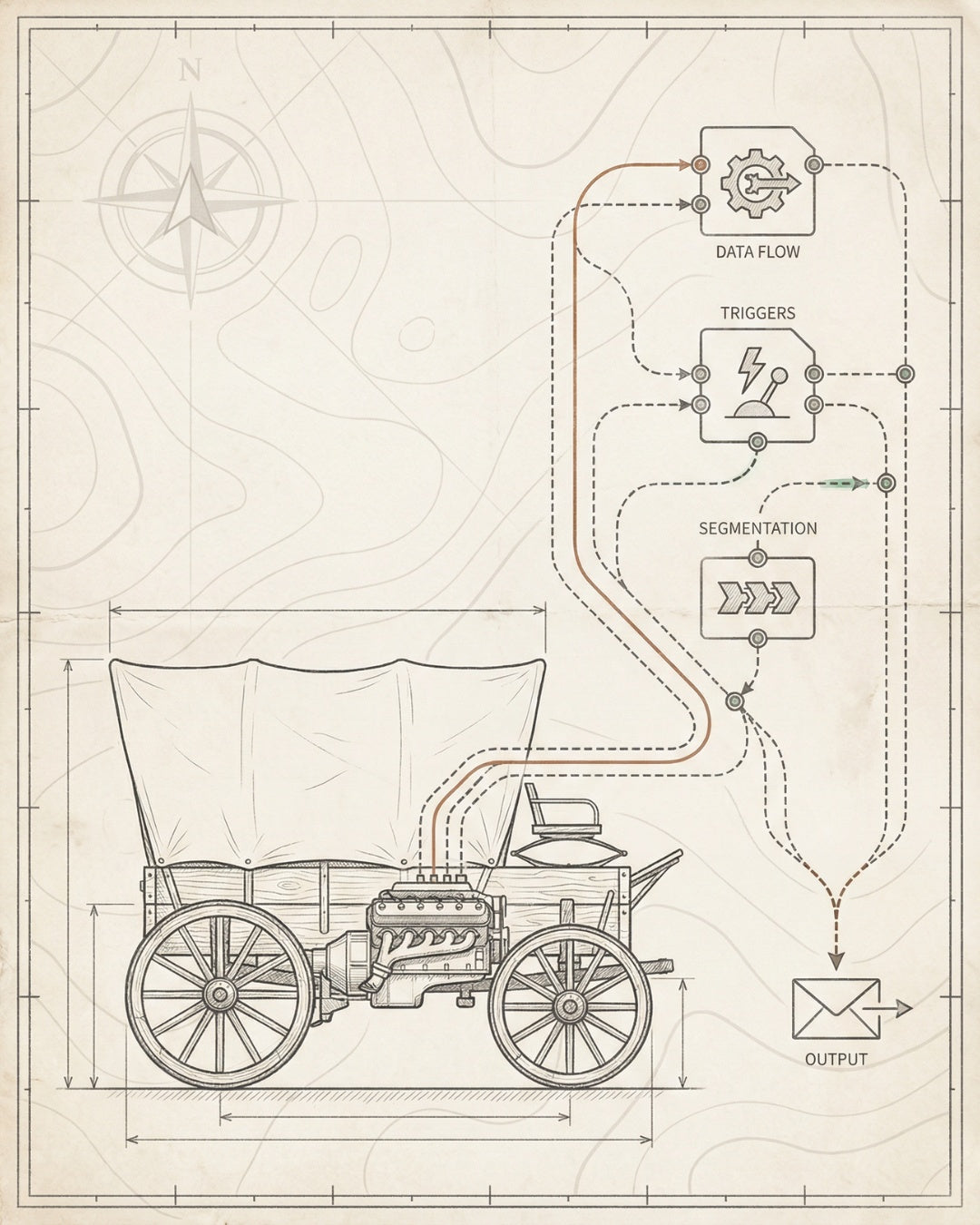
The Audit-to-Throttle Pipeline Explained
Our process is simple: Audit → Build → Throttle.
Audit (Days 1-5): We run a full technical audit, content gap analysis, and competitive landscape review. This identifies the highest-leverage systems to build first.
Build (Days 6-25): We install the infrastructure. This isn’t strategy docs or recommendations — it’s hands-on implementation. Code deployed, schema installed, content structured, internal links built.
Throttle (Days 26-30): We hand off documentation, training, and tracking dashboards. You now own the system and can scale it internally or throttle up with another sprint.
The goal: traction, then throttle. Prove the system works, then scale it.
What Gets Built in a 30-Day SEO Sprint
Here’s what a typical technical foundation sprint includes:
- Technical audit: Crawlability, indexability, Core Web Vitals, mobile optimization, schema markup
- Site architecture fixes: URL structure cleanup, canonical tag implementation, robots.txt optimization, XML sitemap rebuild
- Schema markup installation: Product, Review, Breadcrumb, Organization, FAQ schemas across product and category pages
- Core Web Vitals optimization: Image optimization, lazy loading, script deferral, CLS fixes
- Internal linking system: Category-to-product links, related product modules, breadcrumb optimization
- Tracking and monitoring setup: Google Search Console, Google Analytics 4, Core Web Vitals monitoring, ranking tracking
That’s not a to-do list for you to implement. That’s the infrastructure we install, test, and hand off in 30 days.
Why this works: Ecommerce founders don’t need more strategy decks. They need systems that work. The sprint model delivers infrastructure you can see, measure, and scale.
This is the model we’ve used to generate $30M+ in organic revenue for ecommerce clients. No retainers. No fluff. Just systems that hold.
Learn more about our ecommerce SEO pricing and how the sprint model compares to traditional agency retainers.
How to Evaluate SEO Services for Your Ecommerce Store
You’re evaluating SEO partners. You’ve talked to agencies, freelancers, and consultants. Everyone has a different pitch. Here’s how to cut through the noise and find a partner who builds systems, not sells hours.
Decision Framework: Retainer vs. Project vs. Sprint Model
Model Best For Cost Structure What You Get Risk Level
Monthly Retainer Brands with ongoing content needs and established infrastructure $3K-$15K/month, ongoing Continuous optimization, content, link building High (ongoing cost, unclear ownership)
One-Time Project Brands with specific, defined needs (e.g., site migration, audit) $5K-$50K, one-time Deliverable-based (audit, strategy doc, migration) Medium (clear scope, but no ongoing support)
30-Day Sprint Brands that need infrastructure built, not hours billed $8K-$25K per sprint Installed systems (technical foundation, content infrastructure, AI optimization) Low (clear deliverables, you own the system)
The right model depends on your stage and needs. If you’re pre-$1M revenue and need foundation work, sprints are the move. If you’re $5M+ and scaling content, retainers might make sense. If you’re migrating platforms or need a one-time fix, project-based works.
Red Flags in Ecommerce SEO Proposals
Here’s what to watch for when evaluating proposals:
- “We’ll rank you for [keyword] in 3 months.” No one can guarantee rankings. If they promise it, they’re either lying or using black-hat tactics that will get you penalized.
- No technical audit in the proposal. If they’re not auditing crawlability, indexability, and Core Web Vitals, they’re not doing real ecommerce SEO.
- Content-first approach. If the proposal starts with “We’ll write 20 blog posts,” run. Content without technical foundation is wasted budget.
- Vague deliverables. “Monthly optimization” and “ongoing improvements” aren’t deliverables. Ask: What specific systems are you installing? What do I own when this ends?
- No case studies or results. If they can’t show you specific revenue or traffic outcomes for ecommerce clients, they’re not proven in your space.
- Lock-in contracts. 6-12 month minimum commitments with no exit clause are a red flag. Good work doesn’t need to trap you.
What to Look for in an SEO Partner (Systems vs. Deliverables)
Here’s the checklist we tell founders to use when evaluating SEO services for ecommerce sites:
- Do they lead with technical foundation? The first conversation should be about crawlability, indexability, site architecture, and Core Web Vitals — not keyword rankings.
- Can they explain their systems? Ask them to walk through their process. If it’s vague or buzzword-heavy, they don’t have a real system.
- Do they show you what you’ll own? The deliverable shouldn’t be a report. It should be installed infrastructure: schema markup, internal linking systems, optimized site architecture.
- Do they understand ecommerce-specific challenges? Large catalogs, faceted navigation, crawl budget, product schema, review markup — these are ecommerce-specific. If they’re talking about generic SEO tactics, they’re not specialists.
- Can they show you results? Ask for case studies with specific metrics: organic revenue, traffic growth, keyword rankings, conversion rate improvements.
- Do they have an exit plan? Good partners build systems you can own and scale. If they can’t explain what happens when you stop working together, they’re optimizing for dependency, not outcomes.
The ultimate test: Ask them, “If we work together for 30 days and then stop, what do I own?” If the answer is “a strategy doc” or “some optimized pages,” keep looking. If the answer is “a technical foundation that scales as you grow,” you’ve found a partner who builds systems.
This is how we approach every engagement at Founding Engine. We’re not here to sell you hours. We’re here to install the ecommerce SEO infrastructure that makes organic growth inevitable.
Implementation Guide: How to Install Systems-First SEO
You’ve read the strategy. Now here’s the tactical blueprint for implementing infrastructure-first SEO for your ecommerce store. This is the same process we use with clients in our 30-day sprints.
Step 1: Audit Current State (Days 1-5)
Technical Audit:
- Run a crawl using Screaming Frog or Sitebulb to identify crawlability issues
- Check Google Search Console for indexation errors, coverage issues, and crawl stats
- Audit Core Web Vitals using PageSpeed Insights and Chrome User Experience Report
- Review robots.txt, XML sitemap, and canonical tag implementation
- Check for duplicate content, thin pages, and orphan pages
Content and Architecture Audit:
Map
Matt Hyder
SEO infrastructure and AI search optimization at Founding Engine.
Want SEO that actually holds?
Get a free infrastructure audit from the Founding Engine team.
Get Your Free Audit