SEO Strategy for Ecommerce: Build Infrastructure, Not Pages
Most ecommerce SEO strategies fail because they optimize pages, not systems. Learn the infrastructure-first approach that compounds organic revenue over time.

The Infrastructure-First SEO Playbook
Most ecommerce SEO fails because it optimizes pages instead of building systems. You get a list of keyword targets and meta tag fixes, not architecture.
The 4-Layer SEO Foundation: Crawlability → Indexability → Rankability → Convertibility. Each layer depends on the one before it. Skip one and the whole stack fails.
AI search is rewriting discovery. Structured data and entity signals now matter more than keyword density. ChatGPT and Perplexity don’t rank pages—they cite sources.
Sprint-based SEO (30-day cycles) beats retainer models for ecommerce brands under $10M. You need traction first, then throttle. Not endless monthly reports.
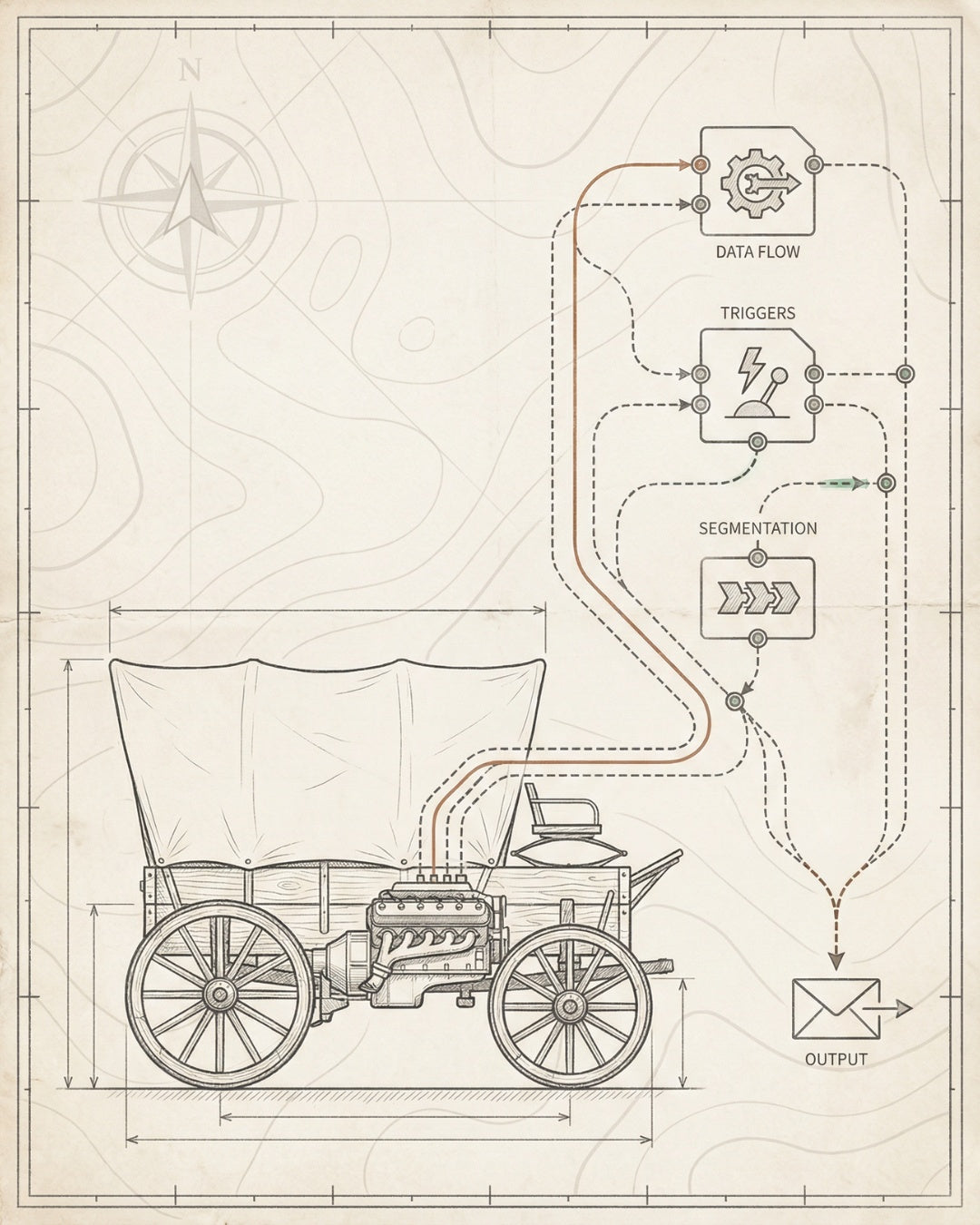
Infrastructure compounds. Build once, scale forever. The right site architecture, internal linking system, and schema markup work harder every month.
What You’ll Learn
- Why Page-Level Optimization Fails at Scale
- The 4-Layer SEO Foundation for Ecommerce
- Site Architecture: The Invisible Revenue Driver
- Internal Linking Systems That Distribute Authority
- Schema Markup & AI Search Signals
- Sprint SEO vs. Retainer SEO for Ecommerce
- Implementation: Installing Your SEO Infrastructure in 30 Days
- Frequently Asked Questions
Why Page-Level Optimization Fails at Scale
Here’s what most ecommerce SEO agencies deliver: a spreadsheet with 200 product pages that need “optimized titles” and “better descriptions.” Maybe a keyword map. Maybe some meta tags.
That’s not a strategy. That’s a to-do list.
The problem isn’t the tactics—it’s the frame. Page-level optimization assumes your site is already crawlable, indexable, and architected for scale. It assumes Google can discover your pages, understand your product relationships, and distribute authority correctly.
For 90% of ecommerce stores, those assumptions are wrong.
When you optimize pages without fixing the foundation, you’re pouring concrete on sand. The work doesn’t compound. Rankings plateau. Organic traffic grows linearly at best, then stalls when you stop publishing.
The difference between pages and systems:
Pages are assets. Systems are infrastructure. Pages need constant maintenance. Systems scale themselves. A well-built SEO infrastructure makes every new product page, category page, and blog post more powerful than the last.
This is why brands that invest in technical SEO for ecommerce first see 250%+ organic traffic increases within 6-12 months, while brands that start with content see diminishing returns after the initial spike.
Infrastructure-first SEO strategy for ecommerce means you build the foundation that makes rankings inevitable. Then you layer content on top. Not the other way around.

The 4-Layer SEO Foundation for Ecommerce
Every ecommerce SEO strategy should follow the same build sequence. We call it the 4-Layer SEO Foundation: Crawlability → Indexability → Rankability → Convertibility.
Each layer depends on the one before it. You can’t rank pages Google can’t index. You can’t index pages Google can’t crawl. And you can’t convert traffic from pages that don’t rank.
Layer 1: Crawlability
Crawlability is the foundation. If Googlebot can’t access your pages efficiently, nothing else matters.
Most ecommerce sites waste crawl budget on:
- Faceted navigation parameters — Every filter combination creates a new URL. Google crawls thousands of duplicate pages instead of your actual products.
- Pagination without rel=“next/prev” signals — Google treats every page of results as a separate entity instead of a paginated series.
- Orphaned pages — Products with no internal links. Google finds them in your sitemap but assigns them zero authority because nothing points to them.
- Redirect chains — Old URLs redirect to temporary URLs that redirect to final URLs. Each hop costs crawl budget and dilutes authority.
The fix starts with your robots.txt file and XML sitemap. Block parameter-based URLs. Consolidate pagination. Ensure every product and category page has at least one internal link from a crawlable page.
Run a crawl audit using Screaming Frog or Sitebulb. Look for:
- Pages with 4+ clicks from homepage (too deep)
- Pages with zero inbound internal links (orphaned)
- Redirect chains longer than one hop
- Duplicate content caused by URL parameters
Layer 2: Indexability
Crawlable doesn’t mean indexable. Google might crawl a page and still choose not to index it.
Common indexation blockers for ecommerce:
- Canonical tag errors — Self-referencing canonicals pointing to the wrong URL, or canonical chains where Page A canonicalizes to Page B which canonicalizes to Page C.
- Noindex tags on valuable pages — Leftover from development or staging. We’ve seen $50K+ in monthly organic traffic blocked by a single noindex tag on a category page.
- Thin content — Product pages with only manufacturer descriptions, no unique content, and no user-generated reviews. Google sees them as low-value duplicates.
- Duplicate content across domains — Same products on multiple domains (e.g., .com and .co.uk) without proper hreflang tags.
Check Google Search Console under Coverage reports. Filter for “Discovered – currently not indexed” and “Crawled – currently not indexed.” These are pages Google found but decided not to rank.
Fix canonical tags first. Then add unique content to thin pages—even 150-200 words of original product descriptions or use cases makes a difference. For duplicate content across domains, implement hreflang tags correctly.
Layer 3: Rankability
Now we’re in the territory most agencies start with. But rankability only works if layers 1 and 2 are solid.
Rankability is driven by:
- On-page optimization — Title tags, meta descriptions, header tags, keyword placement. This is table stakes. On-page SEO for ecommerce follows predictable patterns: product name + category + modifier in title, descriptive H1s, structured content hierarchy.
- Internal linking architecture — How authority flows from high-value pages (homepage, top categories) to target pages (products, subcategories). More on this below.
- Content depth — Comprehensive category pages with buying guides, comparison tables, and FAQs outrank thin category pages every time.
- Schema markup — Product schema, Review schema, BreadcrumbList schema. Structured data helps Google understand your content and display rich results.
- Core Web Vitals — Page speed, interactivity, visual stability. Google’s ranking algorithm includes user experience signals. Slow sites lose to fast sites, all else equal.
Most ecommerce brands have decent on-page optimization but terrible internal linking and incomplete schema. Those are the highest-leverage fixes.
Layer 4: Convertibility
Traffic without conversions is vanity. The final layer is converting organic visitors into customers.
Convertibility optimization for SEO includes:
- Landing page-to-offer match — If someone searches “best running shoes for flat feet,” they should land on a page about running shoes for flat feet, not a generic running shoes category.
- Trust signals — Reviews, ratings, trust badges, return policies. These don’t directly impact rankings but they impact conversion rate, which impacts revenue per visit, which impacts your SEO ROI.
- Mobile optimization — 60%+ of ecommerce traffic is mobile. If your mobile experience is broken, your conversion rate tanks and Google notices (via engagement metrics).
- Clear CTAs and product information — Stock status, shipping times, sizing guides, return policies. Remove friction.
The brands that win long-term SEO treat it as a revenue channel, not a traffic channel. They optimize for conversions from day one, which creates a compounding loop: better conversions → higher revenue per visitor → more budget for content and technical improvements → more traffic → more conversions.
Site Architecture: The Invisible Revenue Driver
Site architecture is the most underrated part of any ecommerce SEO strategy. It determines how authority flows through your site, how easily Google discovers new pages, and how users navigate your catalog.
Good architecture makes SEO easier. Bad architecture makes it impossible.
The 3-Click Rule
Every product page should be accessible within 3 clicks from your homepage. Preferably 2.
Why? Because link equity (PageRank) dilutes with every click. A product that’s 5 clicks deep gets a fraction of the authority of a product that’s 2 clicks deep, even if they’re equally valuable.
Most ecommerce sites violate this rule because they:
- Have too many category layers (Home → Department → Category → Subcategory → Sub-subcategory → Product)
- Don’t link to products from high-authority pages
- Rely on search and filters instead of navigation
The fix: flatten your hierarchy. Reduce category depth. Add “Featured Products” or “Trending Now” sections to your homepage that link directly to target products. Use breadcrumb navigation to create additional crawl paths.
URL Structure That Scales
Your URL structure should be:
- Descriptive — /products/running-shoes-women is better than /p/12345
- Consistent — Don’t mix /category/product with /product structures
- Keyword-rich but not stuffed — /mens-running-shoes is good. /mens-running-shoes-best-running-shoes-for-men is spam.
- Scalable — If you add 1,000 products next year, does your URL structure still make sense?
Avoid date-based URLs (/2024/product-name) and session IDs in URLs (?sessionid=xyz). Both create indexation problems.
Faceted Navigation Without the Crawl Disaster
Faceted navigation (filters for size, color, price, brand) is essential for user experience. It’s also an SEO nightmare if implemented wrong.
Every filter combination creates a new URL:
- /shoes?color=red
- /shoes?color=red&size=10
- /shoes?color=red&size=10&brand=nike
With 5 filters and 10 options each, you have 100,000 possible URLs. Google wastes crawl budget on duplicates instead of your actual products.
The solution:
- Use canonical tags — All filter combinations should canonicalize back to the base category page.
- Block parameters in robots.txt — Prevent Google from crawling filter URLs entirely.
- Use rel=“nofollow” on filter links — Tell Google not to follow filter links (though this is less reliable than canonicals).
- Create static pages for high-value filter combinations — If “red Nike running shoes size 10” gets search volume, make it a real category page with unique content, not a filtered view.
This is covered in detail in our ecommerce SEO checklist.

Internal Linking Systems That Distribute Authority
Internal linking is the most powerful SEO lever you control 100%. You don’t need backlinks. You don’t need to wait for Google. You just need a system.
Most ecommerce sites have random internal linking: a few related products here, a blog post link there, maybe some footer links. No strategy. No architecture.
Here’s how to build an internal linking system that compounds:
1. Hub-and-Spoke Model
Your homepage is the hub. Category pages are primary spokes. Product pages and blog posts are secondary spokes.
Authority flows from hub → primary spokes → secondary spokes.
This means:
- Your homepage should link to your most important category pages (not every category—just the top 5-10)
- Category pages should link to their top products and relevant subcategories
- Product pages should link to related products and back to their parent category
- Blog posts should link to relevant category and product pages (not just other blog posts)
2. Contextual Links > Navigation Links
Google values contextual links (links within content) more than navigation links (header, footer, sidebar).
A link from a blog post about “how to choose running shoes” to your running shoes category page is worth more than a footer link to the same page.
Build contextual links by:
- Adding “Shop Now” links within blog content
- Linking to specific products in buying guides
- Creating comparison tables with product links
- Adding “Related Products” sections with descriptive anchor text, not just product images
3. Anchor Text Strategy
Your internal anchor text should be descriptive and keyword-rich, but not over-optimized.
Good anchor text:
- “Shop our collection of women’s running shoes”
- “Check out the Nike Air Zoom Pegasus 40 for long-distance runs”
- “Our best-selling trail running shoes are built for durability”
Bad anchor text:
- “Click here”
- “Learn more”
- “This product”
Vary your anchor text. Don’t use the exact same phrase 50 times. Google sees that as manipulation.
4. Automated Internal Linking
Manual internal linking doesn’t scale. If you have 500+ products, you need automation.
Build systems like:
- Related products based on category — Automatically show 4-6 related products from the same category on every product page
- Frequently bought together — Link to complementary products based on order data
- Breadcrumb navigation — Auto-generates links from product → category → homepage
- Dynamic blog-to-product linking — If a blog post mentions “running shoes,” automatically link to your running shoes category
Shopify apps like LinkJuice or Internal Link Juicer can automate this. For custom builds, you can script it based on product tags, categories, or SKU relationships.
The result: every new product or blog post automatically gets internal links, and every existing page gets stronger as your catalog grows.
Schema Markup & AI Search Signals
Schema markup is structured data that tells search engines what your content means, not just what it says.
For ecommerce, schema is the difference between a plain search result and a rich result with star ratings, pricing, and stock status. It’s also the difference between being cited by ChatGPT and being invisible to AI search.
Essential Schema Types for Ecommerce
Every ecommerce site should implement:
- Product schema — Name, image, description, SKU, brand, price, availability, reviews. This powers rich results in Google Shopping and organic search.
- Review schema (AggregateRating) — Star ratings and review counts. Shows up in search results and increases click-through rate by 20-35%.
- BreadcrumbList schema — Shows your site hierarchy in search results (Home > Category > Product). Helps users and Google understand your architecture.
- Organization schema — Your brand name, logo, social profiles. Helps Google build your knowledge graph entity.
- FAQPage schema — For category pages or blog posts with FAQs. Can trigger rich results (though Google is phasing this out for non-authoritative sites).
Implementing schema correctly is non-negotiable for best-in-class ecommerce SEO.
AI Search Optimization: The New Frontier
Google’s AI Overviews, ChatGPT, Perplexity, and other LLM-based search tools are changing how people discover products.
They don’t rank pages. They cite sources.
To get cited, you need:
- Entity signals — Clear, consistent mentions of your brand, products, and category terms across your site and the web. Build your knowledge graph presence.
- Structured data for LLMs — Schema markup that AI models can parse. Product schema, Review schema, and FAQ schema all feed into LLM training data.
- Authoritative content — In-depth guides, comparison tables, and original research. AI models prefer citing comprehensive sources over thin content.
- Semantic relationships — Use related terms, synonyms, and natural language. LLMs understand context better than keyword-stuffed content.
Our AI Search Optimization service focuses on building this infrastructure: entity mapping, knowledge graph signals, and structured data designed for LLM citation.
The brands that invest in AI search visibility now will dominate discovery in 2026 and beyond. The ones that ignore it will lose traffic to competitors who show up in ChatGPT answers and Perplexity citations.
Sprint SEO vs. Retainer SEO for Ecommerce
Most SEO agencies sell retainers: $5K-$15K/month for “ongoing optimization.” You get monthly reports, incremental improvements, and a lot of meetings.
That model works for enterprise brands with $50M+ revenue and dedicated SEO teams. It doesn’t work for ecommerce founders running lean.
Here’s why:
Factor Retainer SEO Sprint SEO (30-Day Cycles)
Timeline 6-12 months minimum commitment 30-day focused cycles, no long-term lock-in
Deliverables Monthly reports, incremental optimizations Infrastructure installs: site architecture, schema, internal linking systems
Focus Ongoing maintenance and content High-leverage technical fixes that compound
Cost Structure $5K-$15K/month recurring Project-based pricing, pay for outcomes
Best For Brands with $10M+ revenue, in-house teams Brands with $0-$10M revenue, lean teams
Results Velocity Slow, linear growth Fast initial gains, then compounding growth
Sprint SEO is about installing systems, not delivering hours. You get:
- A technical audit in week 1
- Foundation fixes (crawlability, indexability) in week 2
- Architecture and internal linking systems in week 3
- Schema markup and AI search optimization in week 4
At the end of 30 days, you have infrastructure that compounds. You’re not dependent on an agency to publish blog posts every month. You have systems that make every new product page, category page, and piece of content more powerful.
This is the model we use at Founding Engine. No retainers. No fluff. 30-day focused cycles. You can read more about our approach in this ecommerce SEO case study.

Implementation: Installing Your SEO Infrastructure in 30 Days
Here’s the exact build sequence we use to install ecommerce SEO infrastructure in 30-day sprints. You can follow this internally or use it to evaluate agency partners.
Week 1: Audit Current State
Goal: Understand what’s broken and what’s working.
Tasks:
- Run a full technical crawl using Screaming Frog or Sitebulb
- Audit Google Search Console for indexation issues, manual actions, and Core Web Vitals problems
- Check current rankings and organic traffic baseline (Google Analytics + GSC)
- Map site architecture: how deep are your product pages? How many orphaned pages exist?
- Review existing schema markup (or lack thereof)
- Identify top 10-20 target keywords based on search volume and commercial intent
Deliverable: A prioritized list of technical blockers, indexation issues, and high-leverage opportunities. This becomes your roadmap.
Use our ecommerce SEO audit guide for a detailed checklist.
Week 2: Fix the Foundation
Goal: Make your site crawlable and indexable.
Tasks:
- Fix robots.txt to block parameter-based URLs and allow important pages
- Clean up XML sitemap: remove noindexed pages, add missing pages, submit to GSC
- Fix canonical tag errors (self-referencing canonicals, canonical chains)
- Remove noindex tags from valuable pages
- Fix redirect chains and broken links
- Improve Core Web Vitals: optimize images, reduce JavaScript, enable caching
- Set up or fix breadcrumb navigation
Deliverable: A site that Google can crawl and index efficiently. This is the foundation everything else builds on.
Most of these fixes are covered in our technical SEO for ecommerce guide.
Week 3: Build Content & Linking Infrastructure
Goal: Create scalable systems for authority distribution and content.
Tasks:
- Flatten site architecture: reduce category depth, add direct links from homepage to top products
- Build internal linking systems: related products, breadcrumbs, contextual blog-to-product links
- Optimize top 20 category and product pages: title tags, meta descriptions, H1s, content depth
- Add unique content to thin product pages (150-300 words minimum)
- Create or optimize 3-5 high-value category pages with buying guides and FAQs
- Set up automated internal linking (if using Shopify or a CMS with plugins)
Deliverable: A content and linking architecture that scales as you add products. New pages automatically get internal links and authority.
Week 4: Install Schema & AI Search Signals
Goal: Make your site readable by search engines and AI models.
Tasks:
- Implement Product schema on all product pages
- Add AggregateRating schema (if you have reviews)
- Install BreadcrumbList schema site-wide
- Add Organization schema to homepage
- Implement FAQ schema on category pages and blog posts (where relevant)
- Validate all schema using Google’s Rich Results Test
- Optimize for AI search: add entity signals, semantic relationships, and structured data for LLMs
- Submit updated sitemap to Google Search Console
Deliverable: A site that’s optimized for rich results and AI citations. You’re now visible to ChatGPT, Perplexity, and Google’s AI Overviews.
For ongoing optimization, see our ecommerce SEO best practices guide.
Post-Sprint: Monitor & Iterate
After 30 days, you have infrastructure. Now you monitor and iterate.
Key metrics to track:
- Organic traffic (Google Analytics)
- Keyword rankings (Ahrefs, SEMrush, or manual tracking)
- Indexation status (Google Search Console)
- Core Web Vitals (PageSpeed Insights, GSC)
- Conversion rate from organic traffic
Run another 30-day sprint every quarter to compound improvements. Focus on content expansion, advanced schema, and AI search optimization.
This is the Audit-to-Throttle Pipeline: audit → fix foundation → build systems → monitor → iterate. It’s how we’ve generated $30M+ in organic revenue for ecommerce brands.
Not Pages. Systems.
The brands winning organic search in 2026 aren’t the ones publishing the most content. They’re the ones with the best infrastructure. They built systems that compound: site architecture that scales, internal linking that distributes authority automatically, and schema markup that makes them visible to AI search.
If you’re still optimizing pages one at a time, you’re playing the wrong game.
Frequently Asked Questions
What is the best SEO strategy for ecommerce stores? +
The best SEO strategy for ecommerce is infrastructure-first: fix technical foundation (crawlability, indexability) before optimizing content. Focus on site architecture, internal linking systems, and schema markup that scale as your catalog grows. This approach compounds over time, unlike page-by-page optimization which plateaus. Start with the 4-Layer SEO Foundation: Crawlability → Indexability → Rankability → Convertibility.
How long does it take to see results from ecommerce SEO? +
Technical SEO fixes (crawlability, indexability, site architecture) can show results in 4-8 weeks. Ranking improvements from content and schema markup typically take 3-6 months. The timeline depends on your starting point, competition level, and implementation quality. Brands with strong technical foundations see faster results than those starting from scratch. Infrastructure-first SEO compounds faster than content-first approaches.
Do I need an agency or can I do ecommerce SEO myself? +
You can handle basic on-page SEO yourself (title tags, meta descriptions, content). But technical SEO (site architecture, schema markup, Core Web Vitals, internal linking systems) requires specialized expertise. Most founders underestimate the complexity and waste months on low-leverage tasks. The middle ground: hire an agency for infrastructure setup (30-60 days), then manage content and optimization in-house. This gives you systems that scale without ongoing agency dependency.
What’s the difference between technical SEO and content SEO? +
Technical SEO is the infrastructure: site architecture, crawlability, indexability, Core Web Vitals, schema markup, internal linking. It makes your site discoverable and rankable. Content SEO is the layer on top: keyword research, on-page optimization, blog posts, product descriptions. Technical SEO is the foundation; content SEO is what you build on it. Most ecommerce stores do content first and wonder why rankings plateau—because the foundation is broken.
How much should I budget for ecommerce SEO? +
For brands under $10M revenue: expect $10K-$30K for initial infrastructure setup (technical audit, site architecture fixes, schema implementation, internal linking systems). Retainer agencies charge $5K-$15K/month ongoing, but sprint-based models (30-day cycles) are more cost-effective for lean teams. DIY is possible but slow—most founders underestimate time investment. Budget based on revenue potential: if SEO could generate $500K/year in organic revenue, a $20K infrastructure investment is a 25x ROI. See our ecommerce SEO pricing guide for detailed breakdowns.
What are the most important ranking factors for ecommerce sites? +
Top ranking factors for ecommerce: (1) Technical foundation—crawlability, indexability, site speed, mobile optimization. (2) Site architecture—URL structure, internal linking, category hierarchy. (3) Schema markup—Product, Review, BreadcrumbList schema for rich results. (4) Content quality—unique product descriptions, buying guides, FAQs. (5) User experience—Core Web Vitals, mobile usability, conversion signals. (6) Backlinks—still matter, but less than infrastructure for ecommerce. Most brands over-index on content and backlinks while ignoring technical foundation. Fix the foundation first.
How do I optimize for AI search engines like ChatGPT and Perplexity? +
AI search optimization requires: (1) Entity signals—clear, consistent mentions of your brand, products, and category terms. Build your knowledge graph presence. (2) Structured data—Product schema, Review schema, FAQ schema that LLMs can parse. (3) Authoritative content—in-depth guides, comparison tables, original research. AI models cite comprehensive sources, not thin content. (4) Semantic relationships—use related terms and natural language, not keyword stuffing. Our AI Search Optimization service focuses on building this infrastructure for LLM citation and visibility.
Should I focus on product pages or category pages first? +
Category pages first. They rank for broader, higher-volume keywords and drive more traffic than individual product pages. Optimize your top 5-10 category pages with buying guides, comparison tables, and FAQs. Add schema markup and internal links to top products. Once category pages rank, they’ll lift your product pages through internal linking. Product page optimization comes second—focus on your best-sellers and high-margin items. This strategy generates faster ROI than optimizing hundreds of product pages individually.
Build SEO Infrastructure That Compounds
We engineer the SEO infrastructure that holds. No retainers. No fluff. 30-day focused cycles.
$30M+ organic revenue generated. 250% average traffic increase. 500+ keywords ranked page 1.
Matt Hyder
SEO infrastructure and AI search optimization at Founding Engine.
Want SEO that actually holds?
Get a free infrastructure audit from the Founding Engine team.
Get Your Free Audit