Benefits of Ecommerce SEO: Revenue Systems That Compound
Ecommerce SEO builds revenue infrastructure that scales: organic traffic, customer acquisition cost reduction, and compounding visibility. Here's what actually works.
SEO INFRASTRUCTURE
Benefits of Ecommerce SEO: Revenue Systems That Compound

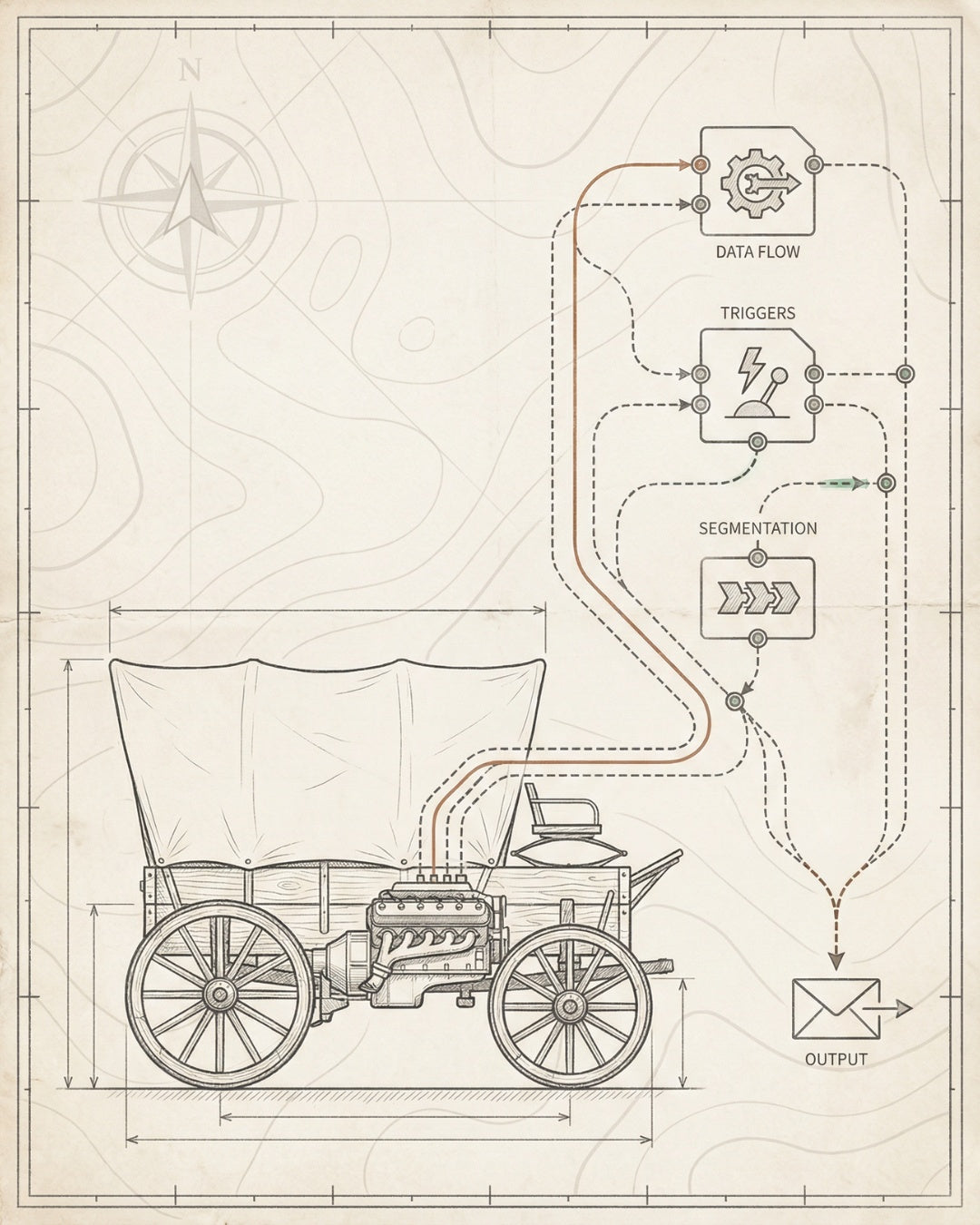
Most ecommerce founders treat SEO like a marketing channel. It’s not. It’s revenue infrastructure.
The difference matters. Marketing channels are expenses that scale linearly. Infrastructure is a system that compounds. You build it once, maintain it strategically, and it generates returns that accelerate over time.
At Founding Engine, we’ve engineered SEO systems that generated $30M+ in organic revenue for ecommerce brands. The benefits aren’t abstract — they’re structural advantages that show up in your P&L, your CAC, and your ability to scale without platform dependency.
Here’s what actually works when you build ecommerce SEO as infrastructure, not a to-do list.
The TL;DR: Why Ecommerce SEO Compounds
SEO isn’t marketing — it’s revenue infrastructure that compounds over time while paid ads stay flat
Lower CAC, higher LTV, owned traffic channel — the structural advantages that show up in your P&L
Technical foundation drives rankings + AI search visibility — not content volume, but architecture
Benefits stack: organic traffic → trust signals → conversion optimization → compounding returns
Build once, scale forever — the infrastructure advantage. 250% average traffic increase, sustained.
What We’re Building
- Lower Customer Acquisition Cost — The Compounding Advantage
- Owned Traffic Channel — Independence from Platform Risk
- Higher Conversion Rates from Intent-Matched Traffic
- Brand Authority and Trust Signals
- Long-Term ROI and Compounding Returns
- Competitive Moat — First-Mover Advantage in AI Search
- Implementation: Building Your SEO Revenue System
- Frequently Asked Questions
Lower Customer Acquisition Cost — The Compounding Advantage
Paid acquisition costs scale linearly. You spend $50 to acquire a customer today, you’ll spend $50 (or more, accounting for auction inflation) to acquire a customer tomorrow. The economics never improve.
Organic acquisition through ecommerce SEO works differently. You invest in infrastructure — technical optimization, content systems, internal linking architecture — and the cost per acquisition decreases as your rankings compound.
Here’s the math that matters:
Channel Month 1 CAC Month 12 CAC Trajectory
Paid Ads $45 $52 ↑ Increasing
Organic SEO $120 (initial investment) $18 ↓ Decreasing
The crossover happens around month 4-6 for most ecommerce brands we work with. After that, every incremental ranking, every new page indexed, every internal link optimized drives CAC down further.
This is why our clients generate $30M+ in organic revenue. Not because we write more blog posts than the competition, but because we build systems where acquisition cost improves with scale instead of degrading.
Infrastructure Insight: The brands winning organic aren’t outspending competitors on content. They’re building SEO infrastructure that makes every page work harder — better crawlability, smarter internal linking, structured data that feeds AI search. Lower CAC is a byproduct of better architecture.
Owned Traffic Channel — Independence from Platform Risk

Platform dependency is an existential risk most founders underestimate until it’s too late.
Meta changes its algorithm. Your cost per click doubles overnight. Google Ads gets more competitive. Your ROAS drops 40%. TikTok Shop changes its fee structure. Your margin compresses.
When you own your organic channel, platform changes are noise, not earthquakes.
Here’s what “owned channel” actually means in practice:
- Search rankings persist independent of auction dynamics. You’re not bidding against competitors every impression. Once you rank, you hold position through authority and technical superiority.
- Algorithm updates favor infrastructure. Google’s core updates increasingly reward sites with strong technical foundations — technical SEO, Core Web Vitals, structured data. The brands that get hit are the ones built on content volume without architecture.
- AI search amplifies owned visibility. When your site has proper entity signals, knowledge graph presence, and structured data, you show up in AI search results (Perplexity, ChatGPT, Google AI Overviews) without paying for placement.
This isn’t theoretical. During the March 2024 core update, our clients with proper SEO infrastructure saw traffic increases while competitors without technical foundations lost 30-50% of organic visibility overnight.
Owned channels compound. Rented channels (paid ads) extract.
Higher Conversion Rates from Intent-Matched Traffic
Not all traffic converts equally. Organic search traffic converts 2-3x better than social or display traffic because the intent is already there.
Someone searching “best running shoes for marathon training” is further down the funnel than someone scrolling Instagram who sees a shoe ad. The search query reveals purchase intent. The social scroll reveals… scrolling.
But here’s where most ecommerce brands miss the leverage: conversion rate optimization for organic traffic isn’t just about your checkout flow. It starts with how you structure your product pages for SEO.
The Rankability → Convertibility Stack
We use a framework called the 4-Layer SEO Foundation that maps directly to conversion:
- Crawlability: Can Google find your pages? If your site architecture is broken, your best converting products never get indexed.
- Indexability: Are your pages getting indexed for the right queries? Duplicate content, thin pages, and canonicalization issues kill rankings for high-intent keywords.
- Rankability: Do your pages have the technical and content signals to rank? On-page SEO, internal linking, schema markup, and entity optimization determine whether you rank page 1 or page 5.
- Convertibility: Once ranked, does the page convert? This is where UX, load speed (Core Web Vitals), trust signals, and structured product data intersect.
Most agencies stop at layer 3. They get you rankings, but the traffic doesn’t convert because the page experience is broken. We build through all four layers because rankings without revenue are just vanity metrics.
Case Study Snapshot: One DTC brand came to us ranking for 200+ keywords but converting at 1.2%. We didn’t add more keywords. We rebuilt their product page architecture — better schema, faster load times, clearer internal linking to related products. Same traffic, 3.8% conversion rate. Revenue up 216%.
Brand Authority and Trust Signals

Page 1 rankings are a credibility proxy. Consumers don’t consciously think “this brand ranks #2 for ‘organic coffee beans,’ so they must be credible” — but the subconscious association is real.
When you consistently appear in search results for high-value queries in your category, you’re building brand authority at scale. Every impression is a micro-endorsement from Google’s algorithm.
But authority isn’t just about rankings. It’s about how search engines (and increasingly, AI systems) understand your brand as an entity.
Entity Signals and Knowledge Graph Presence
Google doesn’t just index pages anymore. It indexes entities — brands, products, people, concepts — and maps relationships between them in the Knowledge Graph.
When your brand has strong entity signals, you get:
- Brand panels in search results: Your logo, description, and key information displayed prominently when someone searches your brand name.
- Product rich results: Star ratings, pricing, availability shown directly in search results before users even click.
- AI citations: Your brand cited as a source in AI-generated answers (Google AI Overviews, Perplexity, ChatGPT).
Building entity signals requires structured data infrastructure — schema markup for products, organizations, reviews, FAQs. This is where advanced ecommerce SEO separates from basic optimization.
We install schema markup as part of our SEO infrastructure service because it’s not optional anymore. Brands without structured data are invisible to AI search. Brands with it are building authority that compounds across every search surface.
Long-Term ROI and Compounding Returns
The ROI curve for SEO looks nothing like paid ads.
Paid ads: you get immediate returns, but they’re linear. Spend $10K, get $30K back (if you’re good). Spend $20K, get $60K back. The multiple stays constant or degrades as auctions get more competitive.
SEO: you invest upfront in infrastructure, see minimal returns for 60-90 days, then the curve goes exponential. Rankings compound. Authority builds. Internal linking creates network effects where every new page lifts the performance of existing pages.
Here’s what the typical ROI trajectory looks like for ecommerce brands we work with:
Timeline Investment Organic Revenue ROI Multiple
Month 1-3 $25K $15K 0.6x
Month 4-6 $25K $65K 2.6x
Month 7-12 $15K (maintenance) $180K 12x
Year 2 $10K (maintenance) $420K 42x
The key insight: after the initial infrastructure build (months 1-6), ongoing investment drops dramatically while returns accelerate. This is the compounding effect of SEO infrastructure done right.
Compare that to paid ads where year 2 looks identical to year 1, just with higher CPCs.
Why This Matters for Founders: SEO isn’t an expense line item. It’s a capital investment in revenue infrastructure. The brands that understand this difference are the ones scaling past $10M without burning cash on paid acquisition.
Competitive Moat — First-Mover Advantage in AI Search
The brands building SEO infrastructure today are establishing a moat that will be nearly impossible to overcome in 2-3 years.
Here’s why: AI search (ChatGPT, Perplexity, Google AI Overviews) is rapidly becoming the primary search interface. And AI systems favor brands with strong technical infrastructure — structured data, entity signals, authoritative backlinks, clean site architecture.
If you wait until “AI search is mainstream” to optimize, you’ll be competing against brands that have 2+ years of entity authority, citation history, and ranking momentum. You won’t catch up by writing more content. The infrastructure gap is too wide.
What First-Mover Advantage Looks Like
We’re seeing this play out in real-time with our clients:
- Early AI citations create authority loops. When your brand gets cited in AI-generated answers, it reinforces your entity authority, which leads to more citations, which builds more authority. This compounds.
- Structured data becomes the ranking signal. AI systems parse structured data (schema markup) more effectively than unstructured content. Brands with comprehensive schema are getting preferential visibility.
- Technical debt compounds negatively. Sites with poor Core Web Vitals, broken internal linking, or thin content are getting filtered out of AI search results entirely. The penalty for bad infrastructure is invisibility.
This is why we built our AI Search Optimization service as a core offering, not an add-on. The window to establish first-mover advantage is 12-18 months. After that, you’re fighting uphill against brands with entrenched authority.
Implementation: Building Your SEO Revenue System
Theory is cheap. Here’s how to actually build ecommerce SEO infrastructure that generates the benefits we’ve covered.
We use a framework called the Audit-to-Throttle Pipeline. It’s a systematic build sequence designed for lean teams that need results in 30-90 days, not 12-month retainer cycles.
Phase 1: Audit Current State (Week 1)
Before you build anything, you need a baseline. Run a comprehensive ecommerce SEO audit covering:
- Crawlability: Check robots.txt, XML sitemap structure, server response codes, redirect chains. Use Google Search Console and Screaming Frog.
- Indexation Status: How many pages are indexed vs. how many should be? Look for duplicate content, thin pages, canonicalization issues.
- Core Web Vitals: Baseline your LCP (Largest Contentful Paint), FID (First Input Delay), and CLS (Cumulative Layout Shift). These are ranking factors and conversion killers.
- Technical Architecture: Site speed, mobile responsiveness, internal linking structure, schema markup coverage.
- Content Gaps: Keyword research mapped to existing pages. Where are you missing high-intent queries?
The output should be a prioritized list of blockers (things actively preventing rankings) vs. optimizations (things that will improve rankings).
Phase 2: Fix the Foundation (Weeks 2-4)
Address technical blockers first. This is non-negotiable. Your ecommerce SEO checklist should prioritize:
- Site Speed Optimization: Compress images, implement lazy loading, minify CSS/JS, leverage browser caching. Target LCP under 2.5 seconds.
- Mobile Optimization: Ensure responsive design, touch-friendly navigation, fast mobile load times. 60%+ of ecommerce traffic is mobile.
- Canonicalization: Fix duplicate content issues with proper canonical tags. This is especially critical for ecommerce sites with product variants.
- Internal Linking Architecture: Build a logical site hierarchy. Category pages should link to product pages. Product pages should link to related products. Blog content should link to commercial pages.
- Schema Markup: Install Product, Organization, BreadcrumbList, and Review schema. This is table stakes for AI search visibility.
This phase is where most DIY efforts fail. Founders underestimate the technical complexity and move on to content creation before the foundation is solid. Don’t.
Phase 3: Build Content Infrastructure (Weeks 5-8)
Now you can build content — but not random blog posts. You’re building content systems mapped to keyword clusters and user intent.
Start with commercial pages:
- Product Pages: Optimize for product-specific keywords. Include schema markup, high-quality images, detailed descriptions, customer reviews, and related product links.
- Category Pages: Target broader category keywords. These should be your highest-authority pages, linking to all relevant product pages.
- Comparison Pages: “Product A vs. Product B” pages capture high-intent comparison queries. These convert exceptionally well.
Then layer in informational content:
- Buying Guides: “How to choose [product category]” content that links to relevant product pages.
- Use Case Content: “Best [product] for [specific use case]” pages that target long-tail, high-intent queries.
- FAQ Content: Answer common questions with structured FAQ schema. This feeds AI search and captures featured snippets.
Every piece of content should have a clear keyword target, internal links to commercial pages, and schema markup where applicable.
Phase 4: Install Distribution and Monitoring (Weeks 9-12)
Content doesn’t rank by existing. You need distribution systems and feedback loops.
- Google Search Console: Monitor indexation status, click-through rates, ranking positions, and Core Web Vitals. This is your primary feedback mechanism.
- AI Search Monitoring: Track citations in ChatGPT, Perplexity, and Google AI Overviews. Tools like BloggedAI can help monitor AI visibility.
- Backlink Building: Not spammy directory links. Strategic partnerships, guest posts on authoritative sites, and digital PR that builds entity authority.
- Email Capture Flows: Convert organic traffic into owned audience. Email subscribers have 3-5x higher LTV than one-time visitors.
This phase is about creating feedback loops that let you iterate and improve. Rankings aren’t static. You need systems to monitor performance and adjust.
The 30-Day Sprint Model: At Founding Engine, we don’t do retainers. We do focused 30-day sprints. Audit → Foundation → Content → Distribution in 4-week cycles. This keeps momentum high, prevents scope creep, and delivers measurable results every month. Learn how we’d build your system.
Frequently Asked Questions
What are the main benefits of ecommerce SEO?
The primary benefits of ecommerce SEO are: (1) Lower customer acquisition cost that improves over time, (2) Owned traffic channel independent of platform changes, (3) Higher conversion rates from intent-matched search traffic, (4) Brand authority and trust signals from page 1 rankings, (5) Long-term ROI with compounding returns, and (6) Competitive moat through early AI search optimization. These aren’t marketing benefits — they’re structural advantages that show up in your P&L and scale economics.
How does ecommerce SEO reduce customer acquisition cost?
Ecommerce SEO reduces CAC through compounding infrastructure. Unlike paid ads where you pay for every click indefinitely, SEO is an upfront investment in technical architecture, content systems, and authority building. Once you rank, the cost per acquisition decreases as traffic increases. Most brands see CAC crossover (where organic becomes cheaper than paid) around month 4-6, then CAC continues dropping as rankings compound. The investment in ecommerce SEO is front-loaded, but the returns accelerate over time.
How long does it take to see benefits from ecommerce SEO?
Initial rankings typically appear in 60-90 days after implementing technical fixes and content infrastructure. Meaningful revenue impact (20%+ increase in organic traffic) usually occurs in months 4-6. Compounding returns — where organic becomes your primary growth channel — typically happen in months 7-12. The timeline depends on your starting point: brands with existing traffic and domain authority see results faster than new stores. This is why we use 30-day sprint cycles — to deliver measurable progress every month while building toward long-term compounding.
Is ecommerce SEO better than paid ads?
It’s not either/or — it’s sequencing. Paid ads give you immediate feedback and revenue, which is critical when you’re validating product-market fit. But paid ads scale linearly and CAC increases over time. SEO scales exponentially once infrastructure is in place, and CAC decreases over time. The optimal strategy: use paid ads to generate initial revenue and learn what converts, then invest in SEO infrastructure to build an owned channel that compounds. Brands that reach $10M+ revenue typically have 40-60% of revenue from organic by that point.
What’s the ROI of ecommerce SEO?
ROI varies by industry and starting point, but our clients typically see 3-5x ROI in the first 6 months and 10-20x ROI by month 12. The ROI curve is exponential, not linear — initial months are investment-heavy with modest returns, then returns accelerate as rankings compound. For context: we’ve generated $30M+ in organic revenue for clients with an average 250% increase in organic traffic. The key is treating SEO as infrastructure investment, not a marketing expense. Infrastructure compounds; expenses don’t.
How does technical SEO impact ecommerce revenue?
Technical SEO is the foundation that makes everything else work. Poor site speed, broken internal linking, or missing schema markup will kill your rankings regardless of content quality. Technical SEO for ecommerce impacts revenue through three mechanisms: (1) Crawlability and indexation — if Google can’t find or index your pages, you don’t rank, (2) Core Web Vitals — slow sites have 30-50% higher bounce rates and lower conversion rates, and (3) Structured data — schema markup is now required for AI search visibility and rich results. Fix technical foundation first, then build content on top.
What’s the difference between SEO and AI search optimization?
Traditional SEO optimizes for Google’s algorithm to rank in the top 10 blue links. AI search optimization optimizes for AI systems (ChatGPT, Perplexity, Google AI Overviews) to cite your brand in generated answers. The technical requirements overlap — structured data, entity signals, authoritative content — but AI search places more emphasis on schema markup, knowledge graph presence, and citation-worthy content. AI search optimization is becoming table stakes because 40%+ of searches now involve AI-generated answers. Brands without AI search visibility are losing traffic to competitors who have it.
Do I need an agency or can I do ecommerce SEO myself?
You can do the basics yourself — keyword research, content creation, basic on-page optimization. But technical infrastructure (site architecture, Core Web Vitals optimization, schema markup, internal linking systems) requires specialized expertise. Most founders underestimate the technical complexity and spend 6-12 months on DIY attempts that don’t move the needle. The strategic question: is your time better spent building product and talking to customers, or debugging canonical tags and site speed issues? Ecommerce SEO services make sense when the opportunity cost of DIY exceeds the cost of expert execution. For most brands past $500K revenue, that threshold has been crossed.

Not Pages. Systems.
The benefits of ecommerce SEO aren’t abstract. They’re structural advantages that compound in your P&L: lower CAC, owned traffic channels, higher conversion rates, brand authority, long-term ROI, and competitive moats.
But these benefits only materialize when you build SEO as infrastructure, not as a content marketing tactic.
Infrastructure means:
- Technical foundation that makes rankings inevitable (crawlability, indexability, rankability, convertibility)
- Content systems mapped to keyword clusters and user intent, not random blog posts
- Schema markup and entity optimization for AI search visibility
- Internal linking architecture that creates network effects
- Monitoring and feedback loops that let you iterate and improve
This is what we build at Founding Engine. Not deliverables. Systems.
We’ve generated $30M+ in organic revenue for ecommerce brands by treating SEO as revenue infrastructure, not a marketing channel. The brands that understand this difference are the ones scaling past $10M without burning cash on paid acquisition.
Build SEO Infrastructure That Holds
We engineer the technical foundation, content systems, and AI search visibility that generate rankings, drive organic revenue, and compound over time. No retainers. No fluff. 30-day focused cycles.
Matt Hyder
SEO infrastructure and AI search optimization at Founding Engine.
Want SEO that actually holds?
Get a free infrastructure audit from the Founding Engine team.
Get Your Free Audit